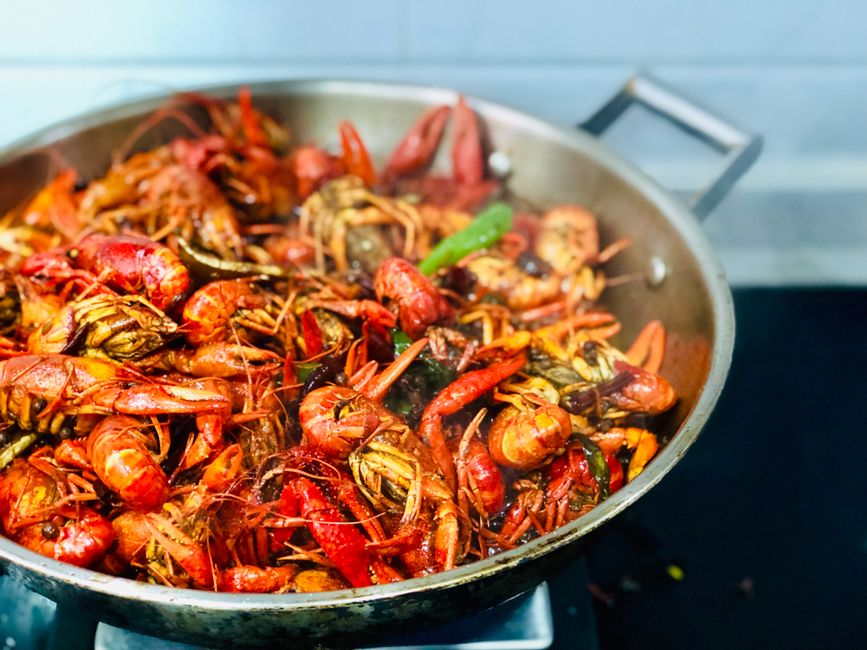
They share a holy trinity, a roux, and a postal code. They do not share a history, a technique, or a flavor architecture. Here is how to tell them apart in a bowl, on a menu, and in the pot.
Cajun and Creole are two separate cuisines built by two separate populations in the same south Louisiana wetland. Cajun descends from Acadian exiles who arrived after 1764 and cooked rural, self-sufficient, one-pot food in cast iron — dark roux, no tomato, heavy on pork, game, and bayou seafood. Creole grew out of urban New Orleans, where French, Spanish, West African, Choctaw, German, and Sicilian cooks cross-pollinated in a port city — lighter roux, tomatoes, butter, cream, and sauce-driven plates. They overlap on gumbo, jambalaya, and the trinity of onion, celery, and bell pepper, but roux color, tomato presence, and thickening method will tell you which tradition you’re eating.
- Two Traditions, One Wetland
- The Acadian Arrival: How Cajun Cooking Formed
- Creolization: The Port City That Ate Everything
- The Roux Divide: Technique as Cultural Fingerprint
- Pantry Signals: Reading a Pot by Its Ingredients
- Region by Region: Lafayette, New Orleans, and the Bayou
- Blackening and the Making of a National Brand
- Reading a Menu Like a Local
- Cajun and Creole Food FAQ
Two Traditions, One Wetland
The confusion is geographic, not culinary. Cajun country and Creole country sit within roughly 150 miles of each other across the Mississippi Delta, and both cuisines were shaped by the same subtropical pantry: crawfish, shrimp, blue crab, oysters, satsuma, mirliton, pecan, rice, and sugarcane. That shared larder is why outsiders flatten them into one category — and why Louisianans never do.
The distinction tracks two very different social histories. Cajun food is the food of a displaced, French-speaking, largely rural population that had to feed itself from what it could trap, raise, and grow. Creole food is the food of a wealthy colonial port where African, European, and Indigenous cooks worked in the same kitchens and where imported butter, cream, and wine were routine.[1]
Cajun: Descended from Acadian settlers expelled from what is now Nova Scotia during the Grand Dérangement beginning in 1755. Roughly 3,000 to 4,000 eventually reached Louisiana between 1764 and 1785, settling the bayous, prairies, and marshland west and south of New Orleans. Their cooking was subsistence-driven: one pot, one fire, everything used.[2]
Creole: A colonial society formed under French and then Spanish rule, with a large free population of color, a substantial enslaved African population, and waves of German, Irish, Italian, and Caribbean arrivals. By the early 1800s New Orleans had a public market economy, professional cooks, and a class structure that supported elaborate multi-course dining.
The Acadian Arrival: How Cajun Cooking Formed
Acadian exiles did not arrive with a fully formed cuisine. They arrived with a technique base — French rural cooking, salt pork, root vegetables, a pot on a hearth — and rebuilt it using whatever the Louisiana landscape offered. The sequence matters, because almost every signature Cajun dish maps to a specific adaptation.
“Cajun cooking is what happens when a French peasant kitchen is dropped into a swamp and told to survive on its own.”
— Common framing among Acadiana culinary historians
Creolization: The Port City That Ate Everything
“Creole” originally meant something born in the colony rather than imported from Europe — the term derives from the Portuguese crioulo by way of Spanish criollo. Applied to food, it describes a cuisine that could only have been assembled in a city where African, French, Spanish, Choctaw, German, Irish, and Sicilian hands worked in the same kitchens.[4]
The African Foundation
The most consequential contribution came from West and Central Africa. Okra — and the word gumbo itself, from the Bantu ki ngombo — arrived with enslaved Africans, along with rice cultivation knowledge, one-pot rice cookery that became jambalaya, and the deep-browning technique that underlies both cuisines.
The European Superstructure
French cooks contributed the mother sauces, the roux, and the pastry kitchen. Spanish rule (1763–1802) added the sofrito-like base and the paella structure that jambalaya echoes. German immigrants brought sausage-making and mustard. Sicilians, arriving in large numbers in the late 1800s, gave New Orleans its muffuletta and its love of cured meat and olive salad.
Why Creole Food Looks Richer
Creole kitchens had access to imported butter, cream, wine, and tomatoes — plus a market economy that rewarded presentation. The result is a sauce-driven cuisine: Sauce Créole, Sauce Piquant, remoulade, hollandaise, and a roux stopped at the color of peanut butter rather than chocolate.
“Creole” in Louisiana refers to culture and heritage, not race — it describes people of French or Spanish colonial descent, free people of color, and the mixed-heritage families and institutions they built. Using “Creole” as an ethnic label for one group only is a modern misreading of a term that was always inclusive of the colony’s diverse-born population.
The Roux Divide: Technique as Cultural Fingerprint
If you have one diagnostic tool for distinguishing Cajun from Creole cooking, make it the roux. Equal parts flour and fat, cooked to a target color, the roux carries the entire flavor architecture of the dish above it. Cajun cooks go dark. Creole cooks stop short.
| Roux Stage | Color | Time (med-low heat) | Typical Use |
|---|---|---|---|
| White | Ivory | 3–5 min | Creole white sauces, béchamel base |
| Blond | Pale straw | 6–8 min | Creole gumbos, light sauces |
| Peanut butter | Medium tan-brown | 12–15 min | New Orleans-style gumbo, sauce piquant |
| Chocolate | Deep brown | 20–30 min | Cajun gumbo, étouffée base |
| Brick / black | Very dark, almost black | 35–45 min | Acadiana gumbo, smoked-meat gravies |
A dark roux has very little thickening power left. Once flour browns past the chocolate stage, its starch granules have been so thoroughly dextrinized that they lose most of their binding ability. Cajun cooks compensate deliberately: they use more roux by volume, and they rely on okra, filé, or long reduction to finish the body. If you darken your roux and the gumbo comes out thin, that is chemistry working as designed — not a mistake.
Pantry Signals: Reading a Pot by Its Ingredients
Before you taste anything, four ingredients will tell you which tradition the cook is working in: tomato, butter, andouille, and filé.
- Dark chocolate-to-brick roux
- No tomato in gumbo or étouffée
- Andouille and tasso for smoke
- Lard, not butter, as the cooking fat
- Filé powder added off-heat at the table
- Rice as a bed, never stirred in
- Blond-to-peanut roux
- Tomato in gumbo, shrimp Creole, sauce piquant
- Smoked sausage, ham, or shrimp stock
- Butter and cream in finishing
- Okra as the primary thickener
- Rice served alongside, plated cleanly
The Holy Trinity vs. Mirepoix
Both cuisines start with onion, celery, and green bell pepper — the holy trinity — which replaces the carrot of French mirepoix. The difference is ratio and treatment. Cajun cooking typically uses a heavier onion proportion and sweats the trinity in the residual fat of browned sausage. Creole cooking more often uses a 1:1:1 ratio and adds garlic and sometimes tomato to the same pan.
Gumbo’s Three Legal Thickeners
Traditional gumbo is thickened by at least one of three agents, and often two: roux, okra, or filé powder. Filé — ground dried sassafras leaf — must never be boiled; it turns stringy and slimy. It is stirred in off the heat or sprinkled at the table.[3]
If a Louisiana cook adds filé to a gumbo that already has okra and a dark roux, they are layering all three thickeners. That is not excess — it is a texture strategy. Roux gives body, okra gives silkiness, filé gives a piney top note and a final tightening.
Region by Region: Lafayette, New Orleans, and the Bayou
Louisiana is not one food region. It is at least four, and the sub-styles diverge enough that a cook from Breaux Bridge and a cook from the French Quarter will argue about the same dish.
| Region | Tradition | Signature Plates | Flavor Marker |
|---|---|---|---|
| Lafayette / St. Martinville | Cajun heartland | Étouffée, boudin, cracklins, sauce piquant | Heavy pork, dark roux, pepper-forward |
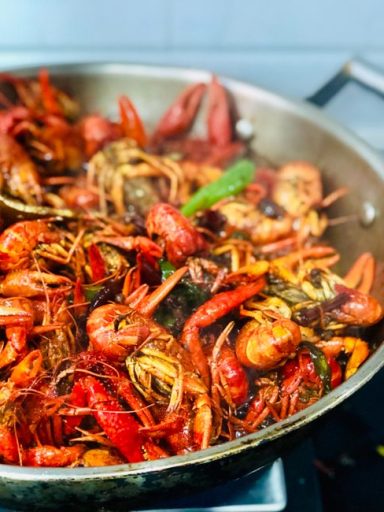
| Breaux Bridge | Cajun, crawfish capital | Crawfish étouffée, crawfish boil | Shellfish-forward, butter and cayenne |
| New Orleans / French Quarter | Creole urban | Shrimp Creole, oysters Rockefeller, turtle soup | Butter, cream, tomato, wine |
| River Parishes (“German Coast”) | Creole-rural hybrid | Gumbo des herbes, grillades and grits | Herb-heavy, brown stock, slow braise |
| Houma / Bayou Lafourche | Cajun coastal | Oyster dressing, shrimp gumbo, courtbouillon | Brackish seafood, filé, satsuma acid |
Étouffée: The Regional Tell
Étouffée is the cleanest test of regional allegiance. In Cajun Acadiana it is built on a dark roux, crawfish, and no tomato. In Creole New Orleans kitchens, versions with tomato and butter appear — a difference old-line Cajun cooks will point out immediately.
Blackening and the Making of a National Brand
For most of the twentieth century, Cajun and Creole food was regional. That changed in 1980, when chef Paul Prudhomme began serving blackened redfish at K-Paul’s Louisiana Kitchen in New Orleans. The technique — dredging a fillet in a heavy spice blend and searing it in a nearly smoking cast-iron skillet — produced a dramatic crust and a plume of smoke, and it went nationwide within about three years.[5]
The commercial fallout was significant: redfish stocks in the Gulf were pressured so heavily that commercial fishing for the species was restricted in the late 1980s. The cultural fallout was arguably larger. “Cajun” became a mass-market seasoning label, and a nuanced regional cuisine was flattened into a spice blend.
Blackening is not the same as burning, and it is not traditional Cajun home cooking. It is a restaurant technique developed in a Creole-city kitchen in 1980. Treating it as the defining Cajun dish is roughly like treating a food-truck invention as the definition of a national cuisine.
What Survived the Branding
The commercialization ran alongside a genuine revival. Louisiana’s 1968 establishment of the Council for the Development of French in Louisiana, the rise of festival culture in Acadiana, and the work of chefs like Emeril Lagasse and the late Leah Chase kept the technique-driven versions alive. Today the most interesting Louisiana cooking sits in the space between the two traditions — Creole cooks using brick roux, Cajun cooks plating with butter sauces.
Cajun and Creole Food FAQ
No. Heat level is not the dividing line. Cajun cooking tends to be more pepper-forward because it relies on cayenne, black pepper, and smoked pork for impact rather than butter and stock. Creole cooking can be equally seasoned but is balanced by cream, tomato acidity, and wine. A well-made shrimp Creole can be quite spicy and still unmistakably Creole.
Yes, and increasingly so. Gumbo, jambalaya, and sauce piquant exist in both traditions with distinct house styles. Modern Louisiana chefs frequently cross the lines — a dark-roux Creole gumbo finished with butter is a perfectly legitimate contemporary dish. The traditions are best understood as two technique lineages, not two sealed boxes.
Onion, celery, and green bell pepper, usually in a roughly equal ratio, sautéed as the aromatic base of a dish. It is the Louisiana adaptation of French mirepoix (onion, celery, carrot) — carrots were swapped for bell pepper because peppers thrived in the subtropical climate and carrots did not figure heavily in the regional pantry.
Most linguists trace it to the Bantu word ki ngombo, meaning okra, carried to Louisiana by enslaved West and Central Africans. That etymology is fitting, since okra was one of gumbo’s original thickeners and remains central to Creole versions.
Rarely in the classic repertoire, though not never. Traditional Cajun gumbo, étouffée, and fricassee are tomato-free. Where tomato does appear in Cajun cooking, it usually reflects a Creole influence absorbed through proximity or a family’s own history. If a dish is called Cajun and the first thing you taste is tomato, you are likely eating a Creole or hybrid preparation.
Commercially sold filé powder is safe. It is made from dried, ground sassafras leaves, which contain negligible amounts of safrole — the compound of concern — compared with sassafras root bark. The FDA prohibited safrole as a food additive in 1960, but filé leaf products remain legal and widely sold.[6] Use it off the heat.
Make the same gumbo twice. Once with a brick-dark roux, andouille, no tomato, and filé at the table — the Cajun method. Once with a peanut-butter roux, tomato, okra, and a butter finish — the Creole method. Tasting them side by side in your own kitchen teaches the distinction faster than any chart.
- Cajun and Creole are separate cuisines with separate histories, not spice levels of the same dish.
- Cajun cooking descends from Acadian exiles who arrived in Louisiana from 1764 and built a rural, one-pot, pork-forward cuisine.
- Creole cooking emerged in colonial New Orleans from French, Spanish, West African, Choctaw, German, and Sicilian kitchens — sauce-driven, tomato-friendly, and urban.
- Roux color is the fastest diagnostic: Cajun goes dark, Creole stops at blond or peanut.
- Gumbo is thickened by roux, okra, or filé — often two of the three, and filé never boils.
- “Blackened” is a 1980 restaurant technique from New Orleans, not the defining dish of Cajun home cooking.
- Louisiana Endowment for the Humanities, 64 Parishes Encyclopedia — entries on Cajun and Creole cuisine and Louisiana colonial history. 64parishes.org
- National Park Service, Jean Lafitte National Historical Park and Preserve — Acadian cultural history and the Grand Dérangement. nps.gov/jela
- Smithsonian Center for Folklife and Cultural Heritage — documentation of Louisiana foodways, Choctaw culinary contributions, and filé use. folklife.si.edu
- Southern Foodways Alliance — oral histories and research on Creole and Cajun cooking traditions. southernfoodways.org
- LSU AgCenter — Louisiana seafood, crawfish production, and regional agricultural extension publications. lsuagcenter.com
- USDA FoodData Central and U.S. Food and Drug Administration — shellfish storage guidance and the 1960 safrole food additive prohibition. fdc.nal.usda.gov
This article is provided for general culinary education. Historical dates and population figures reflect the consensus of published Louisiana historical research and may be interpreted differently across regional sources. Food safety guidance reflects U.S. federal recommendations; always follow local regulations and use your own judgment with shellfish, live crawfish, and long-simmered stocks.