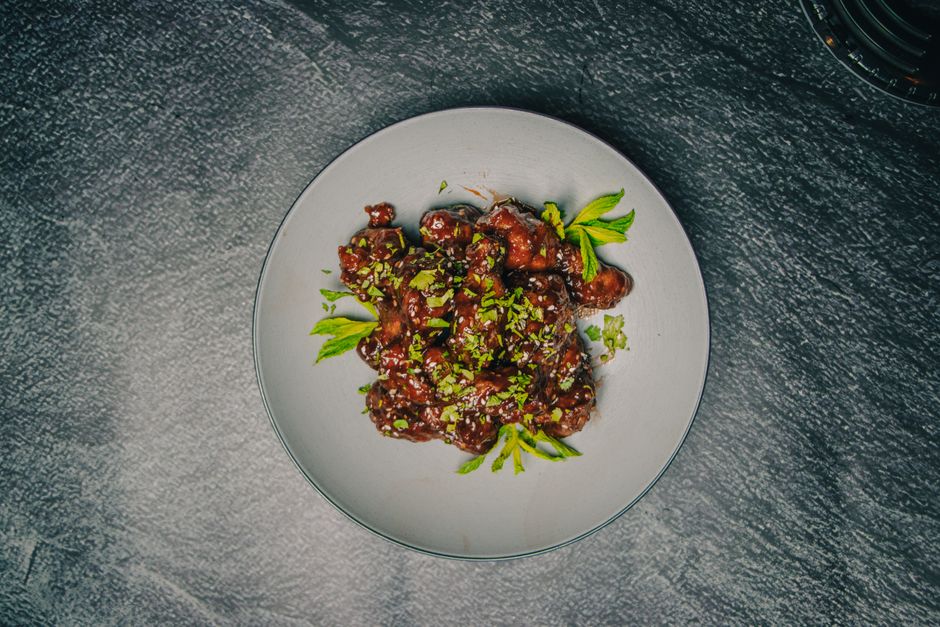
A double-fried, cornstarch-crusted version of the Hunan–Taiwanese restaurant classic — with the exact sugar-to-vinegar ratio that makes the sauce cling to the chicken instead of pooling at the bottom of the bowl.
Marinate 1½ lb (680 g) bite-sized chicken thigh in soy, Shaoxing wine, egg white and ¼ tsp baking soda for 20 minutes, dust heavily with cornstarch, then fry twice — 90 seconds at 350°F (175°C), rest 5 minutes, 60 seconds at 375°F (190°C). Bloom dried chilies, garlic and ginger in a wok, add a sauce built on 8 parts stock : 3 parts sugar : 2 parts soy : 1 part rice vinegar, thicken with slurry, and toss the chicken in off the heat. Total time: 45 minutes. Serves 4.
What General Tso’s Chicken Actually Is
The dish is named for Zuo Zongtang, a Qing dynasty military commander from Hunan who died in 1885 and, by all available evidence, never ate it. The recipe that carries his name was created in the 1950s in Taiwan by chef Peng Chang-kuei, who cooked for Nationalist officials after fleeing the mainland. His original banquet version was Hunan in spirit: dark, sour, fiery, barely sweet at all.
Peng’s Taipei kitchen served General Tso’s chicken as a dry-fried, chili-heavy banquet dish. When he reopened in Manhattan in the 1970s, American diners pushed back on the heat and sourness, and the kitchen answered by adding sugar and cornstarch gloss. That sweeter, stickier formula is what Chinese-American restaurants standardized through the 1980s.
The result: the version most of the world calls “General Tso’s” is essentially an American Chinese invention with a Hunan name — a sweeter cousin of Hunan-style dry-fried chicken. In Hunan province itself, the closest traditional dish is zuo zong tang ji, which is far more sour and chili-forward.
Two things define the restaurant version worth recreating at home. First, the crust: not a batter but a cornstarch shell that shatters. Second, the sauce: glossy, clinging, and balanced on a knife edge between sweet, sour and savory. Get those two things right and you have takeout quality — often better, because home frying oil is fresher than a restaurant’s Friday-night fryer.
“The chicken must be crisp enough to hear across the table, and the sauce must never reach the bottom of the plate.”
The standard test applied to General Tso’s chicken in Chinese-American restaurant kitchens
Ingredient Selection and the Science of Crisp
Chicken thigh vs. breast
Higher fat and collagen content. Stays juicy through two passes in 375°F oil and holds sauce without drying. Cut into 1-inch (2.5 cm) cubes; trim heavy sinew but leave the intramuscular fat.
Leaner, firmer, faster to overcook. If using breast, brine in 3% salt water for 30 minutes first and shorten the second fry to 45 seconds. Costs you about 15% of the margin for error.
Why baking soda goes in the marinade
A quarter teaspoon of baking soda raises the surface pH of the chicken. That alkaline shift discourages the muscle proteins from tightening and squeezing out water, which is why velveting with an alkaline agent produces noticeably more tender meat after high-heat frying.[4] It is the same principle behind the velveted chicken in Cantonese stir-fries, applied here before the cornstarch coating goes on. Do not exceed ¼ teaspoon per pound — too much leaves a soapy, metallic edge.
Cornstarch, not flour
Cornstarch is nearly pure amylopectin starch with no gluten. In hot oil it dextrinizes and puffs into a hard, glassy, low-moisture shell that stays crunchy for 10–15 minutes after saucing. All-purpose flour forms gluten and browns faster at lower temperatures, giving you a softer, breadier crust that goes soggy within three minutes of meeting the sauce. Use cornstarch alone for the dusting step, roughly ½ cup (60 g) per 1½ lb of chicken.
The aromatics and dried chilies
- Dried red chilies: 8–10 Tianjin or árbol chilies, snipped into ½-inch segments, seeds shaken out. Toasting them in oil for 20–30 seconds is what produces the dish’s signature aroma.
- Shaoxing wine: A lightly oxidized rice wine at 15–18% ABV. Dry sherry substitutes one-for-one. Do not use “cooking wine” with added salt.
- Dark soy sauce: Thick, molasses-like, used for color rather than salt. One teaspoon turns the sauce mahogany; two will make it bitter.
- Rice vinegar: Unseasoned, 4–5% acidity. Distilled white vinegar is sharper and flatter — reduce it by a third if substituting.
- Sugar: Light brown sugar brings a faint molasses note that reads as “restaurant.” Granulated works but tastes thinner.
Frying oil
Peanut oil has the highest smoke point of the common neutral oils (about 450°F / 232°C) and a faint nutty note that suits the chilies. Canola or refined vegetable oil work fine at 400°F+ smoke points. Save used oil in a sealed jar for one more fry session at most — oil that has already fried battered food will transfer off-flavors to the chicken.
Prep and Equipment Overview
General Tso’s chicken is a two-part cooking job: fry, then sauce. The sauce comes together in 90 seconds, so everything that goes into the wok must be pre-measured before the first piece of chicken hits the oil. Restaurants call this mise en place; home cooks call it the difference between crisp chicken and soggy chicken.
Keep a lid and a box of baking soda within arm’s reach of the oil. Never add water to a grease fire. Fry on the back burners, keep children and pets out of the kitchen, and never leave 375°F oil unattended — it can reach its smoke point in under three minutes on a high-output gas burner.
Step-by-Step Master Method
Yield: 4 servings · Active time: 35 minutes · Marinating: 20 minutes minimum · Oil: 6 cups
The first fry can be done up to 4 hours ahead. Spread the fried chicken on a rack and refrigerate uncovered — the dry fridge air keeps the crust firm. When ready to serve, do the second fry straight from cold, adding 15 seconds to the timing. The sauce liquid can be whisked and refrigerated up to 3 days; re-whisk before use because the cornstarch settles.
Key Ratios and Temperature Targets
Memorize these two tables and you can cook General Tso’s chicken without looking at the recipe again. The sauce ratio is volumetric and scales cleanly — one “part” is 1 tablespoon for a single batch, ¼ cup for a double.
| Sauce Component | Parts | Single Batch | Function |
|---|---|---|---|
| Chicken broth | 8 | ½ cup (120 ml) | Body; carries aromatics |
| Light brown sugar | 3 | 3 tbsp (36 g) | Sweetness, gloss, browning |
| Soy sauce | 2 | 2 tbsp (30 ml) | Salt and umami |
| Rice vinegar | 1 | 1 tbsp (15 ml) | Acid cut; balances sugar |
| Shaoxing wine | 1 | 1 tbsp (15 ml) | Aromatic depth |
| Dark soy sauce | ¼ | 1 tsp (5 ml) | Color only — not salt |
| Cornstarch slurry | ~1.5 | 1 tbsp + 2 tbsp water | Thickening; cling |
| Target | Temperature | Timing | Why |
|---|---|---|---|
| First fry | 350°F / 175°C | 90 sec per batch | Sets coating, cooks outer layer, no burning |
| Oil floor between batches | 325°F / 163°C | Recover 60–90 sec | Cold oil makes greasy, pale crust |
| Second fry | 375°F / 190°C | 60 sec per batch | Flash-dries surface, hardens shell |
| Chicken interior | 165°F / 74°C minimum[1] | Check thickest piece | USDA safe minimum for poultry |
| Sauce reduction | Simmer, ~200°F / 93°C | 60–90 sec | Dissolves sugar; concentrates flavor |
Common Mistakes and Troubleshooting
If the finished dish tastes flat but sweet, you are missing acid. Add 2 teaspoons of rice vinegar directly to the wok off the heat and toss. If it tastes sharp but dull, add 1 teaspoon of soy sauce and ½ teaspoon of sugar. Adjust in those increments, not tablespoons.
Serving, Pairing and Storage
What to serve alongside
- Steamed jasmine rice — the default. Short-grain or japonica rice holds up better than long-grain if you’re eating leftovers.
- Blanched broccoli or gai lan — 90 seconds in boiling salted water, then a splash of oyster sauce. Bitter greens cut the sugar in the sauce.
- Cold smashed cucumber salad with rice vinegar, garlic and sesame — the acidity resets the palate between bites of fried chicken.
- Pairing note: the dish’s sugar and chili want either a dry Riesling or an off-dry Gewürztraminer. For beer, a crisp pilsner. Avoid heavily hopped IPAs — they amplify the chili heat into something harsh.
Storage and reheating
Refrigerate leftovers in a sealed container for up to 3–4 days.[2] Reheating is where most people ruin the dish: the microwave steams the crust into mush. Instead, spread the chicken on a sheet pan and reheat at 400°F (205°C) for 8–10 minutes, or re-crisp in a 375°F (190°C) air fryer for 5–6 minutes. Both will restore maybe 70% of the original crunch.
Freeze the chicken after the first fry, before the second. Spread on a sheet pan until solid, then transfer to a bag — it keeps 2 months. Second-fry straight from frozen at 375°F (190°C) for 2 minutes. Do not freeze the finished, sauced dish; the sauce separates and the crust never recovers.
Frequently Asked Questions
Can I make General Tso’s chicken without deep frying?
Yes, with a texture trade-off. Toss the cornstarch-coated chicken with 2 tablespoons of oil and air-fry at 400°F (205°C) for 12–14 minutes, shaking the basket at the halfway point. The crust will be crisp but thinner and less glassy than a true double fry. A second option: shallow-fry in ½ inch of oil in a cast-iron skillet, turning once, which uses far less oil and gets you roughly 80% of the way there.
Is General Tso’s chicken very spicy?
Restaurant versions are mildly hot at most — usually a 2 or 3 out of 10. The chilies are there for aroma more than burn. For more heat, add 1 teaspoon of chili oil or a pinch of crushed Sichuan chilies to the sauce. For less, use 4 chilies instead of 10 and leave them whole so they release less capsaicin.
What’s the difference between General Tso’s chicken and orange chicken?
Both are fried, sweetened Chinese-American chicken dishes, but the sauces diverge. General Tso’s is built on dried chilies, garlic, ginger, soy and vinegar with a savory backbone. Orange chicken leans on fresh orange zest and juice with a fruitier, brighter, less chili-driven profile, and its sauce is often thicker and stickier. General Tso’s is the spicier, more savory of the two.
Why is it called “General Tso’s” if he never ate it?
Zuo Zongtang was a celebrated Hunan military leader, and his name carried prestige as a byword for Hunan regional cooking. Chef Peng Chang-kuei named the dish after him in the 1950s to lend it stature. There is no historical record linking Zuo to this recipe, and the sweet American version bears little resemblance to anything cooked in Hunan today.
Can I use chicken breast instead of thigh?
Yes. Brine the cubed breast in 3% salt water (about 3 tablespoons kosher salt per quart of water) for 30 minutes, drain, pat dry, then proceed with the marinade. Reduce the second fry to 45–50 seconds to avoid drying it out. Breast produces a cleaner, firmer bite; thigh produces a juicier, more forgiving one.
How much oil do I actually need?
A 12-inch wok needs about 6 cups (1.4 L) to reach a 1½–2 inch depth, which is enough for the chicken to float freely without touching the bottom. If you’d rather not use that much, shallow-fry in ½ inch of oil in a cast-iron skillet, turning the pieces once — 90 seconds per side for the first fry, 45 seconds per side for the second. Strain and refrigerate the used oil; it will keep for one more fry session.
- Double-fry at 350°F then 375°F (175°C then 190°C) — this is the single biggest difference between home and takeout texture.
- ¼ teaspoon baking soda per pound of chicken raises surface pH and keeps the meat tender through high-heat frying.[4]
- Build the sauce at 8 parts stock : 3 parts sugar : 2 parts soy : 1 part rice vinegar, and stop the reduction at 90 seconds.
- Toss the chicken into the sauce with the burner completely off, and serve within 5 minutes.
- Chicken must reach 165°F (74°C) internally; leftovers keep 3–4 days refrigerated.[1][2]
- Reheat at 400°F (205°C) in the oven or 375°F (190°C) in an air fryer — never in the microwave.
- U.S. Department of Agriculture, Food Safety and Inspection Service. “Safe Minimum Internal Temperature Chart.” Poultry, including ground poultry: 165°F (74°C). fsis.usda.gov
- U.S. Department of Agriculture, FoodSafety.gov. “Refrigeration and Food Safety — Cold Food Storage Chart.” Cooked poultry: 3–4 days refrigerated, 2–6 months frozen. foodsafety.gov
- Dunlop, Fuchsia. The Food of Sichuan and reporting on Chinese-American restaurant cuisine; also documented in obituary coverage of chef Peng Chang-kuei (1918–2016), credited with creating the dish in Taiwan in the 1950s. nytimes.com
- McGee, Harold. On Food and Cooking: The Science and Lore of the Kitchen. On alkaline marinades (baking soda) raising surface pH and limiting protein cross-linking in meat. Scribner.
- USDA FoodData Central. Nutrient reference for fried chicken preparations and frying oil composition. fdc.nal.usda.gov
Editorial note: This guide is a kitchen-tested method, not a nutritional or medical resource. Deep-frying involves hot oil and open flame — follow the safety setup in the Prep section, never leave heating oil unattended, and confirm poultry reaches an internal temperature of 165°F (74°C) before serving. Ingredient substitutions may alter cooking times. Nutrient figures vary by brand and portion size.