A precise, test-kitchen approach to silky egg pasta dough — based on weight, not guesswork. Learn the classic 100:60 flour-to-egg ratio, the science of resting gluten, and the exact technique for rolling dough thin enough for tagliatelle, lasagne, and ravioli.
Great homemade pasta dough contains just two ingredients in a reliable ratio: 100 g of finely milled “00” flour for every 57–60 g of whole egg. For a typical batch, that is 300 g flour + about 170–180 g egg (3 large eggs). Weighing both ingredients gives a dough that is firm, smooth, and barely tacky after 8–10 minutes of kneading. A 30-minute rest before rolling is non-negotiable if you want sheets that stretch instead of snapping back.
Flavor Profile & Culinary Origin
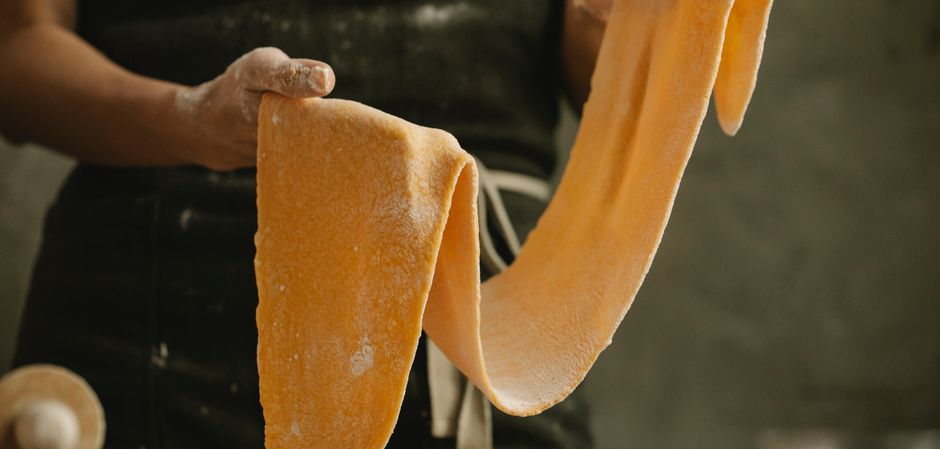
Fresh egg pasta — pasta all’uovo — belongs to the culinary heartland of Emilia-Romagna, stretching through Bologna, Modena, and Ferrara. Unlike the bronze-die pasta of southern Italy, made from durum wheat and water, northern Italian egg pasta relies on soft wheat flour and the rich emulsion of farm eggs. The finished sheet, called a sfoglia, is rolled so thin that lasagne can be layered without weighing down the table, then cut into tagliatelle, pappardelle, tortelloni, or square tortellini.[3]
The flavor is gentle and faintly sweet: tender wheat, a buttery note from egg yolk, and just enough gluten to produce a coiled, al dente bite. Fresh egg pasta does not taste eggy when properly made. Instead, the yolks add a custard-like richness that carries meat ragùs and brown butter sauces far more elegantly than dry pasta. A good homemade sheet should feel like fine silk between your fingers, with a surface that is smooth, matte, and never sticky.
There is no single “authentic” dough. There is only the honest cook’s goal: a thin, even, resilient sheet that cooks into tender pasta without ever becoming mushy.
Ingredient Selection & Dough Science
Flour: “00” Is Not Just a Marketing Term
In Italy, wheat flour is sifted and classified by particle size, not protein content. Tipo “00” is the most finely milled, talc-like flour available, and it creates the smooth, almost creamy mouthfeel associated with hand-rolled sfoglia. Its protein content usually sits between 9% and 13%, depending on the miller — so look for a “00” flour labeled for pasta or fresh dough rather than a lower-gluten cake-style “00”.
All-purpose flour works beautifully, too. A 10–12% protein all-purpose flour produces a slightly stronger, more elastic dough; you may simply need to rest it a few extra minutes before rolling. The key is to weigh flour at 300 g and adjust with a few drops of water only if the dough feels aggressively dry.
Eggs: The Only Hydration You Need
Egg serves two roles: liquid and structure. The yolk carries fat, lecithin, and concentrated protein, contributing richness and plasticity. The white contributes roughly 88% water plus proteins that firm the dough. Together they create a hydration level of about 38–40% actual water against flour weight — low enough to make a stiff, rollable dough, but high enough to develop the gluten network needed to withstand rolling and cutting.
This is why pasta dough should never be handled like bread dough. A wet, sticky dough will cling to the roller and tear. A slightly dry, satiny dough — comparable in feel to a stress ball — is what you are chasing. When the dough rests, the hydration equalizes and the gluten relaxes; this short rest is what turns a rubbery, hard-to-roll slab into a cooperative sheet.[2]
For the most reliable fresh pasta dough, think in baker’s percentages: whole egg weight should equal 55–60% of your flour weight (100 parts flour to 60 parts liquid when measured on a scale). Since eggs vary widely in size, beat the eggs lightly in a measuring cup and pour out 170–180 g for 300 g flour rather than assuming every jumbo egg weighs the same.
Equipment: What Actually Matters
Essential
- Digital scale accurate to 1 g — you cannot make consistently excellent pasta dough by cups and egg counts alone
- Wide mixing bowl or clean countertop for the flour-well method
- Bench scraper — invaluable for gathering sticky remnants and dividing dough
- Rolling pin or manual pasta machine — a long tapered rolling pin is traditional; a pasta machine makes even thickness nearly foolproof
- Clean kitchen towels for resting and drying sheets
Nice to Have But Non-Essential
- Pasta drying racks or a floured sheet pan with baking parchment
- Fluted pastry cutter for decorative ravioli and pappardelle edges
- Stand mixer with dough hook — only necessary if you regularly make double or triple batches
- Pasta machine attachment set for the stand mixer
Master Method: From Flour Well to Thin Sheet
This master recipe yields approximately 480 g of fresh pasta dough — enough for six generous servings of tagliatelle, or four servings of ravioli with leftover trimming. Plan for about 45 minutes of active work, plus a 30-minute rest.
Hand-rolling is completely traditional. Dust the work surface lightly, place the dough in the center, and roll outward from the center using even pressure: roll, rotate the sheet by 45°, roll again. Repeat until the sheet is about 1.5 mm thick. The rhythm matters more than force. Let the sheet rest for 5 minutes on a floured towel before cutting if it becomes too elastic.
Key Ratios & Timing Reference Table
Use this guide as your troubleshooting-friendly starting point. Weigh everything for consistent results.
| Ingredient / Variable | Classic Sfoglia | Use All-Purpose Flour Instead | 50/50 Semola Blend |
|---|---|---|---|
| Tipo “00” flour | 300 g | — | 150 g |
| All-purpose flour | — | 300 g | — |
| Semola rimacinata di grano duro | — | — | 150 g |
| Whole eggs (by weight after beating) | 170–180 g | 170–180 g | 170–185 g |
| Actual dough hydration | ~38% | ~38–39% | ~42–43% |
| Kneading time | 8–10 min | 8–10 min | 9–11 min |
| Resting time at room temp | 30–45 min | 45 min | 45–60 min |
| Rolling target for tagliatelle | 1.2 mm | 1.2 mm | 1.2–1.5 mm |
| Rolling target for ravioli / lasagne | 0.9–1.0 mm | 1.0 mm | 1.0–1.2 mm |
Durum wheat semolina has a coarser particle structure and different starch behavior than milled soft “00” flour, so it demands slightly more hydration. The result is a stronger, golden noodle that stands up well to heartier ragùs — a wonderful bridge between northern egg pasta and southern dried pasta.
Common Mistakes & How to Fix Them
Fix: The difference between 130 g and 160 g of “00” flour in a cup is large enough to turn your dough into concrete. Always measure by grams.
Fix: The sheet is too dry. Beat an egg yolk with 1 teaspoon of water and brush a very thin film over the sheet, then fold and roll twice through the widest setting before continuing. Do not dump water directly into the dough.
Fix: It needs a longer rest. Wrap it tightly and let it rest an additional 20–30 minutes at room temperature; if your kitchen is very cold, wait 60 minutes.
Fix: You may have folded an un-dusted edge into the rollers, creating a stuck seam. Dust the sheet lightly with flour before every other pass, and never allow the sheet to sit on the work surface so long that it adheres to itself.
Fix: You rolled and cut the dough while it was still too moist. Dust the full sheet with flour before cutting, then gently loft the noodles between your fingertips to separate any strands that stick. Let them dry on a floured tray for 15 minutes before cooking.
Pairing, Storage & Food Safety
What To Serve With Fresh Egg Pasta
Fresh pasta is not a blank canvas — it is a specific texture that deserves sauces with body. Ragù alla Bolognese and slow-cooked beef sauces cling naturally to the rougher surface of fresh tagliatelle. Brown butter and sage, porcini mushrooms, and creamy Parmigiano-Reggiano sauces also pair brilliantly. For a light lemon or seafood dressing, choose the semolina-blend version instead, since a delicate white-wine sauce can be overwhelmed by rich egg noodles.
Storage: Fresh, Refrigerated, and Frozen
Because fresh pasta contains raw eggs, treat it with the same sense of urgency you would raw egg dough. Keep it refrigerated until the moment you cook it, and do not leave raw dough out at room temperature for more than two hours total — the combined counter time for kneading and resting should fit comfortably inside that window.[1]
- Refrigerate cut pasta: 24–48 hours in an airtight container, dusted lightly with semolina or flour.
- Freeze cut nests: 1–2 months at or below 0°F. Freeze them first on a floured baking sheet, then transfer to a zip-top bag. Cook directly from frozen; add one extra minute to the boil.
- Freeze the dough block: Wrap tightly in plastic wrap, then aluminum foil. Thaw overnight in the refrigerator before rolling. The texture remains excellent for up to one month.
- Do not dry fresh egg pasta slowly at warm room temperature unless you are using factory-grade equipment and controlled low humidity; drying homemade noodles too slowly can create a food-safety risk with raw egg.[1]
Frequently Asked Questions
Do I need “00” flour if I want to make fresh pasta at home in the U.S.?
No. A dependable unbleached all-purpose flour with 10–12% protein produces excellent fresh pasta. “00” flour gives a more silky, tender bite because it is milled incredibly fine and often has a slightly lower protein content. If you can find a “00” flour labeled for bread, pizza, or pasta, use that; otherwise, all-purpose is better than bread flour, which makes the dough too springy and difficult to roll thin.
Why is my pasta dough so dry and crumbly?
The ratio of flour to egg is disproportionately high — usually because the eggs were small or the flour was measured by volume. First, knead for a full three minutes before assessing; a shaggy dough often transforms into a cohesive mass with palm pressure. If after three minutes it still crumbles, add ½ teaspoon of cold water at a time, kneading thoroughly before adding more. Do not add an entire extra egg unless you are increasing the flour, or you will fight stickiness for the entire rolling stage.
How long should fresh pasta dough rest?
Thirty minutes is the minimum; 45–60 minutes is better. The rest hydrates the flour particles evenly and relaxes gluten that was developed during kneading. You can also refrigerate the wrapped dough for up to 24 hours and bring it to room temperature for 20 minutes before rolling. Resting is not a suggestion — it is the single most important step between a sheet that fights you and a sheet that glides through the machine.
Can I freeze fresh pasta dough, or should I only freeze cut noodles?
Both work. Cut noodles should be frozen in loose nests so they do not fuse into a solid block. Raw dough can be wrapped tightly, frozen for up to one or two months, then thawed overnight in the refrigerator. Freezing cut noodles directly is convenient for weeknight meals: drop the frozen nests straight into boiling salted water and cook one minute longer than fresh.
Should I add salt directly to the pasta dough?
Most Italian sfoglia makers add no salt to the dough itself because the dough is cooked in heavily salted water. Salt in the dough can slightly tighten gluten and requires even more kneading to incorporate evenly. If you prefer seasoned dough, add 3 g fine sea salt for every 300 g of flour, dissolved first in the beaten eggs so it distributes uniformly.
- Weigh the flour and the egg: the sweet spot is 100 g flour to 57–60 g beaten whole egg.
- “00” flour creates the classic silkiness of Emilian sfoglia, but 10–12% protein all-purpose flour works extremely well.
- Knead until the dough feels like a smooth stress ball — then rest it for a minimum of 30 minutes before rolling.
- Roll thin, dust often, and cut only what you plan to cook so noodles do not dry out too much on the counter.
- Fresh egg pasta is a refrigerator-to-pot food: cook within 48 hours, freeze for longer storage, and never leave raw dough at room temperature for more than two hours total.
- USDA Food Safety and Inspection Service. “Egg Products and Food Safety.” Accessed September 2026.
- McGee, Harold. On Food and Cooking: The Science and Lore of the Kitchen. Scribner, 2004 — see the chapters on flour, eggs, and dough structure.
- Riley, Gillian. The Oxford Companion to Italian Food. Oxford University Press, 2007 — entries on “pasta fresca,” “sfoglia,” and Emilia-Romagna.