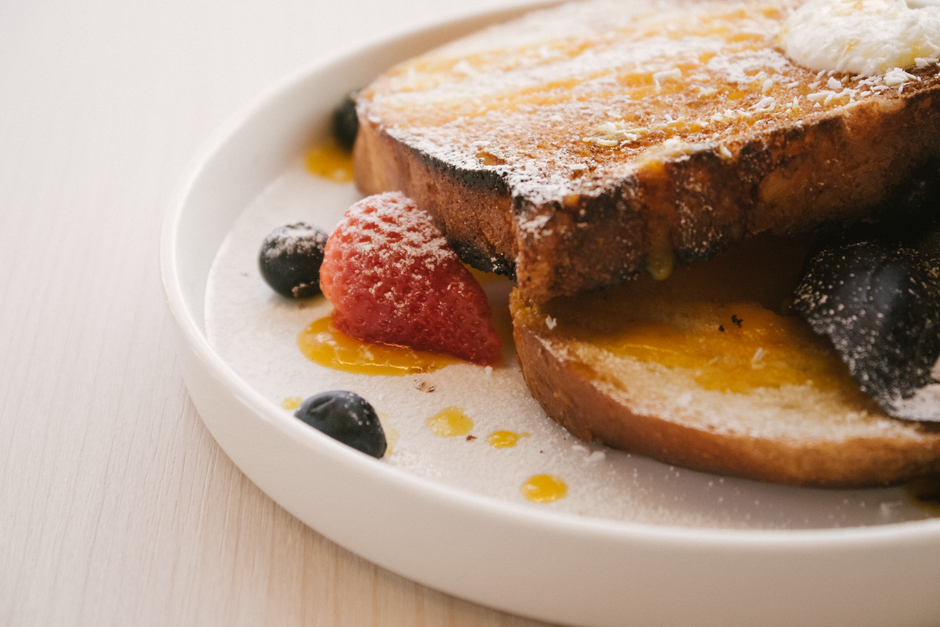
A four-ingredient custard soak, day-old bread, and a griddle held at 170°C — that’s the entire difference between golden, custardy French toast and a plate of sweet scrambled bread.
Whisk 3 large eggs with 180 ml (¾ cup) whole milk, 1 tbsp sugar, 1 tsp vanilla and ¼ tsp fine salt. Soak 1-inch (2.5 cm) slices of day-old brioche, challah or sourdough for 15–20 seconds per side, no longer. Cook on a 165–175°C (330–350°F) surface in a butter–oil blend, 2–3 minutes per side, then finish thick slices in a 175°C (350°F) oven for 5–8 minutes until the custard centre reaches 71°C / 160°F. Rest on a wire rack, not a plate.
Flavour Profile, Texture — and Where French Toast Came From
Good French toast has three simultaneous textures: a lacquered, faintly crisp surface from Maillard browning[4], a soft spongy crumb that has absorbed custard without collapsing, and a set, barely-jiggling centre that stops short of becoming scrambled egg. Every technique in this recipe exists to hit those three targets at once.
The dish is far older than its English name. Roman cooks were soaking bread in milk and egg and frying it in oil, then dressing it with honey, as early as the 1st century — Apicius records it as aliter dulcia, “another sweet.” Medieval France formalised it as pain perdu, “lost bread,” the thrifty answer to a stale loaf. The first printed English use of the term “French toast” appears in 1660 in Robert May’s The Accomplisht Cook, and by the late 1800s the sweet, syrup-topped American version had taken hold in diners and farmhouse kitchens.
The same dish, four passports
- France — pain perdu: shallow-fried in butter, finished with sugar and sometimes orange zest or a splash of rum.
- Spain — torrija: soaked in milk and often wine, sweetened with honey, and served during Lent. The denser soak is possible because Spanish bakers use a firmer, drier loaf.
- Britain — “eggy bread”: frequently savoury, served with Worcestershire sauce or ketchup rather than syrup.
- India — “Bombay toast”: a spiced, pan-fried variant with onion, chilli and turmeric in a savoury custard.
“French toast is not a recipe so much as a ratio problem. Get the custard proportion and the pan temperature right and the bread type barely matters.”
— WorldDishly test kitchen notes
Choosing Bread, Eggs and Dairy
Three ingredients carry this dish, and each one has a measurable reason to be chosen the way it is.
Bread: stale is a requirement, not a suggestion
Fresh bread fails at French toast for a structural reason. During baking, starch granules gelatinise and trap water; as the loaf cools and sits, those starches recrystallise in a process called retrogradation, and free water migrates out of the crumb[3]. That slightly dry, firm crumb is precisely what allows a slice to drink custard to the centre without disintegrating.
- Best: brioche or challah at 1 day old — enriched with butter and egg, so they carry richness and hold shape.
- Best for crisp edges: a country sourdough or firm white pan loaf, cut 2–2.5 cm thick.
- Avoid: presliced sandwich bread (too thin, tears), and anything so fresh it compresses to paste.
- Emergency staleness: 10 minutes in a 150°C (300°F) oven, flipping once — dry the surface, don’t toast it through.
Eggs and dairy: the custard is a set protein gel
Egg proteins begin to unfold and cross-link around 63–70°C, and a custard is fully coagulated — no longer liquid, not yet curdled — near 71°C. Past roughly 80–85°C the network tightens and squeezes out water, which is why an overheated custard weeps and turns rubbery[1]. Fat and sugar both interfere with that protein network, raising the coagulation temperature and widening the window where the custard stays silky — the reason whole milk beats skim, and the reason a tablespoon of sugar is technique, not just flavour.
The classic 1 egg : 60 ml milk ratio. Clean custard set, clean dairy flavour. Best all-purpose choice.
Richer, softer set. Cut a splash into the milk — going all-cream makes heavy, greasy slices that resist browning.
1 tsp vanilla extract — alcohol carries aroma compounds; add it to the custard, not the finished plate. ¼ tsp fine salt — suppresses bitterness and makes the sugar taste sweeter. 1 tbsp melted butter or a spoon of crème fraîche — extra fat for a softer set. 1 tsp cornstarch — thickens the custard slightly so it clings to the slice instead of pooling. Skip cinnamon if you’re using a delicate brioche; it masks the egg and butter.
Pan, Spatula and the Temperature Setup
French toast is one of the few dishes where the pan choice changes the result more than the ingredient list does. You need a surface broad enough that slices never touch, and stable enough that the temperature doesn’t swing when bread hits it.
Butter’s milk solids scorch at roughly 150°C, which sits below the 165–175°C you actually want for fast browning. Fix it two ways: whisk 1 tbsp butter with 1 tsp neutral oil to lift the effective smoke point, or use clarified butter or ghee (smoke point around 250°C) for the entire cook. Brown butter in the pan is desirable; black butter is not.
The Step-by-Step Master Method
This method assumes 6 slices of 2.5 cm (1 inch) brioche or challah. Scaling notes are in the table below.
Cook slices through step 5, cool on a rack, then refrigerate up to 24 hours in a single layer. Reheat on a sheet pan at 190°C (375°F) for 8–10 minutes, flipping once. They come back crisper than they went in — the opposite of what happens with microwave reheating.
Ratios, Temperatures and Timing at a Glance
Master custard ratio
| Slices (2.5 cm thick) | Eggs | Whole milk | Sugar | Salt | Soak per side |
|---|---|---|---|---|---|
| 4 | 2 | 120 ml (½ cup) | 2 tsp | ⅛ tsp | 12–15 sec |
| 6 | 3 | 180 ml (¾ cup) | 1 tbsp | ¼ tsp | 15–20 sec |
| 8 | 4 | 240 ml (1 cup) | 4 tsp | ⅓ tsp | 20–25 sec |
| 12 | 6 | 360 ml (1½ cups) | 2 tbsp | ½ tsp | 25–30 sec |
Rule of thumb: 1 large egg per 60 ml (¼ cup) milk, per 2 thick slices. The custard should coat a spoon thinly — if it’s thicker than heavy cream, loosen with milk.
Temperatures that matter
| Stage | Target | Why it matters |
|---|---|---|
| Griddle surface | 165–175°C / 330–350°F | Sets a crust before the custard can leak out of the slice |
| Butter milk solids | Below 150°C / 300°F | Above this, solids scorch and turn bitter |
| Clarified butter / ghee | 250°C / 480°F smoke point | Allows high-heat browning without burning |
| Custard centre, thick slices | 71°C / 160°F | USDA safe minimum internal temperature for egg dishes[2] |
| Egg protein curdling | Above 85°C / 185°F | Network over-tightens and expels water — the classic rubbery slice |
| Oven finish | 175°C / 350°F, 5–8 min | Sets the centre without re-browning the crust |
| Holding cooked slices | 90°C / 200°F, uncovered on a rack | Keeps crust crisp; covered trays steam it soft |
| Reheating | 190°C / 375°F, 8–10 min | Restores surface crispness; microwave cannot |
Common Mistakes and Troubleshooting
If your bread was too firm and the slices came out dry in the middle, pour the remaining custard into a shallow pan and warm it gently until just barely steaming, then lay cooked slices in it for 30 seconds per side and return them to the pan for a quick 60-second re-crisp. Never dunk cooked toast into cold raw custard.
Serving, Pairing and Storage
Sweet pairings
- Maple syrup — warm it slightly; cold syrup chills the crust on contact.
- Crème fraîche or thick Greek yoghurt — acidity cuts the custard’s richness better than whipped cream does.
- Berry compote — cook 200 g berries with 1 tbsp sugar and a squeeze of lemon for 6 minutes; the tartness balances the sugar in the custard.
- Torrija-style finish — drizzle honey, dust with cinnamon, and add a spoon of thick cream, echoing the Spanish Lenten original.
Savoury pairings
Reduce the sugar to 1 tsp, drop the vanilla, and add ½ tsp black pepper and 2 tbsp grated Gruyère to the custard. Serve with a fried egg and hot sauce, or with crisped bacon and a spoon of mustard. Frying in rendered bacon fat (smoke point around 190°C) is the single best upgrade for a savoury version.
Cooked French toast: refrigerate in a single layer, covered, for up to 3–4 days[6]. Freeze up to 2 months with parchment between slices; reheat from frozen at 190°C (375°F) for 12–15 minutes. Raw custard mix: refrigerate immediately and use within 24 hours, then discard[5]. Never leave the soaking dish or the finished toast at room temperature for more than 2 hours.
French Toast FAQ
Can I make French toast without eggs?
Yes. Whisk 2 tbsp cornstarch or chickpea flour into 240 ml (1 cup) plant milk with 1 tbsp sugar, 1 tsp vanilla and a pinch of salt. The starch gelatinises as it cooks and mimics the set of an egg custard, though the surface browns slightly more slowly. Add 1 tbsp neutral oil to the mix for a softer interior.
Can I soak the bread overnight?
You can, and it’s the technique behind the denser Spanish torrija. The catch is food safety: the custard must sit in the refrigerator at 4°C or below, never on the counter, and no longer than 12 hours. Expect a softer, more pudding-like centre and a shorter cook — reduce the pan time by about 30 seconds per side.
What’s the single best bread for French toast?
Day-old brioche or challah, cut 2–2.5 cm thick. Both are enriched with butter and egg, so they hold structure while absorbing custard, and their slightly sweet crumb browns beautifully. Country sourdough is the better choice if you want crisp, almost savoury edges.
Why does my French toast taste like scrambled egg?
Two causes: too high an egg-to-milk ratio, and overcooking. Stick to 1 egg per 60 ml of whole milk, and pull the slice as soon as the centre is just set — 71°C on a probe. Egg flavour becomes dominant when the proteins are cooked past the point where the custard is silky.
Is French toast the same as pain perdu and eggy bread?
They’re the same family of dish with different traditions. Pain perdu is the French ancestor, typically fried in butter and finished with sugar. “Eggy bread” is the British name, and it’s often served savoury with Worcestershire sauce or ketchup rather than syrup. The American “French toast” is the sweet, syrup-forward version standardised in the late 19th century.
How do I keep French toast warm for a group?
Set a wire rack on a sheet pan and hold it in a 90°C (200°F) oven. Uncovered is essential — foil traps steam and undoes the crust in minutes. Slices hold well for up to 30 minutes this way.
Can I cook French toast in an air fryer?
Yes, with adjustments. Soak as normal, then air-fry at 180°C (355°F) for 6 minutes per side, brushing both surfaces with melted butter first — without surface fat, the bread dehydrates before it browns. The result is closer to a custardy toast than a pan-fried one, and thick slices benefit from an extra 2 minutes.
- Use day-old brioche, challah or country sourdough cut 2–2.5 cm thick — stale crumb absorbs custard without collapsing.
- Stick to 1 large egg per 60 ml whole milk per 2 slices; whisk until uniform and strain through a sieve.
- Soak 15–20 seconds per side for standard bread, 10–12 for brioche, 25–30 for dense sourdough.
- Hold the pan at 165–175°C and use clarified butter or a butter–oil blend to prevent scorching.
- Cook 2–3 minutes per side, then finish thick slices at 175°C until the centre reaches 71°C / 160°F.
- Rest on a wire rack, never a plate, and refrigerate leftovers within 2 hours for up to 3–4 days.
- McGee, Harold. On Food and Cooking: The Science and Lore of the Kitchen. Revised ed., Scribner, 2004 — chapters on egg coagulation and starch behaviour.
- USDA Food Safety and Inspection Service. “Safe Minimum Internal Temperature Chart.” United States Department of Agriculture — egg dishes: 160°F (71°C).
- King Arthur Baking Company. “Why Bread Goes Stale — and How to Slow It Down.” Baking resource library.
- Mottram, D. S. “Flavour Formation in Meat and Savoury Foods: A Review.” Food Chemistry, vol. 62, no. 4, 1998, pp. 415–424 — Maillard reaction browning thresholds.
- U.S. Food and Drug Administration. “Egg Safety: What You Need to Know.” FDA consumer guidance on raw egg handling and refrigeration.
- USDA Food Safety and Inspection Service. “Leftovers and Food Safety.” — refrigerate cooked leftovers within 2 hours; use within 3–4 days.