Some fats are a flavor decision; others are an engineering decision. Butter and margarine may look interchangeable in the baking aisle, but they push cookie spread, pastry layers, crust color, and final mouthfeel in measurably different directions. Here is how to choose the one that belongs in your mixer.
Use butter for nearly everything baked: at 80% milkfat, about 16% water, plus milk solids, it browns deeper, flavors more richly, and creates more distinct pastry layers than margarine. For dairy-free bakes, an 80%-fat block-style vegan butter stick replaces butter 1:1 by weight in cakes and cookies. Never swap in low-fat soft-tub spreads at 60% fat or less — the extra water changes dough hydration and ruins texture.
- Ground rules: identical fat percentage, different chemistry
- The 30-second comparison grid
- Butter in baking: flavor is not optional
- Margarine in baking: engineered to perform, built not to taste
- Why the wrapper decides the bake: fat, water, and salt
- Cookies, cakes, and crusts: a side-by-side look
- When margarine genuinely earns its place
- The practical butter-to-margarine swap chart
- Chef’s Verdict
- Bakers’ FAQ
Ground rules: identical fat percentage, different chemistry
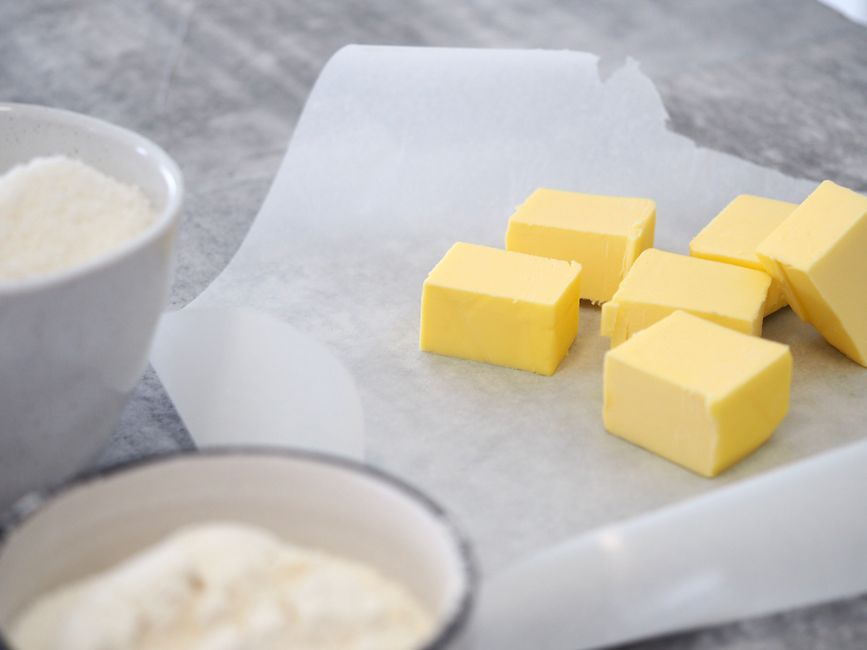
The wrapper legally decides the swap. In the United States, both butter and standard stick margarine must contain at least 80% fat by law[1]. Butter’s 80% is milkfat, suspended in a natural water-in-oil emulsion with roughly 16% water and 2–4% milk solids. Margarine’s 80% is manufactured from refined vegetable oils — often palm, soybean, canola, or blends — whipped with water, emulsifiers, salt, and sometimes cultured milk ingredients into a fat that mimics the texture of butter.
That single legal threshold explains why butter and stick margarine perform so similarly in a mixing bowl. It also sets up the real distinction: one contains milk solids and the other does not. Margarine has none of the lactose, whey, or casein that butter carries, and those milk solids do more work in the oven than their tiny percentage suggests.
Take a simple sugar cookie. Butter and a good stick margarine both cream nicely with sugar; both release steam in the oven; both set into a crisp-chewy matrix. The butter version, however, develops toasted, almost hazelnut-like notes along its rim because the lactose and proteins in butterfat brown in the oven’s heat. Margarine cookies bake to a drier golden tone and rely entirely on wheat flour and sugar for their color — which is why they often look paler around the edges even at the same internal temperature.
The 30-second comparison grid
Flavor profile: rich, creamy, mildly sweet; nutty once browned
Fat & water: 80% milkfat minimum; about 16% water
Best in: pie dough, croissants, shortbread, buttercream, sugar cookies
Substitution: reference fat; 80%-fat margarine may replace it 1:1 by weight
Flavor profile: neutral to mildly oily; flavoring usually added
Fat & water: 80% vegetable fat minimum; about 16% water
Best in: dairy-free cakes, sandwich bread, all-in-one batters
Substitution: use only block-style sticks, never soft tub spreads
Butter in baking: flavor is not a garnish
Butter wins blind tastings in most baked goods because the flavor of a golden crust comes largely from browning — and browning depends on the milk solids margarine lacks. Those solids, mostly milk proteins and lactose, sit in the aqueous phase of the butter. Once a hot pan or oven pushes them past roughly 285°F (140°C), the amino acids and sugars begin rapid Maillard browning, producing the nutty, caramelized, almost toasty character that makes a butter croissant end smell so compelling[2].
Butter’s other structural advantage is its crystallization behavior. Butterfat is naturally composed of many triglyceride fractions, each melting at a slightly different temperature. That broad melting range is why a cold butter cube can be rolled into a croissant laminating block yet still melt elegantly on the tongue. During lamination, solid butter forms continuous sheets between layers of dough; those sheets keep gluten strands separate, and the trapped moisture becomes steam that puffs each layer apart. Margarine simply does not build those same boundaries because its factory-blended oils were formulated to stay uniformly plastic rather than to alternate between brittle and supple.
The creaming stage is equally revealing. When you beat room-temperature butter — ideally between 65°F and 68°F (18°C and 20°C) — with sugar, the fat traps air bubbles that later expand in the oven. Butter that is too cold will not stretch to capture air; butter that is too soft collapses into an oily pool. Within that narrow window, however, nothing beats the combination of flavor and lift it provides in layer cakes and sponge batters.
The short ingredient list is the whole story: cream, possibly salt, and nothing that needs an emulsifier to hold itself together.
Unsalted butter is the baker’s control fat; European-style butters raise the bar further to 82–84% milkfat.
For doughs where taste is the headline — shortbread, sugar cookies, brioche, puff pastry, buttercream — butter is not merely a matter of preference. It is the ingredient that makes the finished bake taste unmistakably buttery. The water content also mattes in the pastry chef’s favor: a slightly higher water content in standard American butter creates a bit more steam in a hot pie oven, contributing to shatter. European-style butters with 82–84% fat supply less water but add richness and produce firmer laminating layers. Most test bakers treat either as superior to margarine whenever dairy is acceptable.
Margarine in baking: engineered to perform, built not to taste
Stick margarine behaves more like butter in a mixer than most cooks expect, because the legal definition of margarine requires the same 80% fat density as butter[1]. When exactly 80% of its weight is fat and roughly 16% is water, a margarine block creams, melts, and hydrates a batter in a way that is remarkably close to dairy butter. Cakes and quick breads made with stick margarine can come out tender, evenly crumbed, and nearly indistinguishable from butter versions in side-by-side tasting — until tasters search for the buttery finish that simply is not there.
Margarine is a manufactured emulsion, not a harvested one. Refined oils are blended with saturated fat fractions so the final product has a spreadable-but-not-runny hardness, then water and salt are dispersed through it with lecithin and mono- and diglycerides. Those same emulsifiers give margarine a quiet advantage in cake baking: they help distribute water evenly through the batter and stabilize the air bubbles created during creaming. In neutral applications like white layer cake, vanilla muffins, or milk bread, margarine can produce a fine, tender crumb with less risk of a dense streak than an imperfectly creamed butter.
What margarine cannot manufacture is flavor. Since it contains no milk proteins or lactose, it contributes almost nothing to Maillard browning at the edges of cookies or the top of a loaf. A butter cookie develops concentric rings of golden-brown crispness before it is fully baked; a margarine cookie relies entirely on wheat sugars and added sugar for crust color. The result is usually blonder, less aromatic, and slightly less complex. Margarine also leaves a faint waxy coating on the palate when used in large quantities, because many vegetable-fat blends contain high-melting fractions designed for shelf stability rather than clean mouthfeel.
Plant-based and vegan bakers should understand that the modern “vegan butter stick” category is essentially margarine rebranded. Some formulas now blend almond or oat milk, fungal cultures, and coconut oil to produce a buttery aroma, but the underlying physics remain the same. The fine print matters more than the label: you want a block-style product with roughly 80% fat, not a reduced-fat spread.
Older margarine formulations relied on partially hydrogenated oils to achieve their solid texture. That created trans fats, which prompted many professional bakers to abandon margarine entirely in the 1990s. Modern stick margarines in most markets have moved to fully hydrogenated, interesterified, or blended palm-oil systems, dramatically lowering trans-fat content while keeping a bakeable fat structure.
Why the wrapper decides the bake: fat, water, and salt
The single biggest baking mistake is treating every yellow block in the dairy case as an equal 1:1 swap. Ingredients labeled “spread,” “light butter,” “vegan spread,” or “baking blend” are not legal margarines and often contain only 40–60% fat. That means their water content can climb to 35% or more, producing cookies that spread into thin lace, cakes that stick to the crumb, and pie dough that toughens from excess water activating gluten.
When a recipe was developed using butter, it assumes a precise fat-to-water ratio. Butter’s approximately 16% water performs several functions: it hydrates gluten, dissolves sugar early in baking, and creates steam that aids lift. Stick margarine’s water content is close enough that the two can stand in for each other. But when you cut the fat to 60%, you are not just removing fat — you are adding roughly an extra tablespoon of water per stick. That extra moisture turns a shortbread into something closer to a pancake.
Salt is the second hidden variable. Unsalted butter is the baking standard precisely because it gives the recipe writer full control. Most stick margarines are salted, and the salt level varies noticeably between brands. If you swap salted margarine for unsalted butter in a recipe that already calls for salt, you may oversalt the dough. Conversely, if you use an unsalted plant-based butter stick, check the label for added salt before adjusting a recipe that expects a salted stick.
Before using any fat in a butter-based recipe, read the nutrition panel’s “fat per 100 g” value or the ingredient legend. In the U.S. and most major markets, a true butter or margarine block lists around 80 g of fat per 100 g. If the package shows 60 g or less, return it to the shelf for spreading on toast — not for making pastry.
Cookies, cakes, and crusts: a side-by-side look
Recipes distribute fat differently — creamed, rubbed into flour, melted, or laminated — and each method magnifies a different contrast between butter and margarine. This table is the fastest way to match the fat to the finished texture you want.
| Baking application | Butter behavior | Margarine behavior |
|---|---|---|
| Cookie flavor & color | Milk solids caramelize at the edges; deep golden rims; rich aftertaste | Blonder edges; relies on flour and sugar for color; neutral finish |
| Cookie spread | Moderate spread with crisp exterior and chewy center in classic chip cookies | Similar spread at 80% fat, but often less defined crust contrast |
| Pie & laminated pastry | Discrete fat layers create flaky shards and dramatic lift | More plastic smear; tender, shorter, and less flaky texture |
| Creamed layer cakes | Airy structure, rich flavor, distinct buttery aroma | Fine, uniform crumb; emulsifiers boost lift; flavor is blander |
| Melted-fat batters (brownies, snacking cakes) | Deeper cocoa and vanilla perception; can curdle if butter burns | Melts cleanly and evenly; allows chocolate or citrus to dominate |
| Biscuits & scones | Flaky, layered, with toasted-dairy flavor | Uniformly tender but more cake-like; fewer visible layers |
| Frosting & buttercream | Airy, stable, and melts cleanly on the tongue | Can turn waxy if chilled; floral or vanilla flavors may taste flat |
| Storage behavior | Refrigerate well wrapped 1–3 months; freeze 6–9 months[3] | Refrigerate 4–5 months; freeze well wrapped up to 12 months[3] |
When margarine genuinely earns its place
Butter may be the superior default, but margarine is not a moral failure — it is a tool with three legitimate strengths: dairy-free functionality, temperature tolerance, and neutrality in highly flavored batters. Any baker who needs to serve people avoiding dairy will find a block-style margarine or vegan butter stick indispensable. In cookies and cakes where cocoa, caramel, or citrus is the dominant voice, margarine’s lack of dairy flavor can actually let those ingredients appear brighter.
Margarine also tolerates a wider range of kitchen temperatures. Butter needs a cool pastry kitchen to remain workable during lamination; margarine’s engineered plasticity keeps it steady in a warm summer bakery. For volume production, margarine delivers consistent results batch after batch because its formula does not shift with the cows’ seasonal pasture, whereas butter’s fat hardness and water content can vary slightly across brands and seasons. Commercial bakeries historically used that consistency to their advantage in cake-shop sponge layers and fondant-covered celebration cakes, where the flavor of butter would be hidden anyway.
A final practical point: texture preference is subjective. The “short” quality that margarine gives to pastry — a crumbly, sandy, melt-away bite — is exactly what some bakers want in a classic tart shell or Mexican wedding cookie. For those recipes, butter creates more flake than crumble, while margarine or vegetable shortening yields the delicate short texture that the name promises. If your goal is literally shortbread in the British sense, the butter should stay; if you are making a sandy, powdered-sugar-coated confection, a high-fat plant block can be the right choice.
Look for a “buttery stick” or “plant-based baking stick” that contains about 80% fat and comes in a paper-wrapped block, not a plastic tub. Chill it before making pie dough, let it soften only to about 65°F for creaming, and weigh the amount instead of relying on a volume measurement. These steps solve most of the texture complaints people blame on margarine.
The practical butter-to-margarine swap chart
When substituting, weigh the fat rather than measuring it in cups. A “stick” of American butter weighs 113 g, and most margarine sticks are intentionally made to the same weight so home bakers can swap them without math. The following ratios cover the situations that actually arise.
| Recipe calls for | Best swap | Bakery note |
|---|---|---|
| 100 g unsalted butter | 100 g stick margarine (80% fat) | Reduce added salt slightly unless margarine is labeled unsalted |
| 113 g butter (1 stick) | 1 block-style vegan butter stick (80% fat) | Choose one with no strong coconut aroma for neutral bakes |
| European-style butter (82–84% fat) | Margarine is not equivalent | The lower water content of European butter changes dough; use dairy butter for croissants and puff pastry |
| 60% tub spread | Not recommended for any baked recipe | Extra water causes excess spread, dense crumbs, and gummy layers |
| Melted butter in brownies | 80%-fat margarine can work 1:1 | Brownies will be less aromatic; add a pinch of cultured flavor or a drop of vanilla if dairy-free |
Bake with butter whenever you want to taste the fat. That includes shortbread, sugar cookies, buttercream, brioche, croissants, pie dough with visible flakes, and any recipe where the words “buttery” and “golden” appear in the headnote. Butter’s milk solids are irreplaceable at the browning stage.
Reach for an 80%-fat block margarine or plant-based stick only when dairy is off the table or when you specifically want a short, crumbly, neutral-textured bake. Use it by weight, keep it properly chilled for pastry work, and adjust the salt before you commit. And treat low-fat spreadable tubs as a breakfast condiment only — they have no legitimate job inside an oven.
Bakers’ FAQ
Can I swap margarine for butter 1:1 in cookies?
Yes, if the margarine is a block-style product with 80% fat. Weigh both fats to keep the ratio exact, and be prepared for slightly paler cookie edges and a less toasted aroma. The dough will usually spread and bake similarly to a butter version because the fat and water balance is so close. Do not swap in a reduced-fat spread.
Why did my margarine cookies spread more than my butter cookies?
The most likely culprit is the wrapper, not the margarine itself. Soft-tub spreads with 60% fat introduce extra water into the dough, which creates more steam and a thinner batter. If you used an authentic 80% stick, check creaming time and dough temperature — over-creamed or overly warm margarine can also lose structure, just like butter.
Which gives a flakier pie crust, butter or margarine?
Butter, decisively. Flakiness in pie dough depends on keeping discrete layers of solid fat intact between sheets of dough. Butter can be cut into flour in cold chunks and flattened into defined shards; margarine’s plastic consistency tends to coat the flour more evenly, producing a tender, short crumb rather than dramatic shattering layers.
Do I need to chill margarine before making biscuits or scones?
Yes. Although margarine is formulated to be plastic at room temperature, it still needs to be very cold during biscuit-making to prevent completely smearing into the flour. Chill the margarine cubes for 20 minutes before cutting them in, then return the shaped dough to the refrigerator before baking for the lightest layers.
Is European-style butter worth the price in baking?
For laminated doughs, pie pastry, shortbread, and buttercream, yes. European-style butters and several American cultured butters sit around 82–84% milkfat, which means less water and more flavor per gram. In everyday cakes and cookies, the difference is subtle; use your standard unsalted butter unless the recipe specifically calls for high-fat butter.
What is the best dairy-free replacement for butter in pastry?
Look for a firm, paper-wrapped plant-based baking block with approximately 80% fat. Palm-and-canola blends tend to produce the most butter-like flake, while all-coconut sticks stay brittle when cold and soften too quickly on a warm counter. Work quickly, chill the block before grating or cutting, and use exactly the same weight as the butter the recipe asks for.
- Both butter and legal stick margarine contain at least 80% fat and about 15–17% water, which is why an 80%-fat block can replace butter roughly 1:1 by weight in cakes and cookies.
- Butter carries milk solids that drive Maillard browning and toasted dairy flavor; margarine has none, so its bakes generally look blonder and taste less complex.
- For flaky pie crust, croissants, puff pastry, and shortbread, butter is the stronger choice because its crystalline structure creates distinct layers that plastic margarine cannot replicate.
- Soft-tub spreads and reduced-fat “baking” products usually contain only 40–60% fat; their surplus water makes cookies spread excessively and produces dense or gummy interior crumb.
- Dairy-free bakers should choose an 80%-fat block-style vegan butter stick, not a spreadable tub, and should chill it as carefully as dairy butter before rolling.
- U.S. Food and Drug Administration, Code of Federal Regulations: federal standards of identity for butter and oleomargarine/margarine (minimum 80% fat requirement), current edition.
- McGee, Harold. On Food and Cooking: The Science and Lore of the Kitchen, revised ed. Scribner, 2004 — sections on heat-driven browning and flavor chemistry.
- U.S. Department of Agriculture, Food Safety and Inspection Service (FSIS), FoodKeeper storage guidance for butter and margarine refrigeration and freezer holding times.