A pound of ground beef and a pot of rice is the fastest route to a real, sit-down dinner. Here are six tested weeknight builds — from a 15-minute gochujang bowl to a 35-minute Lebanese spiced pilaf — plus the ratio that lets you invent your own.
Brown 1 lb of ground beef in a hot skillet, build a sauce or spice base around it, and serve it over 3 cups of cooked rice. That single move covers Korean gochujang bowls (15 min), one-skillet Tex-Mex rice (30 min), gyudon-style simmered beef (20 min), Lebanese hashweh (35 min), stroganoff over rice (25 min), and a 10-minute leftover remix. Cook ground beef to 160 °F and refrigerate leftovers within 2 hours.
The 2:1:1 Formula Behind Every Beef-and-Rice Dinner
Every rice-and-ground-beef dish on earth — Korean bulgogi bowls, Filipino giniling, Cuban picadillo, Indian keema, Lebanese hashweh, Japanese gyudon — is a variation on the same three-part structure. Once you see it, you stop needing recipes.
The formula is: 3 cups cooked rice + 1 lb browned ground beef + 1 cup of a flavor base (a sauce, a spice-and-tomato mixture, or a simmering broth). That yields four generous portions. Everything else — vegetables, cheese, herbs, a fried egg — is a topping decision, not a structural one.
Why 80/20 chuck is the right grind here
Ground beef labeled 80/20 (80% lean, 20% fat) gives you roughly 1 to 2 tablespoons of rendered fat per pound after browning. That fat is what carries spice bloom and keeps the meat from turning to gravel. Choose 90/10 and you will need to add a tablespoon of oil before the aromatics go in. Choose 70/30 and you will want to drain all but a tablespoon before building the sauce.
The sear rule that makes or breaks the dish
Ground beef browns by the Maillard reaction, and that reaction needs a dry, hot surface. Press the meat into a single layer in a preheated 12-inch skillet and leave it alone for a full 2 minutes before you break it up. Most weeknight beef tastes flat because it was stirred from the first second, which drops the pan temperature and steams the meat instead of searing it.
“A ground beef dinner is really two decisions: how hard you sear the meat, and how much acid you finish it with. Rice handles everything in between.”
— WorldDishly Test Kitchen
Ground meat over rice appears independently across food cultures for the same practical reasons: rice is cheap, shelf-stable, and neutral enough to carry strong seasoning, while ground meat cooks in under ten minutes. In Japan, gyudon simmered in soy and mirin became a fast-food staple; in Lebanon, hashweh transforms the same pair into a celebratory pilaf studded with toasted nuts; in the American Southwest, chili-spiced beef and rice converges into a one-skillet casserole.
The lesson for a Tuesday night: you are not improvising. You are choosing which tradition to borrow from.
Six Dinners You Can Make Tonight
Each recipe below serves 4, assumes you already have 3 cups of cooked rice on hand (about 1 cup dry long-grain rice, cooked), and uses one skillet or one pot.
1. Korean Gochujang Beef Rice Bowls — 15 Minutes
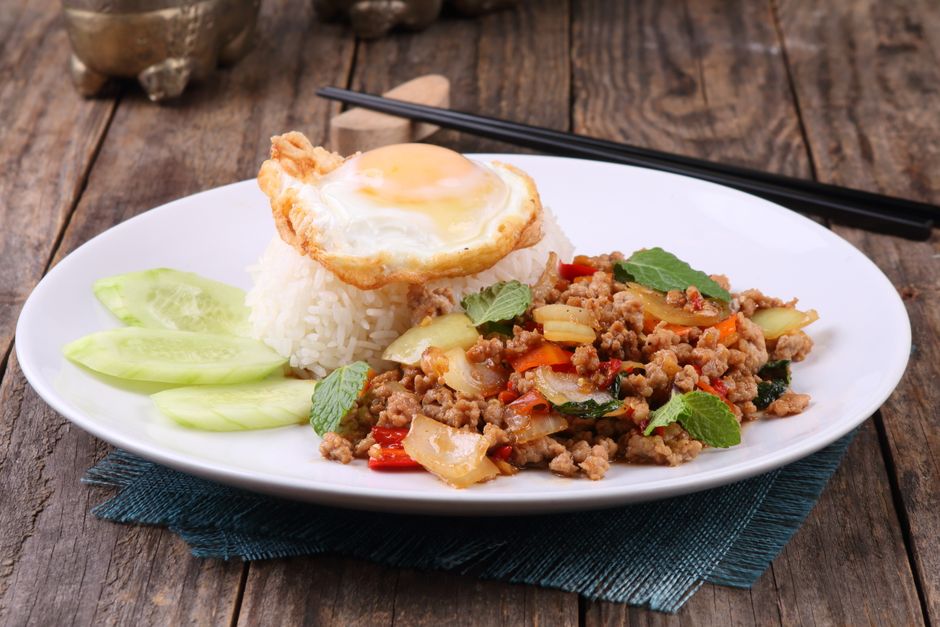
You need: 1 lb ground beef (80/20) · 3 tbsp gochujang · 2 tbsp soy sauce · 1 tbsp honey or brown sugar · 1 tsp toasted sesame oil · 4 garlic cloves, grated · 1 tbsp grated fresh ginger · 3 cups hot cooked short- or medium-grain rice · 4 fried eggs · cucumber matchsticks, sliced scallions, sesame seeds.
2. One-Skillet Tex-Mex Beef and Rice — 30 Minutes
You need: 1 lb ground beef · 1 yellow onion, diced · 1 tbsp chili powder · 1 tsp ground cumin · 1 tsp smoked paprika · 1 cup long-grain rice, rinsed · 1 can (14.5 oz) diced tomatoes with their juice · 1½ cups beef broth · 1 cup frozen corn · 1 cup shredded Monterey Jack or cheddar · salt, lime, cilantro.
3. Gyudon-Style Simmered Beef Over Rice — 20 Minutes
You need: 1 lb ground beef · 1 large onion, sliced thin · ½ cup dashi or water · 3 tbsp soy sauce · 2 tbsp mirin · 1 tbsp sake (optional) · 1 tbsp sugar · 3 cups hot cooked short-grain rice · pickled ginger · 2 soft-cooked eggs.
Traditional gyudon uses paper-thin shaved ribeye. Ground beef gives a looser, more rustic texture, but it also simmers in 5 minutes instead of 12 — which is why this version lands at 20 minutes total.
4. Lebanese-Style Hashweh: Spiced Beef and Rice Pilaf — 35 Minutes
You need: 1 lb ground beef or lamb · 1 onion, finely diced · 2 tbsp ghee or butter · 1½ cups long-grain or basmati rice, rinsed · 2½ cups hot chicken or beef stock · 1 tsp ground allspice · ½ tsp ground cinnamon · ¼ tsp ground cloves · ¼ tsp grated nutmeg · ⅓ cup toasted pine nuts or slivered almonds · salt and black pepper.
5. Weeknight Stroganoff Beef and Rice — 25 Minutes
You need: 1 lb ground beef · 8 oz cremini mushrooms, sliced · 1 onion, diced · 2 tbsp butter · 1 tbsp all-purpose flour · 1 cup beef broth · 1 tbsp Dijon mustard · ½ tsp sweet paprika · ½ cup sour cream, at room temperature · 3 cups cooked rice · chopped dill or parsley.
Got cold rice and leftover cooked beef? Heat 1 tbsp oil in a skillet until it shimmers, add the rice in one flat layer, and press it down for 3 minutes without touching it — you are building a crisp bottom layer. Fold in the beef, push everything to the side, scramble 2 eggs in the empty space, then combine and finish with soy sauce, sesame oil, and scallions. This is the only dish in the guide that is better with day-old rice than fresh.
Choosing and Cooking the Right Rice
The grain you pick changes the architecture of the dish more than the beef does. Short-grain rice clumps and holds sauce on top of a bowl; long-grain rice stays separate and works inside a pilaf or skillet.
Jasmine, basmati, Texmati. Cooks up separate and fluffy, absorbs sauce without turning to paste. Best for Tex-Mex skillets, hashweh, and any dish where you stir the rice into the meat. Basmati benefits from a 15-minute soak before cooking.
Sushi rice, calrose, arborio. Higher amylopectin starch means stickier, clingier grains — exactly what you want under a gochujang bowl or gyudon, where the rice is a sauce delivery system.
Cooking rice is a starch gelatinization process: grains absorb water, swell, and their starch granules rupture and soften[3]. The practical consequence is that the rest period matters as much as the cook time — 10 minutes off the heat with the lid on lets the remaining moisture redistribute evenly from the center of each grain to the surface.
Ratios, Times, and Temperatures at a Glance
| Dinner | Vessel | Total time | Liquid per 1 cup rice | Critical temp |
|---|---|---|---|---|
| Gochujang beef bowls | 12-inch skillet | 15 min | Use pre-cooked rice | Beef 160 °F |
| Tex-Mex beef and rice | 12-inch deep skillet | 30 min | 1½ cups broth + 14.5 oz tomatoes | Beef 160 °F; simmer 200 °F |
| Gyudon-style beef | Wide skillet + small pan | 20 min | Use pre-cooked rice | Beef 160 °F |
| Hashweh pilaf | Heavy pot with lid | 35 min | 1⅔ cups stock (for 1½ cups rice) | Beef 160 °F |
| Stroganoff over rice | 12-inch skillet | 25 min | Use pre-cooked rice | Beef 160 °F |
| Crispy leftover remix | Cast-iron skillet | 10 min | Use cold cooked rice | Reheat to 165 °F |
| Rice type | Water (per 1 cup dry) | Simmer time | Rest time |
|---|---|---|---|
| Long-grain white | 1½ cups | 18 min | 10 min |
| Jasmine | 1¼–1½ cups | 15 min | 10 min |
| Basmati (soaked 15 min) | 1½ cups | 12–15 min | 10 min |
| Short / medium grain | 1¼ cups | 15 min | 10 min |
| Parboiled / converted | 2 cups | 20–25 min | 5 min |
| Brown rice | 2 cups | 40–45 min | 10 min |
Ground beef must reach a minimum internal temperature of 160 °F (71 °C) before it is safe to eat — this applies to crumbles, patties, and any skillet dish where the meat is broken up[1]. Use an instant-read thermometer in the thickest part of the mass, not the edge of the pan.
Common Mistakes and How to Fix Them
Pairing, Storage, and Reheating
Ground beef is fatty and rice is mild, so the balancing act is always the same: something acidic, something crunchy, something fresh. A squeeze of lime, a spoonful of vinegar-based hot sauce, quick-pickled onions, cucumber matchsticks, or a handful of herbs does more for these dinners than any additional spice.
Refrigerating
Cool leftovers in shallow containers — a deep pot of rice can take hours to drop below 40 °F, which keeps it in the danger zone[5]. Spread the mixture into a wide container or divide it into individual portions. Refrigerated cooked beef and rice keep 3 to 4 days[2].
Freezing
Freeze combined beef-and-rice dishes in airtight portions for up to 3 to 4 months at 0 °F or below[4]. Rice freezes better than most people expect — freeze it while still slightly moist, and it reheats without turning to grit.
Reheating
Reheat leftovers to 165 °F throughout[5]. In a skillet, add a splash of water and cover for 5 minutes over medium heat — this steams the rice back to life without drying the beef. In the microwave, cover and heat in 60-second bursts, stirring between each.
Cooked rice is more perishable than it looks. Spores of Bacillus cereus survive cooking, and rice left at room temperature for extended periods can support bacterial growth[2]. The two-hour rule applies here as strictly as it does to the meat.
FAQ
How much ground beef per person should I plan?
Plan 4 oz of raw ground beef per person for a rice-based dinner. With 1 lb of beef and 3 cups of cooked rice plus vegetables or a fried egg, you get four generous portions. Feeding six? Use 1½ lb beef and 1½ cups dry rice.
Can I use leftover rice instead of cooking fresh?
Yes, and it is often better. Day-old rice has drier, firmer grains that hold their shape when folded into a skillet dish or crisped in oil. Use rice refrigerated within the last 1 to 2 days and reheat it to 165 °F[5]. Freshly cooked, still-steaming rice will turn mushy in a skillet.
What if I only have 90/10 or 93/7 ground beef?
Add 1 tablespoon of neutral oil or butter to the pan before the beef goes in. Leaner grinds have less fat to carry spice bloom and to keep the crumbles tender, so they also benefit from a shorter cook time — pull them off the heat as soon as they hit 160 °F[1].
Can I swap in ground turkey or chicken?
Yes, one-for-one by weight. Ground turkey is leaner and milder, so increase the salt slightly and add an extra teaspoon of oil at the start. The 160 °F target still applies to poultry[1].
My rice came out sticky and clumpy. What went wrong?
Three usual suspects: you did not rinse the rice, you stirred it during the simmer, or you used too much water. Rinse until the water runs mostly clear, stir only once when the liquid goes in, and measure — 1 cup of long-grain rice takes 1½ cups of water, not two[3]. If you are cooking rice directly in a skillet sauce, remember that any tomato, stock, or wine counts toward that total.
Can I make any of these dairy-free or gluten-free?
Gochujang bowls, gyudon, and hashweh are naturally dairy-free. For gluten-free versions, replace soy sauce with tamari and check that your gochujang is labeled gluten-free. The stroganoff is the only recipe in the guide that depends on dairy, and coconut cream substitutes reasonably well for the sour cream if you add it off the heat.
Can I assemble these ahead of time?
Yes. Brown the beef and build the sauce up to 3 days ahead, refrigerate in a covered container, and reheat to 165 °F while you cook fresh rice[5]. Hold back any cheese, sour cream, nuts, or herbs until serving — they do not survive reheating.
- The core ratio is 3 cups cooked rice + 1 lb browned ground beef + 1 cup flavor base, serving four.
- Sear the beef undisturbed for 2 full minutes in a 12-inch skillet before breaking it up.
- Ground beef must reach 160 °F; leftovers must be refrigerated within 2 hours and reheated to 165 °F.
- Use short-grain rice for saucy bowls and long-grain for skillets and pilafs; rinse long-grain until the water runs clear.
- When rice cooks in the sauce, the tomatoes and broth together replace the water — 1 cup of rice takes 1½ cups of total liquid plus a 14.5 oz can of tomatoes.
- Acid and crunch at the end (lime, pickles, cucumber, herbs) do more for these dinners than extra spice.
- USDA Food Safety and Inspection Service. “Ground Beef and Food Safety.” fsis.usda.gov
- FoodSafety.gov (USDA). “Leftovers and Food Safety.” foodsafety.gov
- McGee, Harold. On Food and Cooking: The Science and Lore of the Kitchen. Scribner — chapters on rice, starch gelatinization, and the Maillard reaction.
- U.S. Food and Drug Administration. “Refrigerator & Freezer Storage Chart.” fda.gov
- USDA Food Safety and Inspection Service. “Danger Zone (40 °F–140 °F)” and leftover reheating guidance. fsis.usda.gov