It took 40 years for pizza to leave the immigrant neighborhoods where it landed, and only 15 more for it to become the most-eaten restaurant food in the country. Here is how a Neapolitan street snack was rewritten — oven by oven, city by city — into an American cuisine family of its own.
Pizza arrived in the United States with Southern Italian immigrants between 1880 and 1920 and stayed inside Italian neighborhoods for decades, sold from grocery storefronts for a nickel a slice. Gennaro Lombardi’s 1905 New York City mercantile license is the document most historians treat as the birth certificate of the American pizzeria. The real turning point was World War II: soldiers who ate pizza in Naples came home in 1945 wanting it, and by 1954 the first franchise chain (Shakey’s) was selling it nationally. Deep dish (Chicago, 1943), Detroit-style (1946), and the frozen pizza (1957) all followed within 14 years. Today pizza is a distinctly American regional cuisine with at least a dozen documented dialects — New York, New Haven, Trenton, Old Forge, Chicago tavern, Detroit, St. Louis, Quad Cities and more.
- The Naples That America Actually Imported
- 1890s–1920s: Slices Sold From Grocery Storefronts
- 1930s–1940s: The Regional Styles Take Shape
- 1943–1955: GIs Come Home Craving Pizza
- 1954–1990: Franchise Empires and the Delivery Wars
- 1990–2010: The Neapolitan Revival and the Transparency Reset
- 2010–2026: Detroit, Taglio, and the Third Wave
- Why American Pizza Tastes American
- The American Pizza Family Tree
- Frequently Asked Questions
The Naples That America Actually Imported
Pizza did not cross the Atlantic as a product. It crossed as a habit — a way of eating that poor families carried in their hands and their memories, wrapped in paper and sold from a window.
By the early 19th century, Naples had something no other city had: a commercial pizza industry. Open-air stands and low-ceilinged pizzerie around the port baked flat dough rounds in wood-fired domed ovens and sold them to laborers — the lazzaroni — who needed calories they could eat standing up with one hand. Antica Pizzeria Port’Alba began as a stand in 1738 and became a seated restaurant around 1830; it still operates today.
The tomato, meanwhile, had already been in Europe for three centuries. Spanish colonizers brought it from the Americas in the 1500s, and Europeans initially treated it as an ornamental nightshade rather than food. It took a poor, hungry port city to ignore that caution and put crushed tomatoes on flatbread — creating, around the late 1700s, the thing we now call pizza.
Between 1880 and 1920, roughly four million Italians immigrated to the United States, and the overwhelming majority came from the impoverished south — Campania, Sicily, Calabria, Basilicata, Puglia. Campania is Naples. When those families settled, they brought the food of the port with them, along with the trades: baker, macaroni maker, grocer, pushcart vendor.[7]
Immigrant communities condensed into a handful of blocks: Mulberry Street and Italian Harlem in New York, the North End in Boston, Federal Hill in Providence, Wooster Square in New Haven, Taylor Street in Chicago, the Italian Market in Philadelphia, Chambersburg in Trenton, and the mill towns of Pennsylvania and upstate New York.
1890s–1920s: Slices Sold From Grocery Storefronts
The first American pizzas were not sold in pizzerias. They were a sideline — a way for an Italian grocer to use leftover bread dough and feed his own neighborhood.
By 1930, pizza was still a curiosity to most Americans. Newspapers described it in scare quotes as “pizza pie” or “Italian cheese pie,” and outside the Northeast you might go your whole life without encountering one.
1930s–1940s: The Regional Styles Take Shape
This is the most underrated decade in American pizza history. Once pizzerias multiplied inside immigrant enclaves, each one began adapting the formula to what was locally available: a different oven, a different cheese, a different tomato, a different customer.
New Haven: “Apizza” and the White Clam Pie
In New Haven, the dialect word apizza (from the Neapolitan la pizza) described a pie that was thinner, chewier, and cooked harder than anything in Manhattan — often served with grated pecorino rather than mozzarella. Sally’s Apizza opened in 1938, two doors from Pepe’s. Frank Pepe’s white clam pie, made with freshly shucked littleneck clams, olive oil, garlic, and oregano and no tomato at all, became the most imitated regional pizza in America.
Trenton and the Pennsylvania Coal Country
Trenton’s tomato pies were round, thin, and lightly cheesed, cut into a crosshatch of small squares. Old Forge, a tiny Lackawanna County town, developed its own tray-baked square pie — and by mid-century it had accumulated so many pizzerias for its population that it began calling itself the “Pizza Capital of the World.” The style spread through the anthracite towns of Pennsylvania to Utica, New York, where the “tomato pie” was thick, cheeseless, and eaten at room temperature.
Chicago: Tavern Style First, Deep Dish Second
Chicago’s thin, crunchy, square-cut “tavern style” — sometimes called South Side or party cut — came out of the city’s working taverns in the 1940s and 1950s. The logic was economic and social: a thin, cracker-like pie cut into small squares was cheap, shareable, and didn’t fill you up, so it encouraged another round of drinks. Vito & Nick’s, Pat’s, and Marie’s are its enduring examples.
Deep dish is a different animal and a later one. Uno’s, on Wabash Avenue, began serving it in 1943 under founders Ike Sewell and Ric Riccardo. Food historian Peter Regas’s archival research has since argued that the deep-dish form was likely developed in that kitchen by chef Rudy Malnati Sr., with the ownership taking the credit — a reminder that pizza history is usually written by whoever owned the sign.[5]
“Deep dish is not older pizza. It is a pie invented in the 1940s by a restaurant that wanted a dinner, not a snack.”
— The structural difference that made Chicago famous
Detroit: 1946 and the Blue Steel Pan
In 1946, Gus Guerra at Buddy’s Rendezvous on Conant Street started baking rectangular pies in heavy blue steel industrial pans — the kind used to hold auto parts on factory floors. The result: cheese pushed all the way to the pan edge, where it fried into a caramelized rim, with sauce ladled on top of the cheese rather than beneath it. Pepperoni went under the cheese, too. It was a genuinely new pizza, and for decades it stayed mostly a Michigan secret.[8]
New Jersey and Philadelphia: The Bar Pie
Along the Jersey Turnpike corridor, taverns served thin, well-done, 12-inch “bar pies” — blistered, oily, and cut into squares or tiny wedges so they could be eaten with one hand while the other held a beer. Star Tavern in Orange (1945) and Santillo’s in Elizabeth are the canonical reference points.
1943–1955: GIs Come Home Craving Pizza
World War II is the hinge on which American pizza history turns. In October 1943, Allied forces took Naples. For the next 20 months, hundreds of thousands of American soldiers cycled through the city and encountered pizza as street food — cheap, fast, and strange — at pizzerias that had somehow kept their ovens lit through occupation.
They came home and asked for it. Veterans from Chicago, Kansas City, Denver, and Cincinnati walked into Italian bakeries and asked whether anyone made “that pizza.” Between 1945 and 1950, American pizzerias went from a regional curiosity to a national business category. Around 1947, “pizza” began appearing in general American dictionaries — less than a generation after it was an unfamiliar foreign word.
Popular culture finished the job. Dean Martin’s 1953 hit “That’s Amore” put the line “When the moon hits your eye like a big pizza pie” into every jukebox in the country. Through the mid-1950s, women’s magazines and community cookbooks ran pizza-party spreads, and Chef Boyardee’s pizza mix in a box let any home cook make a version at home from shelf-stable ingredients.
Pizza Americanized itself fastest in the places farthest from Naples. With no fresh mozzarella, no wood oven, and no Italian neighborhood to defend tradition, new pizzerias substituted what they had — low-moisture mozzarella, dried oregano, canned tomato sauce, and gas deck ovens. Those substitutions became the American standard.
1954–1990: Franchise Empires and the Delivery Wars
Once pizza was no longer an ethnic food, it became a logistics business. The next four decades were about scale, speed, and reach.
By the end of the 1980s, pizza was the biggest single category in American restaurant franchising. The chain era didn’t erase regional pizza — it simply made sure that a traveler from New Haven could find a reasonable facsimile anywhere in the country, and that a pizza from a strip mall could be delivered in 30 minutes or less.
1990–2010: The Neapolitan Revival and the Transparency Reset
Two things happened in parallel: a small group of American bakers went back to the source, and the largest chain in the country publicly admitted its pizza wasn’t good.
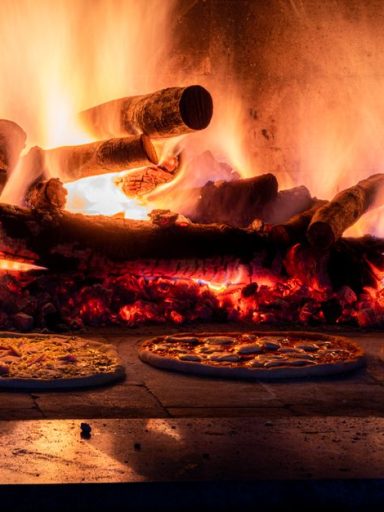
The Associazione Verace Pizza Napoletana (AVPN) was founded in Naples in 1984 to codify and protect the true Neapolitan method — specific flours, a 24-hour-plus fermentation, San Marzano tomatoes, and a 60–90 second bake at roughly 850–900°F.[2] In 1998, Antica Pizzeria in Marina del Rey, California, became the first American pizzeria to earn AVPN certification. Anthony Mangieri’s Una Pizza Napoletana opened on Staten Island in 1996 and became the obsessive American benchmark for the style.
Meanwhile the incumbent chains hit a credibility wall. In 2009, Domino’s ran the “Pizza Turnaround” campaign, in which its own executives read customer reviews on camera calling the crust “cardboard” and the sauce “ketchup,” then publicly reformulated the recipe. The strategy is still taught in business schools as one of the most effective brand resets of the decade.
New York’s remaining coal-fired pizzerias — on the order of a hundred, baking at 800–1,000°F in hand-built ovens that predate zoning law — became protected heritage rather than regulatory targets. They are the physical link between the 1905 storefront and the modern slice shop, and no gas oven has ever fully replicated their heat profile.
2010–2026: Detroit, Taglio, and the Third Wave
The current chapter of American pizza history is the most self-aware one. Americans now argue about pizza the way they argue about wine.
The clearest shift has been the national rise of Detroit-style. For 60 years it was a Michigan regional, sold by Buddy’s, Jets (founded 1978 in Sterling Heights), and a handful of others. Then Via 313 opened in Austin in 2011, Emmy Squared opened in Brooklyn in 2016, and by the early 2020s the caramelized cheese-edge square was on menus in Portland, Nashville, and London. A 1946 factory-town invention had become a national style in under a decade.
Alongside it: Roman-style al taglio and pizza alla pala shops; the “grandma pie” (a thin, rectangular, Long Island and Brooklyn style with sauce over cheese and heavy garlic); a tavern-style revival driven by Chicago exiles; and a renewed interest in the American square, from Sicilian sheet pies to Ohio Valley cold-cheese pizza, where shredded cheese is piled on a hot slice after it leaves the oven.
In 2017, UNESCO inscribed the art of the Neapolitan pizzaiuolo on its Representative List of the Intangible Cultural Heritage of Humanity — the first time the craft of pizza making received that level of international recognition.[3] American pizza makers, including certified AVPN pizzaioli in New York, Los Angeles, and Phoenix, are part of the tradition now, not just imitators of it.
Why American Pizza Tastes American
American pizza isn’t an inferior copy of Neapolitan pizza. It’s a different engineering solution to the same problem, built around a cooler oven and a longer bake. Three substitutions did most of the work.
1. Low-Moisture Mozzarella
Fresh mozzarella is about 60% water. On a 90-second Neapolitan bake there’s no time for that water to cause trouble. On an American deck oven running 500–550°F for 10–14 minutes, it would flood the crust. So the American industry adopted low-moisture mozzarella — shreddable, brownable, and legally defined by the FDA as containing more than 45% but not more than 52% moisture, with the part-skim version holding milkfat between 30% and 45% of solids.[1] It’s a cheese engineered for the bake time.
2. Sugar and Oil in the Dough
Traditional Neapolitan dough is flour, water, salt, and yeast — nothing else. American pizza dough typically includes 1–3% sugar and 2–4% oil by flour weight. The sugar matters because a longer, cooler bake dries the crust surface; without a little reducing sugar available, the crust won’t brown properly. The fat coats gluten proteins and limits their cross-linking, producing a softer, more foldable crumb. Take away sugar and oil and an American slice becomes pale, tough, and brittle.
3. Cooked, Seasoned Sauce
Naples uses raw crushed tomatoes, salted. Most American pizzerias cook the sauce down with oregano, garlic, basil, and often a pinch of sugar. It’s thicker — which protects a wet, long-baked crust — and sweeter, which balances the saltier low-moisture cheese.
4. Pepperoni, an American Invention
Pepperoni is not a traditional Italian salume; it’s an American dry-fermented, smoked sausage built for the pizza oven. When sliced from a narrow natural casing, the disc contracts and the fat renders inward, forming the characteristic “cup” that pools orange fat. It’s the single most ordered topping in the country, appearing on roughly a third of all pizzas sold.[9]
New York’s municipal water does carry a distinctive mineral profile — calcium and magnesium in particular — and those ions do affect gluten development and dough extensibility. But dozens of New York pizzerias use filtered or reverse-osmosis water, several out-of-state pizzaioli replicate the profile with mineral salts, and blind tastings haven’t confirmed a detectable signature. Water is a real variable. It is not the reason a New York slice tastes like a New York slice. Fermentation time, oven type, and cheese choice do far more work.
| Variable | Neapolitan Standard | American Slice-Shop Standard |
|---|---|---|
| Oven temperature | 850–900°F, wood-fired | 500–550°F, gas deck or coal |
| Bake time | 60–90 seconds[2] | 8–14 minutes |
| Dough hydration | About 55–62% | About 58–65%, plus oil and sugar |
| Cheese | Fresh mozzarella or fior di latte | Low-moisture mozzarella, 45–52% moisture[1] |
| Sauce | Raw crushed tomato, salted | Cooked, seasoned, often sweetened |
| Diameter | 10–12 inches | 14–18 inches |
| Structure | Soft, wet center; eaten with knife and fork | Firm enough to fold and eat one-handed |
The American Pizza Family Tree
Few countries have generated this many distinct pizza dialects from a single immigrant template. Roughly in order of birth:
| Style | Birthplace | Era | Defining Feature |
|---|---|---|---|
| New York | Manhattan | 1905 onward | Wide, thin, hand-tossed, coal or gas oven, folded to eat |
| New Haven apizza | New Haven, CT | 1925 onward | Thin, chewy, charred; white clam pie; pecorino over mozzarella |
| Trenton tomato pie | Trenton, NJ | 1910 onward | Round, light cheese, sauce-forward, cut into small squares |
| Old Forge tray | Old Forge, PA | 1920s–30s | Square tray pie, sweet-tangy sauce, heavy on the cheese |
| Chicago tavern style | Chicago, IL | 1940s–50s | Thin, cracker-crisp, party-cut squares, built for taverns |
| Chicago deep dish | Chicago, IL | 1943 | Tall buttery crust, cheese first, chunky tomato on top |
| Detroit | Detroit, MI | 1946 | Blue steel pan, cheese to the edge, sauce on top, pepperoni under cheese |
| St. Louis | St. Louis, MO | 1960s | Cracker-thin crust, Provel processed cheese, square cut |
| Quad Cities | IL/IA border | 1950s | Malt in the dough, fennel in the sauce, cut into strips |
| Bar pie | NJ / PA / NY | 1940s–50s | Small, thin, well-done, oily, tavern-service format |
| Ohio Valley | Steubenville, OH | 1945 onward | Cold shredded cheese added after the bake |
| Rhode Island pizza strips | Providence, RI | Mid-20th c. | Bakery-baked, no cheese, thick sweet tomato topping, served cold |
| Grandma / Sicilian | NY & Long Island | Post-war | Rectangular, thin or thick, sauce over cheese, heavy garlic and oregano |
| California | Los Angeles | 1980–85 | Chef-driven, unconventional toppings, wood-fired or grill-baked |
Every one of these styles was created by an operator solving a local problem: a specific oven, a specific cheese supplier, a specific customer with a specific amount of time and money. That’s the actual history of pizza in America — not a single lineage, but dozens of parallel adaptations that all happen to share a Neapolitan ancestor.
Frequently Asked Questions
Gennaro Lombardi is the standard answer. He opened a grocery at 53½ Spring Street in Manhattan in 1897 and received a New York City mercantile license to sell pizza in 1905 — the earliest surviving documentation of a licensed American pizzeria. Trenton’s Joe’s Tomato Pies (1910) and Papa’s Tomato Pies (1912) are the strongest rival claims outside New York, and some New Haven and Philadelphia bakeries sold pizza earlier without a paper trail.
Three forces converged. Hundreds of thousands of U.S. soldiers passed through Naples between 1943 and 1945 and came home with a taste for pizza. Italian-American neighborhoods had by then spent 40 years building the supply chain — ovens, tomato suppliers, cheese makers, and trained bakers. And the post-war middle class had money, cars, and a new willingness to eat food outside their own ethnic tradition. Popular culture, including Dean Martin’s 1953 “That’s Amore,” supplied the final push.
No. Thin, square-cut tavern-style pizza was already established in Chicago’s working-class bars before deep dish appeared in 1943, and its roots go back further than the deep-dish form. Deep dish is also a restaurant creation — built to be a sit-down meal rather than a snack — whereas tavern style evolved out of bar culture. Both are authentically Chicago; they’re just different generations of the same city.
It’s about how the pie was meant to be eaten. A big, foldable New York slice is a meal-format: you hold it by the crust, fold it, and eat it walking. Chicago tavern-style pies were designed for a group sitting at a bar, sharing from a single tray — small squares let six people take a piece without committing to a whole slice, and they stay crisp longer in a cardboard-lined tray.
Both are baked in rectangular pans and both have a thick, airy crumb. The difference is what happens at the edge and where the toppings go. Detroit-style uses a heavy blue steel automotive-style pan, cheese is pushed against the walls so it fries into a lacy caramelized rim, the sauce is ladled on top of the cheese in stripes rather than underneath it, and pepperoni typically goes beneath the cheese. Sicilian pizza usually has sauce under the cheese and a thicker, more bread-like base.
There’s no single date, but the crossover happened in stages: national availability in the 1950s, chain-level ubiquity in the 1970s and 1980s, and dominance in consumption surveys by the 1990s and 2000s. Today, USDA data indicate that about 1 in 8 Americans eats pizza on any given day[4], and it is consistently ranked the most-ordered restaurant food in the country.
- Pizza entered America with the 1880–1920 wave of Southern Italian immigration, not as a restaurant dish but as a grocery-store sideline sold by the slice.
- Gennaro Lombardi’s 1905 New York City mercantile license is the earliest surviving record of a licensed American pizzeria.
- Pizza stayed regional for four decades; World War II veterans who ate it in Naples drove the national boom after 1945.
- The first franchise chain (Shakey’s, 1954), the first national frozen pizza (Celentano Brothers, 1957), and the first big chains (Pizza Hut 1958, Little Caesars 1959, Domino’s 1960) all arrived within seven years.
- American pizza is a separate engineering tradition: 500–550°F ovens, 1–3% sugar and 2–4% oil in the dough, and low-moisture mozzarella defined by the FDA at 45–52% moisture.[1]
- At least a dozen distinct American regional styles exist today, and the most recent one to go national — Detroit-style — was invented in 1946 and took 60 years to travel.
- U.S. Food and Drug Administration, 21 CFR 133.156 — Low-Moisture Mozzarella and Scamorza Cheese; 21 CFR 133.157 — Low-Moisture Part-Skim Mozzarella and Part-Skim Scamorza Cheese (moisture and milkfat standards of identity).
- Associazione Verace Pizza Napoletana, International Regulation for the Obtaining of the Verace Pizza Napoletana — Avpn (current edition), Naples; founded 1984.
- UNESCO, Art of Neapolitan “Pizzaiuolo”, Representative List of the Intangible Cultural Heritage of Humanity, inscribed 2017.
- USDA Economic Research Service, Amber Waves — analysis of NHANES dietary intake data on pizza consumption in the United States.
- Regas, Peter, The Real History of Chicago Deep-Dish Pizza, peterregas.com (archival research on the origin of the 1943 Uno’s pie).
- McGee, Harold, On Food and Cooking: The Science and Lore of the Kitchen, revised edition (2004) — on Maillard browning, gluten development, and cheese melt behavior.
- Library of Congress, Italian Immigration to the United States, 1880–1920, Immigration and Relocation in U.S. History collection.
- Detroit Historical Society, materials on Buddy’s Rendezvous and the 1946 origin of Detroit-style square pizza.
- USDA Food Safety and Inspection Service, Food Standards and Labeling Policy Book — definitions for dry-fermented sausage products including pepperoni.