Italian & Mediterranean World Cuisines

Italian Dinner Recipes: The Real Multi-Course Tradition

World Cuisines · Italian & Mediterranean

A real Italian dinner does not arrive on one plate. It arrives as a sequence of small acts — a spritz, a folded pasta, a braised meat, a cool spoon of cream. These Italian dinner recipes trace that sequence across four regions and give you the exact ratios, temperatures, and techniques to host the table properly.

By WorldDishly Editorial Team·Updated September 2026·16 min read
Chef’s Quick Summary

An authentic Italian dinner follows a loose but codified choreography: aperitivo, antipasto, primo, secondo with contorno, then dolce and a digestivo. The portions start small, grow only slightly, and never compete for the same space on the plate. The recipes below — an Aperol Spritz from Veneto, bruschetta and cacio e pepe from Lazio, hunter-style chicken from Tuscany, and panna cotta from Piedmont — teach the grammar of that tradition rather than another list of weeknight one-pan meals.

Why the Italian Dinner Is a Ritual, Not a One-Pan Plate

The most common misunderstanding outside Italy is the one-plate model: spaghetti with meatballs on the left, chicken parmesan on the right, garlic bread somewhere in between. That plate is an American invention, born from restaurant menus and immigrant resilience. In Italy, cena (dinner) is structured as a sequence, each course intended to be small, distinct, and gently cumulative. Even a fast weeknight dinner follows the logic: a soup or pasta, then a modest meat or egg course, then fruit — never everything stacked together.

Food Culture Snapshot
The table, not the recipe, is the real Italian artifact

The sequence Italians recognize — aperitivo, antipasto, primo, secondo, contorno, dolce, caffè, digestivo — was not invented in a rustic farmhouse. It was codified for the Italian middle class by Pellegrino Artusi in La Scienza in Cucina e l’Arte di Mangiare Bene, first published in 1891 [3]. Artusi drew on a courtly, French-inspired service and translated it into the domestic Italian kitchen. His organization of recipes — from antipasti through minestre, secondi, contorni, and dolci — gave the new nation a shared culinary vocabulary almost before it had a shared language [2].

What matters today is not that every dinner include six courses. Very few Italian homes serve a complete sequence on a Tuesday. What matters is the architecture: pasta is a course of its own, greens are not dumped onto the meat plate as an afterthought, and dessert, when present, is light enough to leave the table with energy for conversation. The best Italian dinner recipes follow that architecture even when you scale them down to two courses.

Practical consequence: When you plan an Italian dinner at home, treat the meal like a tasting sequence with a theme — not like an American entree with sides. Cook pasta as the main event of its course, keep the second course modest in portion, and let one or two authentic flavors define each plate.

The Four-Region Italian Dinner: A Step-by-Step Menu

Italy is a republic of regions first and a nation second. This menu moves from Venice to Rome, then inland to Tuscany and north to Piedmont. You can prepare the whole meal as a slow Saturday dinner, or pull out any single course as a standalone Italian dinner recipe.

I
Veneto — Aperitivo: The Aperol Spritz

Dinner in northern Italy begins before the table is set. The aperitivo exists to stimulate appetite, not to fill the stomach, and its alcohol is low enough that conversation stays sharp. The benchmark is the Venetian spritz.

The ratio is fixed: 3 parts dry Prosecco, 2 parts Aperol, 1 part chilled sparkling water. Build it over one large ice cube in a balloon glass, add a slice of orange, and stir gently once. Service temperature should be about 6°C (43°F).

Why it works: Bitter Aperol molecules are better perceived against slow effervescence, which is why the drink is built, never shaken. At roughly 8–10% ABV after dilution, it brightens the palate for the olive oil and acid of the first food course.
II
Lazio — Antipasto & Primo: Bruschetta al Pomodoro and Cacio e Pepe

Rome gives this menu its two most important lessons: bread should be toasted over fire, and pasta can be transformed by almost nothing. Both recipes are deceptive — the first because simplicity exposes ingredient quality, the second because an emulsion built from cheese and water is one of the great technical feats of Italian home cooking.

Bruschetta al Pomodoro

For 4 antipasti:

  • 4 thick slices of rustic sourdough or pane casereccio, about 2 cm thick
  • 5 ripe medium tomatoes (Roma or San Marzano, not refrigerated), diced into 1 cm pieces
  • 1 garlic clove, cut in half
  • 45 ml (3 tbsp) extra-virgin olive oil, plus more for brushing
  • 6 fresh basil leaves, torn
  • flaky sea salt

Toss the diced tomatoes with salt and 30 ml (2 tbsp) of oil in a bowl. Let them sit for 15 minutes — the released juice becomes your sauce. Toast the bread on a grill pan, over a charcoal fire, or under a high broiler until charred at the edges but still soft in the center. Rub one side of each warm slice with the cut garlic, brush with olive oil, then spoon the tomatoes over the bread. Add torn basil last. Do not drizzle balsamic vinegar on this and do not assemble it more than five minutes before serving, or the bread turns sodden.

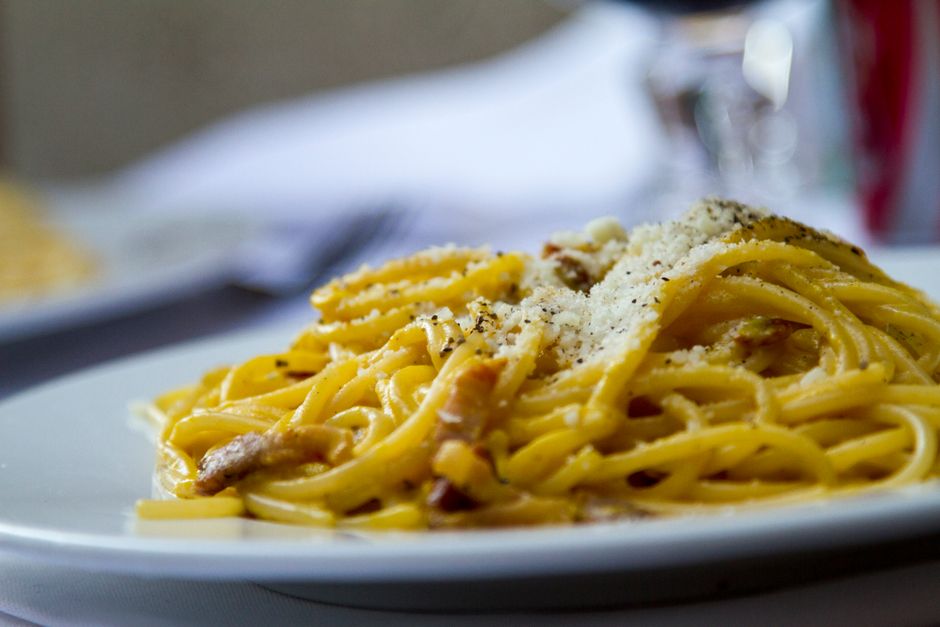
Cacio e Pepe — the Roman Pasta That Tests Your Emulsion Skills

For 2 as a primo course:

  • 200 g tonnarelli or spaghetti (long, rough-cut pasta preferred)
  • 100 g Pecorino Romano DOP, grated on the finest rasp [5]
  • 2 tsp whole black peppercorns, coarsely cracked in a mortar
  • 10–12 g fine sea salt for 2 L of pasta water
  • about 300 ml reserved pasta cooking water

Bring 2 L of water to a full boil, add the salt, and cook the pasta until 1 minute shy of the package’s al dente time. While the pasta cooks, toast the cracked pepper in a dry sauté pan over medium heat for 60–90 seconds until fragrant; transfer to a small dish. Reserve the pasta water, then lift the pasta directly into the sauté pan with tongs.

Working off the heat, add 125 ml of the still-hot pasta water to the pan, then whisk in the Pecorino in three batches, stirring briskly between additions until each handful of cheese melts into a pale, creamy sauce. Add the toasted pepper, return the pan to the very lowest heat, and toss for 30 seconds, loosening with extra pasta water one tablespoon at a time until the sauce coats each strand without pooling. Serve immediately in warm bowls.

The starch science: Pasta water carries soluble amylose, which wraps around the fat droplets in the Pecorino and keeps the sauce from separating into greasy curds. Adding the cheese away from high heat gives the casein proteins time to hydrate rather than shock into clumps [4]. There is no cream, no butter, and no olive oil in the orthodox Roman version.
III
Tuscany — Secondo & Contorno: Pollo alla Cacciatora and Fagioli all’Uccelletto

The second course is where the Italian table becomes generous. Our Tuscan-leaning pollo alla cacciatora — hunter-style chicken — browns hard, then braises softly with wine and tomato. Nothing is floured, battered, or buried under cheese.

Pollo alla Cacciatora

Serves 4:

  • 8 bone-in, skin-on chicken thighs (about 1.6 kg / 3.5 lb)
  • 45 ml (3 tbsp) extra-virgin olive oil, divided
  • 2 medium onions, thinly sliced
  • 2 garlic cloves, smashed
  • 175 ml (¾ cup) dry red wine, ideally Sangiovese
  • 800 g canned whole San Marzano tomatoes, crushed by hand
  • 2 sprigs fresh rosemary
  • fine sea salt and freshly ground black pepper

Pat the chicken completely dry. Season generously with salt and pepper. Heat 2 tbsp of oil in a wide Dutch oven over medium-high heat, then place the thighs skin-side down in a single layer. Leave them untouched for 6–8 minutes until the skin is deep amber and releases easily. Flip and brown the underside for 3 minutes. Remove to a plate. Add the onions with a pinch of salt and cook 6–7 minutes until golden; stir in the garlic and cook 30 seconds. Pour in the wine and scrape the browned bits from the bottom of the pan, letting the wine reduce by half — 4–5 minutes. Add the crushed tomatoes and rosemary, and simmer for 5 minutes. Return the chicken skin-side up, spoon a little sauce over it, and bring to a gentle simmer. Cover, reduce the heat to low, and cook until the meat is fork-tender, 40–50 minutes, until the thickest part reads at least 74°C (165°F) [1]. For silky braised dark meat, the ideal is closer to 85–90°C (185–195°F), which allows connective tissue to melt into gelatin. If the sauce is thin at the end, remove the chicken and simmer it uncovered 5–8 minutes before serving.

Fagioli all’Uccelletto — Sage-Scented Cannellini Beans

A contorno in Tuscany is often a vegetable or legume cooked simply enough to stand beside the main. These beans are named after the way little birds are cooked — in a pan with sage — and they make a perfect partner for hunter’s chicken.

For 4: 1 can (400 g) cannellini beans, drained; 6 large sage leaves; 1 small garlic clove, smashed; 45 ml (3 tbsp) olive oil, divided; 120 ml (½ cup) tomato passata; 45 ml (3 tbsp) water; flaky salt.

Warm 30 ml (2 tbsp) of the oil in a skillet over medium heat. Add the sage and garlic, and let them sizzle for 30 seconds without browning. Add the passata and water with a pinch of salt, reduce the heat, and simmer 5 minutes. Stir in the beans and cook over low heat for 5–8 minutes until the sauce turns glossy and clings to the beans. Finish with the remaining 15 ml (1 tbsp) of raw olive oil and a twist of black pepper.

Weeknight Shortcut

If you are not hosting the full meal, make the chicken and beans alone and skip the pasta course. That is a proper Italian piatto unico — a complete meal on one plate — and it is exactly how many Tuscan families eat on an ordinary Tuesday.

IV
Piedmont — Dolce: Vanilla Panna Cotta

Panna cotta means “cooked cream,” and the name comes from the Langhe district of Piedmont. Unlike heavier baked custards, it is set with gelatin and should wobble like a confident handshake.

Makes 4 small ramekins:

  • 400 ml heavy cream (36–40% fat)
  • 100 ml whole milk
  • 70 g (⅓ cup) fine sugar
  • 1 vanilla bean, split lengthwise, or 2 tsp vanilla paste
  • 7 g (1 packet) powdered gelatin, bloomed in 45 ml cold water for 5 minutes

Combine the cream, milk, sugar, and vanilla bean in a saucepan over medium heat. Stir until the sugar dissolves and small bubbles appear around the edge — about 80°C (175°F). Do not boil. Remove from the heat, lift out the vanilla pod, and add the bloomed gelatin, stirring until completely dissolved. Strain into a measuring cup, pour into ramekins, and chill for at least 6 hours or overnight. To unmold, dip each ramekin into hot water for 5 seconds, run a thin knife around the edge, and invert onto a plate. Serve alone or with lightly macerated berries.

Texture check: The gelatin-to-liquid ratio of 7 g per 500 ml yields a soft, elegant set. Use 6 g if your gelatin sheets are labeled “bronze” at 2 g each; the goal is a spoon that sinks, not a custard you must slice.

Cheat-Sheet: Ratios & Cooking Temperatures for Italian Dinner Recipes

Memorize the numbers below and you can improvise any of these recipes with confidence. The table is the distillation of everything in the four-region menu.

Course Critical Ratio Key Temperature Why It Works
Aperol Spritz 3 Prosecco : 2 Aperol : 1 soda Serve at ~6°C (43°F) Cold keeps bitterness crisp and mutes alcohol burn.
Bruschetta 5 tomatoes : 4 bread slices : 45 ml oil Tomatoes at room temperature Chilling suppresses the volatile aroma compounds in ripe tomatoes.
Cacio e Pepe 100 g pasta : 50 g Pecorino : 150 ml pasta water Pasta water hot but not boiling when cheese is added Amylose in the water stabilizes the cheese emulsion; excess heat makes caseins seize.
Pollo alla Cacciatora 2 parts chicken to 1 part crushed tomato by volume Braise at 85–90°C (185–195°F) internal Collagen converts to gelatin while the meat stays moist; minimum safe doneness is 74°C / 165°F [1].
Fagioli all’Uccelletto 400 g beans : 120 ml passata : 45 ml oil Simmer at 90°C (195°F) A lazy, even simmer thickens the bean sauce without breaking the skins.
Panna Cotta 7 g gelatin : 500 ml dairy liquid Heat to 80°C (175°F); chill below 4°C (40°F) Boiling weakens gelatin and creates a grainy dairy texture.

Six Mistakes That Ruin an Italian Dinner

Italian dinner recipes fail more often from bad timing and false shortcuts than from missing ingredients. These are the errors I see most in home kitchens.

Building the bruschetta too early. The tomatoes release liquid, the bread goes wet, and the texture flattens. Keep toasted bread and marinated tomatoes separate and compose the plate just before you carry it to the table.
Adding Pecorino over a boiling pan. Torn between heat and shock, the cheese siezes into a granular mess. Turn the heat off, work with hot water and a whisk, then return the pan to very low heat only at the very end.
Grilling chicken for hunter-style too quickly. It should be browned, not charred, and then braised far below a rapid boil. A furious simmer makes the sauce greasy and the chicken tough.
Boiling panna cotta cream. Boiling denatures milk proteins and weakens gelatin so the dessert refuses to set properly. Stop the heat at the first shimmer of bubbles after steam begins to rise.
Cooking pasta “to the minute.” Al dente varies with pot size, altitude, and the age of the dried pasta. Taste at the package minimum and finish the pasta in the cacio e pepe pan for the last 30 seconds, because the hot sauce continues the cooking.
Stacking every course with garlic and herbs. In a single Italian dinner, the garlic belongs to one course, the sage to another, the rosemary to a third. Layering all of them on every plate is how you end up with indistinguishable, generic “Italian” food.

Pairing, Sequencing & Leftovers the Italian Way

Wine by Course

  • Aperitivo: Keep the Aperol Spritz, or pour a chilled Valdobbiadene Prosecco Extra Dry at about 6°C.
  • Cacio e Pepe: A mineral white such as Frascati Superiore or a young Orvieto Classico cuts through the Pecorino’s richness. If you prefer red, a light Cesanese del Piglio drinks beautifully in Rome.
  • Pollo alla Cacciatora and beans: Serve a Chianti Classico at 16–18°C (60–65°F); Sangiovese’s cherry acidity matches both the tomato and the sage.
  • Panna cotta: A cool glass of Moscato d’Asti, no more than 5.5% alcohol, is the traditional Piedmontese close.

Sequencing Rules

Serve the pasta course before the meat course, always. The Italians do this because pasta prepares the palate and the stomach for meat rather than competing with it. When you serve the second course, put the chicken on one plate and the beans on a separate plate or a shared bowl; modern casual Italian tables do allow both on one plate, but the sauce should still be allowed to exist as a coherent main dish rather than a topping for everything.

Storing the Leftovers

  • Cacio e pepe: Best eaten the moment it is made. If forced, reheat gently in a pan with a spoonful of water and a little extra Pecorino — but expect a firmer texture.
  • Pollo alla cacciatora: Refrigerate up to 3 days in an airtight container; it improves overnight. Freeze for up to 3 months without the bones and defrost slowly in the refrigerator.
  • Fagioli all’uccelletto: Refrigerate up to 4 days. They also freeze well and taste exceptional spooned over grilled bread the next day.
  • Panna cotta: Keep in ramekins, covered, for up to 3 days. Unmold only when ready to serve.

Italian Dinner Recipes: FAQ

What is the difference between an Italian dinner and an Italian-American dinner?

Italian-American dinner culture tends to collapse courses: pasta becomes a side dish, meat is draped over spaghetti, and only one plate carries everything. In Italy, most dinner recipes keep courses separate — a pasta course, then a meat course, then vegetables. This does not make Italian-American food “wrong.” It grew out of Southern Italian immigrant cooking in America, where abundant ingredients met the need for a single sustaining plate. They are related but distinct traditions; one places architecture first, and the other places abundance first.
Can I use parmesan instead of Pecorino Romano for cacio e pepe?

You can, but you will be making a different dish. Pecorino Romano DOP is a salty, sharp sheep’s-milk cheese, and its bold character is the entire flavor backbone of cacio e pepe

You may also like...