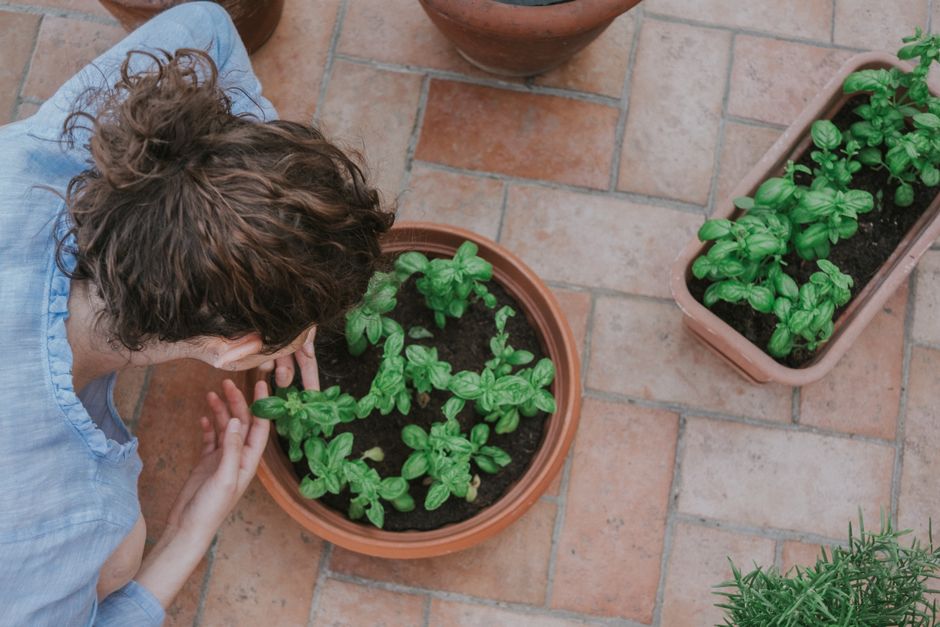
Basil that blackens by Tuesday and cilantro that turns to slime by Thursday are not inevitable. They are the result of two fixable mistakes — too much surface water and the wrong temperature. Here is the sorting, trimming, and packaging routine professional kitchens use.
Sort your harvest into two groups before anything else. Tender herbs (basil, cilantro, parsley, dill, mint, tarragon, chives) go stem-down in a glass of water, loosely bagged, in the fridge — except basil, which stays on the counter at 50–65°F. Hardy woody herbs (rosemary, thyme, oregano, sage, bay) go into a loosely closed paper bag or jar in the fridge door and keep 3–4 weeks. Never wash before storing. Anything you cannot use within two weeks gets frozen in oil or blanched and frozen — not left to rot in the crisper.
- The 60-second sorting checklist
- Why garden herbs fail in the fridge
- Tender herbs: the cut-flower method
- Basil is the exception — treat it like a tomato
- Woody herbs: the dry-air route
- Freezing, drying, and salt: method comparison
- Equipment that actually matters
- Storage life by herb (full table)
- Five mistakes that ruin a harvest
- Frequently asked questions
The 60-Second Sorting Checklist
Do this on the kitchen counter before any herb touches a bag or a jar. Everything downstream depends on it.
Why Garden Herbs Fail in the Fridge
Refrigerators are designed to slow microbial growth, not to keep plant tissue alive. Three mechanisms do the damage, and each has a different fix.
1. Free water feeds decay
Washed herbs sitting in a sealed bag create a saturated microclimate. Bacteria and soft-rot fungi need only a film of water to multiply, and the leaf tissue itself softens as cell walls break down. Damp — never wet — is the target for the paper-towel method.
2. Cold damages basil specifically
Basil is a tropical herb and behaves like one. Postharvest research has long established that basil develops chilling injury — surface browning, blackened veins, and a loss of aroma — when held below roughly 50°F (10°C).[2] A standard fridge at 37–38°F is well past that line.
3. Ethylene and respiration
Fresh herbs are still respiring. Cut cilantro and parsley are ethylene-sensitive, meaning exposure to ripening fruit accelerates yellowing. Basil is both a producer and a responder. Keep harvested herbs away from apples, bananas, avocados, and tomatoes.
“A herb bunch is a cut flower with a flavor job. Treat the stem like a stem and half the problem disappears.”
— WorldDishly test kitchen note
Tender Herbs: The Cut-Flower Method
This is the technique to learn first. It works for parsley, cilantro, mint, dill, tarragon, chervil, and lemongrass stalks, and it routinely delivers two to three weeks of usable leaf.
The damp-towel alternative (better for chives and dill)
For feathery or thin-stemmed herbs that flop in a glass — chives, dill fronds, fennel fronds — lay the dry bunch on a clean kitchen towel or paper towel that has been misted and wrung out until barely damp. Roll loosely, slide into a zip bag left open a finger’s width, and refrigerate. The towel buffers humidity; the open bag prevents condensation.
Keep upright jars at the front of the crisper and flat towel rolls at the back. Position herbs away from the fridge’s coldest rear wall, where partial freezing causes the same collapse as chilling injury.
Basil Is the Exception — Treat It Like a Tomato
Every rule about refrigeration bends for basil. Cold air destroys the volatile compounds that make it worth growing in the first place: the leaf tissue browns, the veins go black, and what survives tastes like wet grass.
Trim the stems, stand the bunch in a glass of water at room temperature, and tent a loose bag over the top. Change the water daily. Expect 5–8 days of near-harvest quality. Keep it out of direct sun.
If your kitchen runs above 75°F, wrap the dry, unwashed leaves in a dry paper towel, seal in a rigid container, and store in the warmest spot — the door shelf. Expect 4–6 days, with the first signs of edge browning by day three.
For a large harvest you cannot use in a week, skip refrigeration entirely and make pesto or freeze the leaves in oil. Basil is the one herb where preservation beats storage — the flavor loss is smaller than the texture loss.
Woody Herbs: The Dry-Air Route
Rosemary, thyme, oregano, sage, marjoram, savory, and bay have low moisture content and thick, waxy cuticles. They resist dehydration in a way tender herbs cannot, which means the strategy inverts: you want air movement, not humidity.
If you see fine white fuzz at the base of a woody herb bundle, discard the whole bundle — not just the affected stems. Mold hyphae extend well beyond what is visible, and rosemary in particular can carry it deep into the needle clusters.
Freezing, Drying, and Salt: Which Method for Which Herb
Storage buys days. Preservation buys months. Match the method to the herb’s moisture content and to how you actually cook.
| Method | Best for | Process | Keeps | Flavor result |
|---|---|---|---|---|
| Tray freeze | Dill, chives, parsley, mint, tarragon | Spread dry whole leaves on a sheet pan, freeze 2 hours, transfer to a freezer bag, squeeze out air | 4–6 months at 0°F (−18°C) | Near-fresh for cooked dishes; soft texture when thawed |
| Oil-slurry cubes | Basil, oregano, rosemary, sage, thyme | Chop, pack into ice cube trays, cover with olive oil, freeze, then pop into a bag | 4–6 months | Excellent — oil carries the fat-soluble aromatics |
| Blanch then freeze | Basil, parsley, mint destined for pesto or soup | 15–30 seconds in boiling water, immediate ice bath, squeeze dry, blend with oil, freeze flat | 6–12 months | Best color retention of any method[3] |
| Air drying | Rosemary, thyme, oregano, sage, bay | Bundle, hang in a dark room at 65–85°F with airflow, 10–14 days until stems snap | 1 year in an airtight jar | Concentrated; loses top notes, gains depth |
| Oven or dehydrator drying | Any woody herb, in humid climates | 95–110°F (35–43°C), door cracked, 2–4 hours; dehydrator at 95–105°F | 1 year | Reliable, faster, slightly flatter than air-dried |
| Microwave drying | Small batches, same-day use | Leaves between two paper towels, 30-second bursts, 1–3 minutes total | 3–6 months | Fast but easy to scorch — stop the second you smell it |
| Herb salt | Rosemary, sage, thyme, basil, tarragon | 1 part packed leaves to 3 parts kosher salt in a processor; spread and dry 24–48 hours; jar | 6 months | Salt-soluble aromatics stay vivid |
| Compound butter | Any herb | 2 tbsp minced herb per ½ cup softened butter; roll in parchment; chill, then freeze | 3 months frozen | Excellent, and the fat blocks oxidation |
Herb-and-oil mixtures are safe frozen or refrigerated for short periods, but a garlic- or herb-in-oil blend left at room temperature creates the anaerobic, low-acid environment that Clostridium botulinum needs. Keep infused oils refrigerated and use within 4 days, or freeze them immediately.[4] Never store infused oil on the counter as a flavoring shortcut.
Equipment That Actually Matters
You need less than you think. Four items do 90% of the work.
- A salad spinner. The only reliable way to remove surface water from washed herbs. Wringing or patting leaves bruises them and starts the browning clock.
- Pint and quart glass jars. For the stem-in-water method and for dried herbs. Glass does not hold aroma the way plastic does, and it does not stain.
- Clean cotton kitchen towels plus paper towels. Use the cotton for drying and the paper for lining containers, where it wicks condensation away from leaves.
- Rigid freezer containers and ice cube trays. Rigid containers prevent the crushing that freezer bags inflict on frozen leaf tissue.
Skip: vacuum sealers for tender herbs (they crush leaf structure), and mesh “herb keeper” gadgets that trap water at the bottom of the box.
When the garden delivers more than you can eat in a week, process in this order: (1) make pesto and freeze it flat in bags; (2) tray-freeze whole leaves for soups and braises; (3) pack a jar of herb salt; (4) hang the woody bundles to dry. Anything left after those four steps was never going to be eaten.
Storage Life by Herb
Realistic numbers, assuming a fridge running at 35–38°F and herbs harvested at peak quality. Garden herbs stored well routinely outperform supermarket bunches, which may already be a week off the plant.
| Herb | Category | Best storage method | Fridge life | Best preservation |
|---|---|---|---|---|
| Basil | Tender | Stem in water, room temperature, bagged | 5–8 days (counter) | Blanch + freeze, or pesto |
| Cilantro | Tender | Stem in water, loosely bagged, crisper | 10–14 days | Oil cubes |
| Flat-leaf parsley | Tender | Stem in water, loosely bagged, crisper | 2–3 weeks | Blanch + freeze |
| Curly parsley | Tender | Damp towel roll, open bag | 10–14 days | Tray freeze |
| Mint | Tender | Stem in water, crisper | 1–2 weeks | Tray freeze or dry |
| Dill | Tender | Damp towel roll, open bag | 7–12 days | Tray freeze |
| Tarragon | Tender | Stem in water, crisper | 10–14 days | Herb vinegar |
| Chives | Tender | Damp towel roll, airtight | 10–14 days | Chop + tray freeze |
| Rosemary | Woody | Paper bag or cracked jar, fridge | 3–4 weeks | Air dry |
| Thyme | Woody | Paper bag or cracked jar, fridge | 3–4 weeks | Air dry |
| Oregano | Woody | Paper bag or cracked jar, fridge | 3–4 weeks | Air dry |
| Sage | Woody | Paper bag or cracked jar, fridge | 2–3 weeks | Compound butter |
| Bay leaf | Woody | Cracked jar, room temperature or fridge | 2–4 weeks | Air dry |
Five Mistakes That Ruin a Harvest
Federal guidance is consistent on one point: rinse fresh produce under cold running water just before eating or cooking, and never use soap, detergent, or commercial produce washes. Refrigerate cut or washed produce within two hours, and hold your refrigerator at 40°F (4°C) or below.[1][5]
Frequently Asked Questions
Should I wash herbs before I store them?
No. Wash them the moment you are about to cook. Exception: if the harvest is muddy or gritty, rinse it, spin it completely dry in a salad spinner, spread it on a towel for 20 minutes until no surface moisture remains, and then store. Any water you can still see is water that will cause rot.
Why did my basil turn black in the refrigerator overnight?
Chilling injury. Basil is a warm-climate plant whose cell membranes lose integrity below roughly 50°F (10°C), causing the browning and blackening you saw. Move it to a glass of water on the counter, away from direct sun and away from the stove.
How do I stop cilantro from turning to slime?
Three things: never wash before storing, keep it upright in water rather than flat in a bag, and keep it away from ripening fruit. Cilantro also benefits from having its lowest leaves stripped off before storage, since those are the ones that sit closest to the water line and rot first.
Can I freeze herbs without blanching them?
Yes, and for most herbs you should. Blanching is worth the extra step only for basil, parsley, and mint destined for pesto or anything where you need bright green color preserved. For soups, stews, and marinades, tray-freezing whole unblanched leaves is faster and tastes nearly identical after cooking.[3]
Is it safe to freeze herbs in olive oil?
Frozen, yes — the freezer prevents the anaerobic bacterial growth that makes room-temperature herb-and-oil mixtures risky. The danger is the intermediate step: a jar of chopped herbs in oil left on the counter or in the fridge for weeks is a botulism risk, particularly if garlic is involved. Freeze within a few hours of mixing.[4]
How do I know when air-dried herbs are finished?
Two tests. The stem should snap cleanly rather than bend, and a leaf rubbed between your fingers should crumble to flakes with no cool, pliable feel. Expect 10–14 days in a dark, airy room at 65–85°F. Herbs dried in humid weather can take three weeks and may mold before they finish — use an oven or dehydrator at 95–110°F instead.
Do dried herbs really last a year?
Whole-leaf dried herbs held in airtight glass, away from light and heat, keep meaningful flavor for about 12 months. Crushed or ground herbs fade in 3–6 months because more surface area is exposed to oxygen. Store whole and crush over the pot — it is the single easiest upgrade to your dried-herb shelf.
What about herbs with roots still attached, like cilantro or mint?
Roots attached actually extend storage, because the plant keeps drawing water. Stand the bunch in an inch of water, keep the roots submerged and the leaves above the waterline, and change the water daily. Mint handled this way can hold 2–3 weeks, and cilantro roots — which are intensely flavored — can be washed and frozen separately for curry pastes.
- Sort before you store: tender herbs and woody herbs need opposite conditions.
- Never wash herbs before storing — surface water is the primary cause of slime and rot.
- Tender herbs keep 1–3 weeks stem-down in water, loosely bagged, in the crisper drawer.
- Basil is the exception: keep it at 50–65°F on the counter, never in the fridge.
- Woody herbs want dry air and circulation — a paper bag or cracked jar, 3–4 weeks.
- Freeze or dry anything you cannot use within two weeks; frozen herb-in-oil cubes are the highest-quality shortcut.
- Keep infused herb oils refrigerated and use within 4 days, or freeze them immediately.
- USDA FoodSafety.gov — Refrigeration and Food Safety, guidance on holding refrigerators at 40°F (4°C) or below and handling fresh produce.
- UC Davis Postharvest Technology Center — research summaries on basil chilling injury and the approximately 50°F (10°C) storage threshold for fresh basil.
- Colorado State University Extension — Freezing Herbs, including blanching times and ice-cube preservation methods for culinary herbs.
- USDA / National Center for Home Food Preservation — guidance on garlic and herb in oil mixtures and Clostridium botulinum risk in anaerobic, low-acid environments.
- U.S. Food and Drug Administration — Selecting and Serving Produce Safely, recommending cold running water and no soap or produce washes.