A 1:1 swap works for almost everything in a home kitchen — except the fryer. Here’s what actually changes in flavor, smoke point, and cost, with the temperatures that matter.
Substitute extra virgin olive oil for vegetable oil 1:1 by volume for sautéing, roasting, baking, dressings, marinades, and shallow frying. The catch is flavor, not heat: quality EVOO smokes between 375°F and 405°F (190–207°C), well above the 350°F (175°C) you actually cook at, but below vegetable oil’s roughly 450°F (232°C). Skip the swap for multi-batch deep frying, neutral-tasting cakes, and anything where you don’t want an olive note. Expect to pay 3–4× more per liter.
The Swap at a Glance
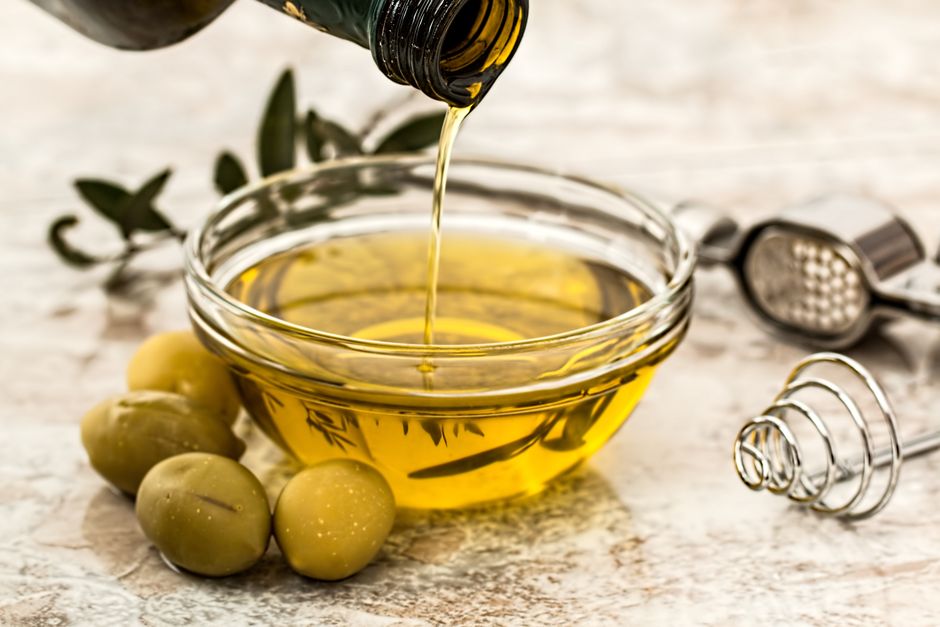
Unrefined, cold-pressed, ≤0.8% free fatty acids. Roughly 73% monounsaturated fat, plus 100–500 mg/kg of polyphenols depending on harvest and cultivar.[2] Tastes like something — grassy, peppery, fruity — and that flavor lands in your food.
Smoke point: 375–405°F (190–207°C)
Refined, bleached, deodorized blend. In the US this is usually soybean oil, or a mix of soybean, canola, corn, sunflower, and safflower. High in omega-6 polyunsaturates, essentially flavorless by design.[1]
Smoke point: ~440–450°F (227–232°C)
Here’s the part most substitution charts get wrong. Smoke point alone does not determine how an oil performs under heat. What matters more is oxidative stability — how quickly the fat molecules react with oxygen and break down into aldehydes and other off-flavors. And on that measure, extra virgin olive oil outperforms many refined seed oils at real cooking temperatures.
A well-known study published in Food Chemistry heated extra virgin olive oil at 190°C (374°F) for 30 hours and compared the aldehyde profile against sunflower oil treated identically. The sunflower oil produced markedly higher concentrations of toxic oxygenated aldehydes — including 4-hydroxy-2-nonenal — than the EVOO, despite having a higher smoke point.[3] The monounsaturated fat and the polyphenol load protect EVOO.
“Smoke point tells you when an oil starts to visibly fail. Oxidative stability tells you how long it’s been failing quietly.”
— Stable Frying Fats, Culinary Science Desk
How Extra Virgin Olive Oil Behaves in a Hot Pan
Extra virgin olive oil is a mechanically extracted fruit juice, not a refined industrial product. That distinction drives everything about its kitchen behavior.
It has a flavor ceiling and a flavor floor
A delicate Ligurian Taggiasca or a mild Greek Koroneiki reads as buttery and faintly sweet — it disappears into a cake batter. A late-harvest Sicilian Nocellara or a Tuscan Frantoio with high polyphenols will punch through a roasted chicken and make a mayonnaise taste assertively bitter. Choosing the right bottle for the job is more important than the swap ratio itself.
It smokes later than most people think
The commonly repeated figure of a 320°F (160°C) smoke point for EVOO comes from measuring deliberately degraded oil with high free fatty acid content. Fresh, well-made EVOO — legally capped at 0.8% free oleic acid under the Codex Alimentarius standard — sits at 375–405°F (190–207°C).[2] Standard sautéing happens at 300–350°F. Standard shallow frying happens at 350–375°F. You have headroom.
It resists breakdown because of what’s in it
Two things work together. First, the fatty acid profile: roughly 73% of EVOO’s fat is oleic acid, a monounsaturated fat with only one double bond available for oxidation. Polyunsaturated fats in soybean oil have multiple double bonds and oxidize far more readily. Second, EVOO carries its own antioxidants — hydroxytyrosol, oleuropein, and vitamin E — which are largely stripped out of refined oils during processing.
That peppery catch in the back of your throat? It’s oleocanthal, a phenolic compound with a documented anti-inflammatory mechanism similar to ibuprofen.[6] The stronger the throat burn, the higher the polyphenol content — and the more heat-stable the oil tends to be.
What “Vegetable Oil” Actually Is
“Vegetable oil” is a marketing category, not an ingredient. On a US label it most often means 100% refined soybean oil; in the EU it’s frequently a rapeseed (canola) blend. Either way, the manufacturing process is the same: solvent extraction or expeller pressing, followed by degumming, alkali refining, bleaching, and steam deodorization.
That pipeline produces a fat with three defining traits:
- Neutral flavor. Deodorization strips aroma compounds — which is exactly why it works in a vanilla cake.
- High smoke point. Removing free fatty acids and impurities pushes the smoke point to roughly 440–450°F (227–232°C).
- Low antioxidant content. The same process that removes flavor removes tocopherols and polyphenols, leaving a fat that’s chemically unprotected once it’s hot.
Vegetable oil is also cheap — typically $3–5 per liter against $14–22 for a decent extra virgin olive oil — which is why commercial fryers run on it and why home cooks default to it.
Repeated high-volume deep frying. A 450°F smoke point plus near-zero cost makes it the rational choice for a turkey fryer, a batch of doughnuts, or any fry session you’ll repeat three times in an afternoon. EVOO at those temperatures isn’t dangerous, but it’s expensive, and its flavor compounds accumulate in the fry medium.
Head-to-Head: The Numbers That Matter
| Dimension | Extra Virgin Olive Oil | Vegetable Oil (Soybean Blend) |
|---|---|---|
| Smoke point | 375–405°F / 190–207°C | 440–450°F / 227–232°C |
| Ideal cooking range | Up to ~400°F / 205°C | Up to ~450°F / 232°C |
| Dominant fat | ~73% monounsaturated (oleic) | ~50% polyunsaturated (linoleic + ALA) |
| Natural antioxidants | High (polyphenols, tocopherols) | Very low (stripped in refining) |
| Flavor | Fruity, grassy, peppery, varies by cultivar | Neutral to faintly waxy |
| Calories per tbsp | 119 kcal | 120 kcal |
| Saturated fat per tbsp | ~1.9 g | ~2.0 g |
| Best for deep frying | No (cost + flavor carryover) | Yes |
| Best for baking | Yes, if flavor is compatible | Yes, for neutral profiles |
| Best for dressings & finishing | Yes — the benchmark | No |
| Typical cost per liter | $14–$22 | $3–$5 |
| Shelf life opened | 3–6 months, cool and dark | 6–12 months |
Substituting about 2 tablespoons (23 g) of olive oil per day for an equivalent amount of saturated fat — without increasing total calories — may reduce the risk of coronary heart disease. The claim applies to olive oil generally, not specifically to extra virgin.[4] The American Heart Association’s 2017 advisory reinforces the underlying principle: replace saturated fat with unsaturated fat rather than simply adding oil.[5]
Note the calorie column. The two oils are functionally identical in energy density — the swap is about fat quality and flavor, not about lightening a dish.
Substitution Rules by Cooking Method
Work through these in order. The ratio stays 1:1 almost everywhere; what changes is the bottle you reach for and how you manage heat.
Volumetric 1:1 works for everything in a home kitchen. If you bake by weight: 1 tablespoon of either oil weighs 13.5–13.6 g, so there’s no conversion penalty. If a recipe calls for melted butter and you’re weighing the substitute, use 75–80% of the butter weight in oil.
Chef’s Verdict: When to Swap, When to Buy Both
Keep one bottle of each. Buy a $16–$20 extra virgin olive oil for sautéing, roasting, dressings, marinades, pesto, and any baking where a grassy or fruity note is welcome. Buy a $4 bottle of neutral vegetable oil for the fryer, for neutral cakes and pastry, and for high-volume frying where you’ll discard the oil afterward.
If you can only stock one: make it extra virgin olive oil. It handles every job in a home kitchen except repeated deep frying, and it carries flavor and antioxidant compounds that vegetable oil cannot replace. Just choose a mild bottle if you cook a lot of neutral baking.
Choosing the right EVOO for the swap
Intensity tracks with polyphenol content and harvest timing, and most producers label it now:
- Delicate / mild: early-harvest Ligurian, Koroneiki, or Arbequina. Best for cakes, mayonnaise, delicate fish, and anything where you want the fat to disappear.
- Medium: most supermarket-quality Tuscan and Spanish blends. The all-purpose workhorse for sautéing and roasting.
- Robust: late-harvest Sicilian, Puglian Coratina, Greek Kalamata. Finishing oil for soups, beans, grilled bread — too assertive for baking or emulsions.
Frequently Asked Questions
Can I substitute extra virgin olive oil for vegetable oil in cakes and brownies?
Yes, at 1:1 by volume. Brownies and olive oil cakes are the most forgiving — the cocoa and the fruit notes actually complement a fruity EVOO. Yellow cakes and sugar cookies are the least forgiving, because a grassy oil reads as a savory off-note against vanilla. If you bake a lot of neutral desserts, keep a bottle of refined “light” olive oil on hand: it has a 468°F (242°C) smoke point, a neutral flavor, and the same monounsaturated fat profile, though none of the polyphenols.
Is extra virgin olive oil actually bad for high-heat cooking?
No — within the range of normal home cooking. The “EVOO can’t take heat” claim is based on a smoke point figure measured from degraded, high-acidity oil. Fresh EVOO smoke-points at 375–405°F (190–207°C), which comfortably covers sautéing, roasting, and shallow frying. The real limit is deep frying at 400°F+ for repeated batches, where the economics and flavor carryover make vegetable oil the better tool.
There’s also a counterintuitive finding worth knowing: when researchers heated EVOO and sunflower oil side by side at 190°C, the EVOO generated fewer toxic aldehydes despite its lower smoke point.[3] Stability, not smoke point, is the better predictor.
Does the swap change the calorie count?
Barely. One tablespoon of extra virgin olive oil has 119 calories and about 13.5 g of fat; one tablespoon of soybean-based vegetable oil has 120 calories and about 13.6 g.[1] The substitution changes the type of fat — more monounsaturated, fewer omega-6 polyunsaturates — not the energy content. If you’re tracking calories, measure either oil the same way.
Will my food taste like olives?
Only as much as the bottle you choose demands. A delicate early-harvest EVOO used to sauté onions is essentially undetectable. A robust, peppery oil used to bake a vanilla cake will be very detectable. Match intensity to dish: mild oil for neutral applications, medium for everyday savory cooking, robust for finishing and for cuisines where olive flavor belongs — Italian, Greek, Spanish, Levantine.
Is the swap worth the extra cost?
For dressings, marinades, and finishing, yes — the flavor difference is the entire point, and you use small volumes. For sautéing and roasting, it depends on your budget: you’ll go through a $18 bottle in three to four weeks of daily cooking, versus roughly $5 for the same volume of vegetable oil. For deep frying, no — the economics don’t work in EVOO’s favor and the flavor degrades with reuse.
Can I use extra virgin olive oil in a deep fryer?
You can, but you shouldn’t — for cost and flavor reasons rather than safety ones. EVOO held at 350–375°F (175–190°C) is chemically stable; the problem is that at $18 a liter you’re spending roughly $55 per fryer fill, and after two batches the oil carries enough accumulated flavor compounds to tint everything you cook. Use vegetable oil, or blend in no more than 25% EVOO for a single session.
What about “light” or “pure” olive oil — are those the same thing?
No. “Light” and “pure” olive oils are refined — they’ve been chemically treated to neutralize acidity and strip flavor. They carry a much higher smoke point (roughly 465–470°F / 240–242°C) and a neutral taste, which makes them an excellent bridge substitute when you want olive oil’s fat profile without its flavor. They are not extra virgin olive oil, and they contain a fraction of the polyphenols.[2]
- Swap extra virgin olive oil for vegetable oil 1:1 by volume across sautéing, roasting, baking, shallow frying, dressings, and marinades.
- Quality EVOO smokes at 375–405°F (190–207°C) — high enough for every home cooking task except repeated deep frying.
- Oxidative stability matters more than smoke point: EVOO produces fewer toxic aldehydes than sunflower oil when both are held at 190°C.[3]
- Calories are effectively identical (119 vs 120 per tablespoon); what changes is the fat type and the flavor.
- Keep two bottles — a good EVOO for flavor and everyday cooking, a cheap neutral oil for the fryer and neutral baking.
- Match EVOO intensity to the dish: delicate for cakes and emulsions, medium for sautéing, robust for finishing.
- USDA FoodData Central. “Oil, olive, salad or cooking” and “Oil, soybean, salad or cooking” nutrient profiles. fdc.nal.usda.gov
- FAO/WHO Codex Alimentarius. Standard for Olive Oils and Olive Pomace Oils (CODEX STAN 33-1981), including free fatty acid limits and category definitions. fao.org
- Guillén MD, Uriarte PS. “Aldehydes contained in edible oils of a very different nature after prolonged heating at frying temperature: Presence of toxic oxygenated α,β unsaturated aldehydes.” Food Chemistry, 131(3):915–926, 2012.
- US Food and Drug Administration. Qualified Health Claim for Olive Oil and Coronary Heart Disease. fda.gov
- Sacks FM, et al. “Dietary Fats and Cardiovascular Disease: A Presidential Advisory From the American Heart Association.” Circulation, 136(3):e1–e23, 2017.
- Beauchamp GK, et al. “Phytochemistry: Ibuprofen-like activity in extra-virgin olive oil.” Nature, 437:45–46, 2005.