Two cuisines grew up within 130 miles of each other, share the same trinity of vegetables, and still get confused at every restaurant table in America. Here is the difference — told through the dishes themselves.
Cajun food is rural, Acadian-descended, and built for one pot: a roux cooked to dark chocolate, no tomato, andouille and tasso, crawfish, filé powder, and rice served on the side. Creole food is urban New Orleans — French, Spanish, African, Caribbean and Italian threads — with butter and cream, tomatoes, layered sauces, and a restaurant tradition dating to the 1840s. Order crawfish étouffée, boudin or brown jambalaya to taste Cajun cooking; order shrimp Creole, Oysters Rockefeller or red jambalaya to taste Creole cooking. The single fastest visual tell is broth color: dark brown means Cajun, red-orange means Creole.
- The 30-second difference — and why it is not a rule
- Cajun food: country cooking built for one pot
- Creole food: city cooking built in layers
- Ten classic dishes, side by side
- Head-to-head: roux, seasoning, and the plate
- Chef’s verdict: which one to cook tonight
- What to order to taste the difference
- FAQ
The 30-Second Difference — and Why It Is Not a Rule
Cajun and Creole cooking overlapped for three centuries before anyone wrote the distinction down. The clean version is a geography lesson: Cajun is country, Creole is city. Cajun food comes from the bayous, prairies and small towns of southwest Louisiana — Lafayette, Breaux Bridge, Eunice, Mamou — where Acadian exiles settled after their expulsion from Canada and cooked with what the land gave them. Creole food comes from New Orleans, a port that swallowed French, Spanish, African, Caribbean, German and Sicilian kitchens and turned them into a restaurant cuisine.
The shorthand gets cited as law — “Cajun has no tomato, Creole has tomato” — and it mostly holds for jambalaya and gumbo. Then you meet a Cajun sauce piquante simmering with tomato, or a Creole gumbo built on a dark roux with no tomato at all, and the rule collapses. Treat the distinction as a spectrum with a center of gravity, not a border checkpoint.
Country food. One pot, cast iron, a roux taken to the color of dark chocolate, andouille and tasso, crawfish, filé powder, cayenne-forward heat. Rice is usually on the side. Born of subsistence cooking — nothing wasted, everything from the immediate landscape.
City food. Butter, cream, tomatoes, layered stocks and sauces, beurre manié and hollandaise. Rice typically sits underneath the sauce. Born of a wealthy port city with a professional restaurant culture and access to imported ingredients.
“Cajun is food that came out of the yard and the bayou. Creole is food that came out of a restaurant kitchen.”
— A framing used across Louisiana culinary-trail programming; the reality is that both traditions have fed the other for generations.
Cajun Food: Country Cooking Built for One Pot
Acadians were expelled from what is now Nova Scotia beginning in 1755, and significant numbers reached Spanish-controlled Louisiana from 1765 onward, settling along the bayous and the southwest prairies.[3] They arrived with French peasant technique — a flour-and-fat roux, a mirepoix instinct — and rebuilt it with what was available: wild game, pork, rice from the wet prairies, crawfish, and the Gulf’s shrimp and crab. The result is food engineered to feed a household from one vessel over a low fire.
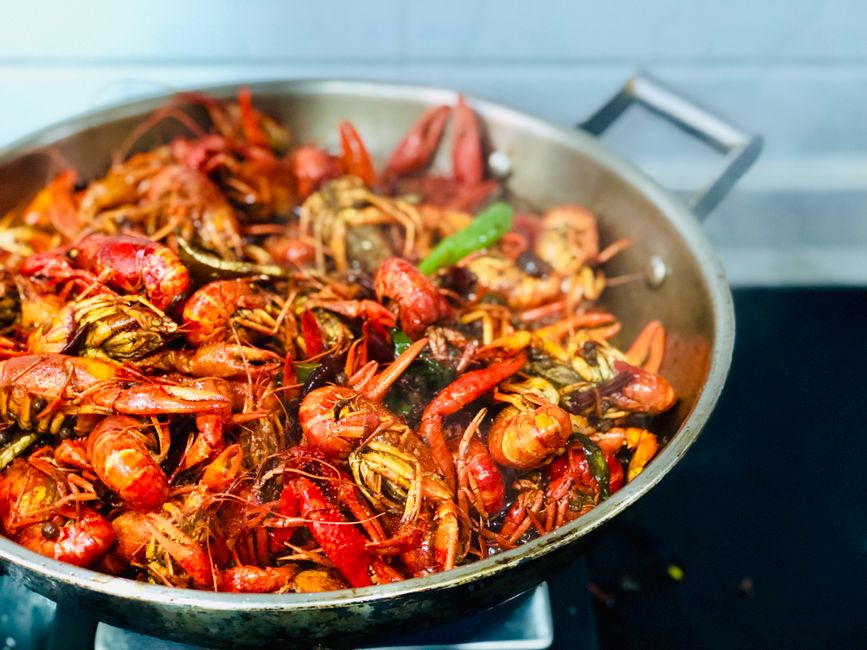
Breaux Bridge, Louisiana — population roughly 8,000, self-declared “Crawfish Capital of the World”
Breaux Bridge has hosted a crawfish festival since 1960 that anchors the regional calendar. But the commercial crawfish crop only became a major industry in the mid-20th century, which is why so many “ancient” Cajun classics — crawfish étouffée among them — are actually 20th-century inventions that were codified in living memory.
The point worth keeping: Cajun cuisine is not a fossil. It is a working tradition that keeps re-editing itself based on what the market and the estuary provide.
Signature Cajun dishes and what makes each one Cajun
- Chicken and andouille gumbo — dark roux, no tomato, thickened further with okra or filé powder, served over rice. Filé is ground dried sassafras leaf, a Choctaw contribution to the Louisiana pot.[5]
- Crawfish étouffée — crawfish “smothered” in a light-medium roux with the trinity; no cream, no tomato in the Cajun version, and the crawfish goes in at the very end so it stays tender.
- Brown jambalaya — meat browned first, rice cooked in the same pot with the meat and stock, no tomato. The color comes from caramelized fond and a dark roux or browned meat.
- Boudin — pork, liver, rice and seasoning in a casing; sold by the link at gas stations and meat markets from Eunice to Lake Charles.
- Boudin balls, cracklins, tasso, sauce piquante, chicken fricassée — the working vocabulary of a household cook, not a restaurant menu.
- Smothered dishes — pork chops, rabbit, or green beans cooked down slowly with onion and stock until the liquid becomes a gravy.
For gumbo, one cup of flour cooked into one cup of oil produces enough roux to thicken roughly one gallon (16 cups) of stock. Cook that roux 20–35 minutes for a chocolate-brown Cajun gumbo base, or 5–10 minutes for the peanut-butter-toned roux you’ll see in Creole kitchens.
Creole Food: City Cooking Built in Layers
New Orleans was founded by the French in 1718, handed to Spain in the 1760s, returned to France briefly, and sold to the United States in 1803 — and its kitchen absorbed every wave. African cooks, both enslaved and free, shaped the technique and the seasoning base. Caribbean refugees arriving from Saint-Domingue around 1809 brought additional French-African cooking. Sicilians arrived in large numbers in the late 1800s and reshaped the city’s groceries. The Choctaw contributed filé; West Africa contributed okra, and with it the word gumbo.[5]
“Creole” originally described people born in the colony rather than in Europe or Africa — a category that eventually broadened.[4] The cuisine that carries the name is inseparable from the city’s grand restaurant culture: Antoine’s opened in 1840, Commander’s Palace in 1893, Galatoire’s in 1905. Creole cooking was professionalized far earlier than Cajun cooking, and that shows in the plate.
Signature Creole dishes and what makes each one Creole
- Shrimp Creole — shrimp simmered in a tomato-based sauce with the trinity, garlic, bay and thyme, spooned over rice. Tomato is the defining move.
- Red jambalaya — tomato in the pot, often with ham, shrimp and chicken; distinctly redder and more sauce-forward than the Cajun version.
- Oysters Rockefeller — invented at Antoine’s in 1889 (and named for the richest man alive at the time). A restaurant dish, pure and simple.
- Eggs Sardou and Eggs Hussarde — brunch constructions of poached eggs, artichoke bottoms, hollandaise, marchand de vin sauce. This is haute-cuisine Creole.
- Gumbo z’herbes — a Lenten gumbo made with a dozen or more greens, traditionally served on Holy Thursday.
- Trout amandine, crabmeat rémoulade, turtle soup, grillades and grits — the French-Spanish backbone of the old-line Creole menu.
- Bananas Foster, beignets, café au lait, pralines — the sweet end of a city that has been selling sugar since the 1800s.
If a dish requires a whisk, a finished sauce, or a garnish added at plating, it is probably Creole in lineage. If it is finished in one pot and spooned over rice from a communal pot, it is probably Cajun.
Ten Classic Dishes, Side by Side
This table is the fastest way to answer the question. Each row is a dish both traditions claim — and the differences in the two columns are the differences between the cuisines.
| Dish | Cajun version | Creole version | Quick tell |
|---|---|---|---|
| Gumbo | Dark chocolate roux, chicken and andouille, filé or no okra, no tomato | Lighter roux, seafood (shrimp, crab, oysters), okra and often tomato | Broth color: dark brown vs. red-orange |
| Jambalaya | Brown, no tomato, meat browned first, rice cooked in the pot | Red, tomato-forward, frequently ham and shrimp | Color of the rice |
| Crawfish étouffée | Roux and crawfish fat, no cream, no tomato, deeply savory | Butter-forward, sometimes tomato and/or cream | Pink-orange sauce = Creole, deep brown = Cajun |
| Shrimp | Blackened in a cast-iron skillet, fried, or in a sauce piquante | Shrimp Creole; cold shrimp with rémoulade | Cold rémoulade = Creole |
| Rice service | Rice on the side, sauce ladled over at the table | Rice as a bed under a finished sauce | How the plate is built |
| Sausage | Smoked andouille, coarse boudin, tasso as a seasoning meat | Andouille plus chaurice and a wider charcuterie range | Boudin on the menu = Cajun kitchen |
| Eggs | Eggs with boudin or grilled meats; not a major category | Eggs Sardou, Eggs Hussarde, omelets as a ritual | Named brunch classics = Creole |
| Soups | Catfish court-bouillon, chicken and sausage gumbo | Turtle soup, gumbo z’herbes, bisques enriched with cream | Turtle soup = old-line Creole |
| Vegetables | Smothered green beans; corn maque choux; smothered okra | Stuffed mirliton with shrimp; spinach and artichoke preparations | Stuffed vegetables = city kitchen |
| Dessert | Sweet dough pies, couche-couche, pecan candies sold at rural markets | Bananas Foster, beignets, pralines, café brûlot | Tableside flambé = Creole |
Several rows above have documented exceptions. Cajun sauce piquante uses tomato. Creole gumbo can be built on a dark roux with no tomato at all. Red beans and rice belongs to both traditions — the New Orleans Monday wash-day story is Creole, but the dish is cooked in Cajun households with equal conviction. Use the table as probability, not policy.
Head-to-Head: Roux, Seasoning, and the Plate
| Dimension | Cajun | Creole |
|---|---|---|
| Roux | Oil or lard; cooked 20–45 minutes to chocolate or near-black | Butter or oil; cooked 5–15 minutes to white, blond, or peanut-butter tone |
| Thickening | Dark roux (low thickening power) plus filé or okra; reduction | Lighter roux, beurre manié, egg yolk liaisons, cream |
| Tomato | Absent from jambalaya and gumbo; present in some smothered dishes and sauce piquante | Central to shrimp Creole, red jambalaya, Creole gumbo, sauces |
| Aromatic base | Onion, celery, green bell pepper — heavier on onion, with garlic | Same trinity, plus garlic, bay, thyme, parsley, green onion, sometimes tomato |
| Heat source | Cayenne and dried pepper forward; heat is a primary flavor | Cayenne present but layered under herb, butter and acid notes |
| Signature meats | Andouille, tasso, wild game, pork, crawfish | Ham, shrimp, crab, oysters, veal, chicken livers |
| Vessel | Cast-iron Dutch oven or black iron pot; one-pot finishes | Sauté pan, stock pot, sauce pot; components finished separately |
| Service style | Family-style, rice on the side, plate lunch tradition | Plated courses, sauce under or over rice, garnished at the pass |
| Historic home | Acadiana: Lafayette, Eunice, Mamou, Breaux Bridge, Lake Charles | New Orleans and its old-line restaurants and Creole homes |
Chef’s Verdict: Which One to Cook Tonight
You have one heavy pot, one or two hours, and you want depth over delicacy. Cajun cooking rewards patience with a roux and forgiving of improvisation — swap the protein, keep the trinity, keep the heat. Start with chicken and andouille gumbo or brown jambalaya.
You want a sauce that behaves like a classical French sauce, you enjoy building a dish in stages, and you want tomato and acid in the picture. Creole cooking is more technique-dependent — a broken hollandaise or a scorched tomato base shows immediately. Start with shrimp Creole or trout amandine.
Cook both in the same week and you will taste the difference permanently. Make one dark-roux chicken gumbo and one Creole seafood gumbo with tomato and okra, side by side. The comparison teaches more in one afternoon than any article can.
What to Order to Taste the Difference
If you are sitting in a Louisiana restaurant and want a side-by-side education, order in this sequence.
Gumbo, jambalaya and étouffée all combine cooked rice with a moist, protein-rich base — a combination that needs fast cooling. Refrigerate within two hours of cooking, spread into shallow containers so the interior drops through the 40°F–140°F danger zone quickly, and eat leftovers within three to four days.[1] Reheat to 165°F and bring leftover gumbo to a full simmer, not just a warm-through.
FAQ
Is jambalaya Cajun or Creole?
Both, and the color tells you which. Cajun jambalaya is brown: no tomato, meats browned first, rice cooked directly in the pot with the stock. Creole jambalaya is red: tomato goes in, often with ham and shrimp, and the result is looser and more sauce-like.
Is gumbo Cajun or Creole?
Gumbo belongs to both, and to neither exclusively. The word comes from West African ki ngombo (okra) or Choctaw kombo (filé), depending on which origin you follow.[5] Cajun gumbo tends toward a dark roux with chicken and andouille; Creole gumbo tends toward a lighter roux with seafood, okra, and often tomato. Gumbo z’herbes is a distinctly Creole, Lenten version.
Why do people say Cajun food has no tomato?
Because the two dishes most often compared — jambalaya and gumbo — are reliably tomato-free in the Cajun tradition, while their Creole counterparts usually include it. The rule is a useful shorthand rather than a law: Cajun sauce piquante and several smothered dishes do use tomato.
Which cuisine is spicier?
Cajun cooking typically runs hotter, with cayenne sitting closer to the front of the flavor profile. Creole cooking uses cayenne too, but layers it beneath butter, herbs, acid and stock, so the heat reads as part of a larger structure rather than the headline. Neither is inherently “milder” in a well-cooked dish — it depends on the cook.
What is the Holy Trinity, and is it the same in both?
Onion, celery and green bell pepper — the Louisiana answer to French mirepoix, with bell pepper replacing carrot. Both cuisines start there. Cajun versions often lean heavier on onion and add garlic immediately; Creole versions routinely add garlic plus bay, thyme, parsley and green onion, and sometimes tomato.
Can a dish be both Cajun and Creole?
Constantly. Modern Louisiana restaurants blend the traditions, and families cook across both. The distinction is most useful as a set of tendencies — rural vs. urban, one-pot vs. plated, heat-forward vs. sauce-forward — rather than as a set of enforceable rules.
- Cajun = country, Creole = city. Acadian settlers in southwest Louisiana vs. the port city of New Orleans.
- Roux color is the master tell. Cajun roux runs 20–45 minutes to dark chocolate; Creole roux runs 5–15 minutes to blond or peanut butter.
- Tomato is a tendency, not a law. It reliably separates Cajun and Creole jambalaya and gumbo, but not every dish in either tradition.
- Rice placement matters. On the side = Cajun plate lunch. Under the sauce = Creole plating.
- Signature Cajun examples: crawfish étouffée, boudin, brown jambalaya, chicken and andouille gumbo, tasso, sauce piquante.
- Signature Creole examples: shrimp Creole, Oysters Rockefeller, red jambalaya, gumbo z’herbes, Eggs Sardou, bananas Foster, beignets.
- USDA Food Safety and Inspection Service, “Refrigeration and Food Safety” — two-hour cooling rule, 40°F–140°F danger zone, and 3–4 day leftover guidance. fsis.usda.gov
- Harold McGee, On Food and Cooking: The Science and Lore of the Kitchen (Scribner, revised edition) — starch dextrinization in browned roux and the resulting loss of thickening power.
- National Park Service, “Acadian Expulsion (Le Grand Dérangement)” — the 1755 deportation and subsequent Acadian settlement in Louisiana from 1765. nps.gov
- 64 Parishes (Louisiana Endowment for the Humanities), “Creoles” — the historical meaning of Creole in colonial and post-colonial Louisiana. 64parishes.org
- 64 Parishes, “Gumbo” — filé powder, okra, and the competing West African and Choctaw roots of the dish’s name and thickening methods. 64parishes.org