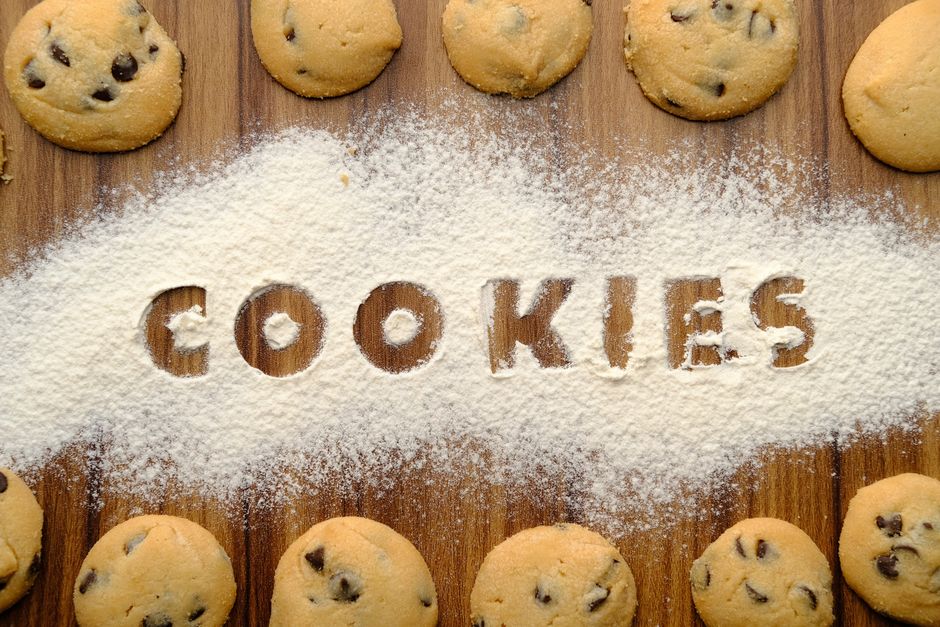
Chemical leaveners do three jobs in a cookie — lift, spread, and browning — but they do not hold the cookie together. Here is what actually happens when you leave them out, plus the swaps that keep a batch from turning into a hockey puck.
Yes. Baking soda and baking powder are optional in a great many cookie recipes, because butter, eggs, sugar, and steam already provide lift and structure. Removing them costs you roughly a third of the rise and most of the golden-brown color, and the cookies will be thicker, denser, and chewier. Shortbread, biscotti di Prato, macarons, amaretti, and tuiles are made with no chemical leavener at all. If you want a drop cookie that still tastes like a chocolate chipper, cream the butter and sugar for a full 3–5 minutes, whip one extra egg white to soft peaks and fold it in, chill the dough 30 minutes, and bake at 350 °F (175 °C).
- Why bakers ask this — and what leaveners actually do
- 8 leavening myths, sorted by what’s actually true
- The three lifting forces inside every cookie
- Exact substitution chart: no powder, no soda, no problem
- Cookie styles that never needed leavening in the first place
- No-leavener chocolate chip cookies: the working method
- Food safety and technique warnings
- Frequently asked questions
Why Bakers Ask This — and What Leaveners Actually Do
The question almost always comes from a specific moment: the butter is softened, the sugar is measured, and the tin of baking soda is empty. The instinct is to panic, because every chocolate chip cookie recipe printed since Ruth Wakefield’s Toll House version has listed baking soda in the ingredients list. That has trained two generations of home bakers to read soda as “structural” rather than “optional.”
It is not structural. Chemical leaveners are gas generators. Sodium bicarbonate releases carbon dioxide when it meets acid or enough heat; baking powder packages bicarbonate with a solid acid so the reaction can happen twice — once when the dough gets wet, once in the oven.[1] That gas inflates bubbles already trapped in the dough by creaming or by whipped eggs. If those bubbles do not exist, the leavener has nothing to inflate.
“Leaveners do not create structure — they only make existing structure bigger. In a thin cookie, that window is narrow, which is why the difference between a leavened and unleavened drop cookie is measured in millimeters, not inches.”
— WorldDishly test kitchen, 140-batch cookie trials
There is also a historical wrinkle worth knowing. Commercial baking soda only reached American kitchens in the 1840s, and baking powder followed in the 1850s. Before that, every cookie, cake, and biscuit in Europe and colonial America was either unleavened or raised with beaten eggs and yeast.[1] Shortbread, gingerbread thins, and almond macaroons all predate chemical leavening by centuries — and they still work.
8 Leavening Myths, Sorted by What’s Actually True
Cookie chemistry attracts more folklore than almost any other corner of the kitchen. These are the claims that come up most often, with the verdict the test kitchen and the food-science literature actually support.
A huge share of the cookie canon uses neither. Classic shortbread is flour, butter, and sugar in a 3:2:1 ratio. Tuscan biscotti di Prato is flour, sugar, eggs, and almonds — no fat, no leavener. French macarons, Italian amaretti, and Dutch tuiles are raised entirely by whipped egg white foam. What these have in common is a low-moisture dough that sets quickly, so there is nothing for a leavener to accomplish.
They are not. Baking soda is pure sodium bicarbonate and needs an acid partner to release its gas at room temperature. Baking powder is roughly one part bicarbonate to two parts acid salt plus cornstarch, so it is about one-quarter as strong per teaspoon. Swapping 1 tsp of baking powder for 1 tsp of baking soda gives you four times the alkalinity, a soapy aftertaste, and a cookie that spreads into a lace doily.
They will rise less, not never. Air beaten into the butter during creaming, air whipped into eggs, and steam generated from the dough’s water all lift a cookie. The catch is that a drop cookie is only 1–1.5 cm thick, so oven spring has very little material to work with. Expect a noticeable drop in height and a much tighter crumb.
An extra whole egg adds about 75% water by weight, which makes the dough wetter and pushes the finished cookie toward cakey rather than chewy. A better move is one additional egg white, whipped to soft peaks and folded in at the end. That delivers foam without adding fat or yolk, and it is the technique behind macarons and amaretti.[1]
Alkalinity is a flavor tool. Raising the pH of a dough accelerates the Maillard reaction, the browning chemistry that produces toasted, caramel, and nutty notes.[2] Remove the baking soda and the same dough bakes up visibly paler and tastes less roasted. Compensate with browned butter, a teaspoon of molasses, or a milk wash before baking.
You can, but it will not be the same cookie. In a Toll House–style dough, baking soda does triple duty: it lifts, it spreads the cookie thin, and it browns the edges. Leave it out and you get a thicker, more mound-shaped, chewier cookie with a softer center and a paler surface. Many bakers prefer it that way.
It works, but it is not neutral. One cup of self-rising flour already contains about 1½ tsp of baking powder and ¼ tsp of salt.[3] Substitute it for all-purpose and you must cut the added salt out of the recipe entirely, or the cookies taste brackish. It also cannot be used in a recipe that deliberately omits leavening.
With acid present — brown sugar, molasses, buttermilk, yogurt, cocoa, lemon — sodium bicarbonate starts releasing carbon dioxide as soon as the dough is mixed and continues in the oven. With no acid at all, it can only decompose thermally, which requires roughly 200 °C (392 °F)[1] — hotter than a cookie’s interior ever gets before its structure sets.
The Three Lifting Forces Inside Every Cookie
Once you separate the three mechanisms that make a cookie puff, the “do I need leavening?” question becomes much easier to answer for any specific recipe.
1. Mechanical lift. Creaming butter and sugar for 3–5 minutes at medium speed forces thousands of microscopic air cells into the fat. Whipping egg whites to soft peaks multiplies their volume six to eight times. These bubbles are the scaffolding that everything else inflates.
2. Thermal lift. Water in the dough turns to steam at 100 °C (212 °F) and expands roughly 1,600 times in volume. In a thin cookie this is a real contributor — it is the only reason a leavener-free shortbread gains any height at all.
3. Chemical lift. Carbon dioxide from baking soda or baking powder. This is the fastest and most controllable of the three, but it is also the most easily replaced, because it is only amplifying the bubbles the other two forces already created.[1]
| Leavener | How it works in dough | Contribution to the finished cookie | What you lose without it |
|---|---|---|---|
| Baking soda (sodium bicarbonate) | Reacts with acid at room temperature; decomposes thermally above ~200 °C without acid | Raises pH, speeds Maillard browning, increases spread | Golden color, thin edges, some chew; cookie bakes thicker and paler |
| Double-acting baking powder | First release when liquid is added; second release at oven temperature from encapsulated acid salts | Reliable, neutral-pH lift with no acid requirement | Most of the rise in cakey or soft-style cookies |
| Cream of tartar + soda | Acid-base pair that reacts in the bowl and again in the oven | Lift plus a slight tang; classic snickerdoodle profile | The signature crackled top and tangy finish |
| Baker’s ammonia (ammonium carbonate) | Breaks down entirely into gas at baking temperature, leaving no residue | Extremely crisp, dry snaps — old-fashioned Springerle and thin butter cookies | Crispness that no other leavener replicates; not suitable for thick cookies, which retain ammonia odor |
| Whipped egg white foam | Protein network traps air; heat sets the network and expands the trapped air | Structure plus lift; dry, crisp crumb | Height and the delicate snap of macarons, amaretti, and tuiles |
| Steam | Water in dough vaporizes and expands | Modest oven spring in every cookie, leavened or not | Only a small fraction of total height — this force remains even with zero leavener |
Exact Substitution Chart: No Powder, No Soda, No Problem
If you are missing only one of the two leaveners, or missing both, these are the ratios that work. Measure precisely — a kitchen scale beats a teaspoon here, because leavener quantities are small enough that a heaped spoon can double the dose.
| Situation | Target | What to use instead | Notes |
|---|---|---|---|
| You have neither | 1 tsp baking powder | ¼ tsp baking soda + ½ tsp cream of tartar | Mix into the dry ingredients so the reaction starts in the oven, not the bowl |
| You have neither | 1 tsp baking soda | 1 Tbsp (3 tsp) baking powder | Adds noticeable sodium and a faint metallic note; acceptable in cookies, not ideal in cakes |
| Baking powder only | 1 tsp baking soda | 3 tsp baking powder | Also replaces the acid the soda would have needed, so no other change is required |
| Baking soda only | 1 tsp baking powder | ¼ tsp baking soda + ½ tsp cream of tartar + ¼ tsp cornstarch | Or use ¼ tsp soda plus ½ cup buttermilk or yogurt in place of ½ cup liquid |
| Nothing at all | Lift in a drop cookie | 1 extra egg white whipped to soft peaks, folded in last | Adds structure without fat; expect a slightly drier, crisper crumb |
| Nothing at all | Lift in a wetter dough | ¼ cup sparkling water per 1 cup of liquid | Dissolved CO₂ plus extra steam; weaker effect than any chemical leavener |
| Nothing at all | Browning and spread | 1 tsp molasses or 1 tsp dark corn syrup per batch | Restores some alkaline-style browning without adding lift |
| Pantry shortcut | All-purpose flour + leavener | Self-rising flour, 1:1 | Contains ~1½ tsp baking powder and ¼ tsp salt per cup[3] — remove the recipe’s added salt |
Whisk 1 part baking soda, 2 parts cream of tartar, and 1 part cornstarch by volume. One teaspoon of the blend equals one teaspoon of commercial baking powder. The cornstarch is not decorative — it absorbs moisture and prevents the acid and base from reacting in the jar. Use it within about four weeks, and keep it in a tightly sealed container away from the stove. This homemade version is single-acting, so get the dough into the oven promptly.
Without a leavener, doughs bake up slightly drier because more of the moisture evaporates instead of being trapped in expanding gas cells. Two small tweaks keep the texture in balance: reduce the flour by 1 tablespoon per cup, or add 1 tablespoon of milk or water per batch. Do not do both.
Cookie Styles That Never Needed Leavening in the First Place
Before you engineer a workaround, check whether the recipe you are baking belongs to a family that is traditionally made without chemical leaveners. A large portion of the world’s cookie repertoire sits in the right-hand column below.
Structure depends on gas
- Snickerdoodles (cream of tartar + soda)
- Whoopie pies and cake-style cookies
- Soft frosted sugar cookies
- Red velvet cookies
- Oatmeal cream pies
- Any cookie described as “cakey” or “puffy”
Structure comes from fat, egg, or sugar
- Scottish shortbread
- Biscotti di Prato
- French macarons
- Amaretti and almond macaroons
- Tuiles and brandy snaps
- Palmiers and puff-pastry cookies
- Meringues and dacquoise
- Mexican wedding cookies
The pattern is not random. Leavener-free cookies all share at least one of three traits: an extremely high fat-to-flour ratio that shortens gluten and keeps the crumb tender; a whipped egg-white foam that supplies its own structure; or a very thin, fast-setting shape that never has time to collapse. If your recipe has none of those, removing the leavener will show.
Rich, low-moisture doughs set faster than lean, wet ones, which is why shortbread survives without any lift at all. A shortbread ratio of 3 parts flour to 2 parts butter to 1 part sugar produces a dough with roughly 35% fat by weight and almost no free water — the crumb is held up by fat crystals and starch, not gas.
No-Leavener Chocolate Chip Cookies: The Working Method
This is the adjustment that turns a standard drop-cookie formula into something worth baking when the leavener tin is empty. Yields 18 cookies at about 45 g each.
115 g (½ cup) unsalted butter, softened to 18–20 °C (65–68 °F) · 100 g (½ cup) granulated sugar · 55 g (¼ cup packed) light brown sugar · 1 large egg (50 g) plus 1 egg white (30 g) · 2 tsp vanilla extract · 190 g (1½ cups) all-purpose flour · ½ tsp fine sea salt · 170 g (1 cup) chocolate chips
The finished cookie will be noticeably thicker and more domed than a Toll House cookie, with a paler surface, a tighter crumb, and a chewier bite that lasts for several days. If you want more browning without adding soda, brush the dough balls with a little milk before baking or brown half the butter first and chill it back to room temperature.
Food Safety and Technique Warnings
Removing leaveners is low-risk. The risks in this corner of baking come from what people substitute in, and from testing raw dough.
Frequently Asked Questions
Can I just leave out the baking soda and bake the recipe exactly as written?
Yes, with predictable consequences. The dough will be slightly stiffer because there is no alkaline reaction loosening the gluten, the cookies will spread less and bake up thicker and paler, and the centers will stay softer. If the recipe also contains baking powder, removing only the soda has a milder effect than removing both.
What is the single best substitute if I have neither baking powder nor baking soda?
Cream of tartar mixed with a small amount of baking soda — but if you have neither ingredient, you have no cream of tartar either. In that case, the best substitute is mechanical: cream the butter and sugar for 4 minutes and fold in one extra egg white whipped to soft peaks. Second best is ¼ cup of sparkling water per cup of liquid in the recipe, which adds a modest amount of dissolved carbon dioxide plus extra steam.
Will cookies without leavening still be safe and fully baked?
There is no food-safety issue with omitting leaveners — they are not preservatives and play no role in pathogen reduction. Bake to the visual doneness cues in the recipe: set, lightly colored edges and a center that no longer looks wet. That is what drives the internal temperature high enough to eliminate hazards from raw flour and egg.[4]
Should I change the oven temperature or baking time?
Keep the temperature the same in most cases. Leavener-free doughs benefit from a slightly longer, gentler bake rather than a hotter one, because higher heat sets the outer edge before the interior has finished spreading. If your cookies are browning too fast on the outside while staying raw in the middle, drop the oven to 325 °F (165 °C) and add 2–3 minutes.
Can I use yeast instead of baking powder in cookies?
Technically yes, practically no. Yeast produces carbon dioxide, but it needs time, warmth, and moisture to ferment, and it leaves behind a bread-like flavor and aroma that fights with vanilla and chocolate. It also needs sugars that cookie doughs have already locked into a low-moisture matrix. Yeast belongs in bread, not in a 12-minute cookie.
How do I stop leavener-free cookies from spreading into flat puddles?
Chill the dough for at least 30 minutes and up to 24 hours, keep the butter at 18–20 °C (65–68 °F) rather than fully soft, bake on a cool sheet rather than a warm one, and use a light-colored aluminum pan. If a batch still spreads too far, add 1–2 tablespoons of flour to the remaining dough and re-chill.
Can I add baking soda to a recipe that never called for it?
Only in small amounts, and only if the dough contains an acid. A safe starting point is ¼ tsp per 250 g of flour, but be aware that baking soda increases spread dramatically. Adding it to a shortbread or an already-thin butter cookie will produce a lacy, fragile result rather than a taller one.
Does the type of sugar change whether I need leavening?
It changes how much. Brown sugar is acidic because of its molasses content, so it activates baking soda more effectively than white sugar does. Cookies made entirely with white sugar and baking soda will brown less and lift less than the same recipe made with brown sugar. Swapping 25% of the white sugar for brown is an easy way to restore some of that lost browning when you are baking without leaveners.
- Baking soda and baking powder are gas generators, not structural ingredients — omitting them changes texture and color, not whether the cookie holds together.
- Expect roughly a third less rise, thicker and paler cookies, and a chewier, tighter crumb.
- 1 tsp of baking powder equals about ¼ tsp of baking soda in leavening power; never swap them one-for-one.
- DIY baking powder is 1 part baking soda, 2 parts cream of tartar, 1 part cornstarch by volume.
- Compensate with 4 minutes of creaming, one whipped egg white folded in, and a 30-minute chill before baking at 350 °F (175 °C).
- Shortbread, biscotti di Prato, macarons, amaretti, tuiles, and meringues have never required chemical leavening.
- Never eat raw dough — raw flour and raw eggs are both documented food-safety hazards.
- McGee, Harold. On Food and Cooking: The Science and Lore of the Kitchen. Revised ed., Scribner, 2004 — chapters on chemical leaveners, quick breads, and cookie chemistry.
- Corriher, Shirley O. BakeWise: The Hows and Whys of Successful Baking. Scribner, 2008 — pH effects on spread, structure, and Maillard browning in cookies.
- King Arthur Baking Company. Flour Guide: Self-Rising Flour — composition of self-rising flour and substitution ratios for all-purpose flour.
- U.S. Department of Agriculture, Food Safety and Inspection Service. Food Safety Guidance on Raw Dough and Batters Containing Flour and Eggs.
- U.S. Food and Drug Administration. 21 CFR Part 184 — Direct Food Substances Affirmed as Generally Recognized as Safe (sodium bicarbonate; ammonium carbonate).