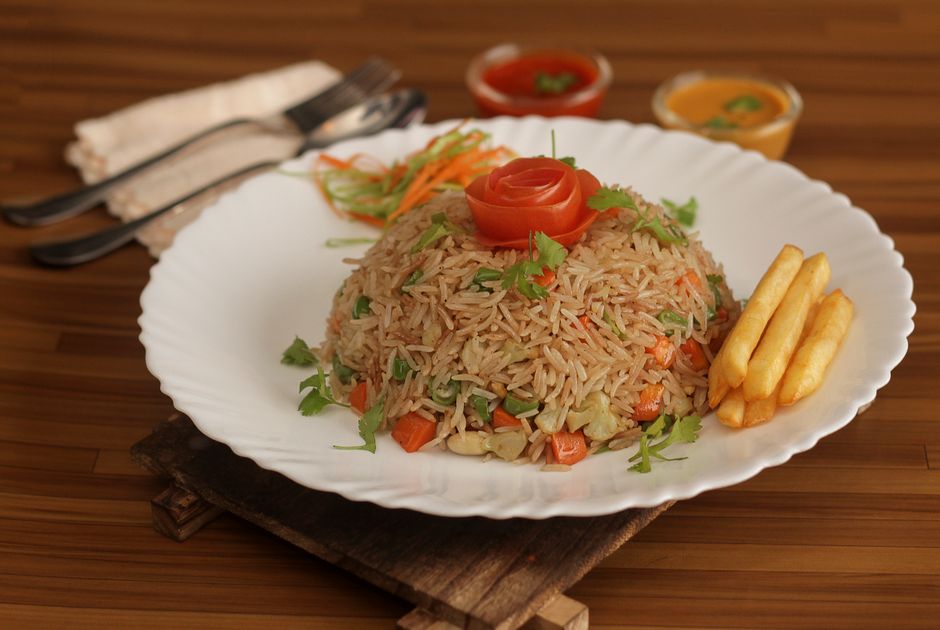
Every great fried rice comes down to four variables: how dry the rice is, how hot the pan is, how much liquid you add, and how long you keep tossing. Get those right and even a home skillet can produce grains that are separate, glossy, and faintly smoky.
Use 4 cups of fully chilled, day-old long-grain rice per batch. Preheat a 12–14 inch carbon steel wok or cast iron skillet until a flicked water droplet evaporates in under a second (roughly 400–450°F / 205–230°C). Scramble 2 eggs in 1 tablespoon of oil and set aside. Sear aromatics for 15 seconds, add protein for 45 seconds, then rice — press it flat for 30 seconds before the first toss. Season with 1½ tablespoons light soy sauce poured around the hot rim of the pan, not onto the rice. Finish with sesame oil and white pepper off the heat. Total active cooking time: 4 minutes.
- What Fried Rice Actually Is — And Why It Tastes Like That
- Ingredient Selection and the Starch Science
- Prep, Equipment, and the Mise en Place Rule
- The Step-by-Step Master Method
- Master Ratios and Temperature Benchmarks
- Seven Common Mistakes and How to Fix Them
- Pairing, Storage, and Rice Food Safety
- Fried Rice FAQ
What Fried Rice Actually Is — And Why It Tastes Like That
Fried rice is not a recipe so much as a technique for reheating a starch. That distinction matters, because almost every failure home cooks experience comes from treating it like a stir-fry of fresh ingredients rather than a controlled dehydration-and-sear of cooked grains.
The earliest written reference to a fried rice dish appears in the Qimin Yaoshu, an agricultural encyclopedia compiled around 544 CE, which describes breaking eggs into hot oil and adding cooked rice.[5] Chinese culinary tradition credits the dish’s refinement to Yangzhou, where it developed as yángzhōu chǎofàn — historically nicknamed “broken gold rice” (suìjīn fàn) for the way scrambled egg fragments cling to each grain like gold leaf.
From there the technique traveled outward along trade routes and became a template rather than a fixed formula. Japan’s chāhan leans on short-grain rice and butter. Thailand’s khao phat adds fish sauce and lime. Indonesia’s nasi goreng layers in kecap manis and shrimp paste. Every version solves the same technical problem: how to get moisture out and flavor in before the grains turn to paste.
The Four-Layer Flavor Architecture
Good fried rice is built in order, and each layer must be sealed before the next one goes in:
- Fat and protein — oil heated to its smoking threshold, then egg, which sets in 20–30 seconds and forms the base layer.
- Aromatics — garlic, ginger, and the white parts of scallions, which need 10–20 seconds of contact with fat to release sulfur volatiles. Beyond that they burn and turn acrid.
- Starch — the chilled rice, which must be pressed against the hot surface to develop Maillard browning rather than steamed.
- Seasoning — soy, oyster sauce, and wine, added late and poured down the hot wall of the pan so it reduces on contact instead of pooling in the rice.
“The wok breath people chase — wok hei — is not a single flavor. It’s a family of compounds produced when rice starch and oil meet metal above roughly 400°F, partly caramelizing, partly pyrolysing, partly oxidizing.”
That’s the target. It is a chemical reaction with a temperature threshold, which means it is reproducible — in a wok, in a cast iron skillet, or in a heavy nonstick pan that can hold sustained heat. What matters is that your cooking surface stays above the threshold long enough to brown the rice, not long enough to steam it.
Ingredient Selection and the Starch Science
Two cooks can follow the same fried rice recipe and get wildly different results because of what happened to the rice before the wok was lit. This section covers what to buy and, more importantly, why it behaves the way it does.
Rice: The Only Ingredient You Cannot Improvise
Long-grain jasmine is the default for most Asian fried rice, and medium-grain is the standard for Japanese chāhan. What you want is a rice with a moderate amylose content — enough to stay firm when reheated, not so much that it turns dry and separate like basmati.
Grains are firm and surface-dry. Starch has retrograded, so the grains resist clumping. Absorbs sauce without turning soggy. Produces distinct, glossy grains with visible sear marks.
Still holding 60–65% moisture. Surface starch is gelatinized and tacky. Releases steam into the pan, cools the metal, and glues grains into a dense, gummy mass within 30 seconds.
Cook the Rice With Less Water
For 1 cup of jasmine rice destined for fried rice, use 1 cup of water instead of the usual 1¼. Rinse the rice in three changes of cold water until the water runs nearly clear — this removes loose surface starch that would otherwise gelatinize into glue. Let the cooked rice rest 10 minutes covered, then fluff and spread it on a sheet tray.
Fat: Match the Smoke Point to the Heat
- Rice bran oil — smoke point around 450°F (232°C). The best all-purpose choice, neutral and cheap.
- Peanut oil — smoke point around 450°F (232°C). Slightly nutty, classic for wok cooking.
- Refined canola or sunflower — around 400–440°F (204–227°C). Reliable and widely available.
- Toasted sesame oil — smoke point around 350°F (177°C). A finishing oil only. Added at the start, it burns and turns bitter within seconds.
- Extra-virgin olive oil — around 375°F (190°C). Its polyphenols and grassy notes clash with soy and sesame. Skip it here.
Seasoning: Layers, Not a Single Pour
The seasoning in fried rice is a stack of small amounts, each doing a different job:
- Light soy sauce (生抽) — the salt and umami backbone. Roughly 1½ tablespoons per 4 cups of rice.
- Dark soy sauce (老抽) — color only. Cap it at 1 teaspoon, or the rice turns mahogany and tastes of molasses.
- Oyster sauce — 1 teaspoon adds body and a glossy sheen. Vegetarian mushroom “oyster” sauce substitutes cleanly.
- Shaoxing wine — 1 teaspoon, added with the aromatics. Its ethanol carries aroma compounds and evaporates fast.
- MSG — ¼ teaspoon, optional. Glutamate plus the inosinate naturally present in the egg and meat produces a synergistic umami effect roughly eight times stronger than either alone.[3]
- White pepper — ¼ teaspoon, off the heat. Floral and hotter than black pepper; it’s the flavor that makes fried rice taste “restaurant-style.”
Prep, Equipment, and the Mise en Place Rule
Fried rice cooks in about four minutes of actual pan time. There is no moment to chop garlic while the rice sears. Everything must be prepped, portioned, and within arm’s reach of the stove before the burner goes on.
Equipment You Actually Need
- A 12–14 inch carbon steel wok — the ideal vessel. Thin walls and a concave interior let you move rice up the sides while the base stays ripping hot. Flat-bottom versions work on electric and induction ranges.
- A 12-inch cast iron skillet — the best alternative. High thermal mass means it recovers temperature fast after cold rice hits it.
- A heavy nonstick skillet — acceptable if nothing else is available, but you will not develop wok hei. Nonstick coatings also degrade above 500°F (260°C), so keep the heat at medium-high rather than maximum.
- A thin metal spatula or wok chuan — a wooden spoon cannot press rice flat against the pan, which is the motion that produces browning.
- A sheet tray — for spreading and cooling rice.
Mise en Place Checklist for 4 Cups of Cooked Rice
A 14-inch wok handles a maximum of 4 cups of cooked rice. Beyond that, the rice steams itself while it waits to touch hot metal, and you end up with a wet, clumped result no amount of extra heat can rescue. If you need to feed six people, cook two batches, wiping the wok between them.
The Step-by-Step Master Method
This is the sequence for a classic egg-and-scallion fried rice with protein. Read through it once before you start — the timing is tight and the steps do not pause for reading.
Carbon steel and cast iron woks at 450°F will scorch any oil left in them for more than a few minutes. Never walk away from a preheating wok. Keep a lid or sheet tray within reach in case of a flare-up, and never move a screaming-hot wok to a wet surface — thermal shock can warp carbon steel permanently.
Cook rice on Sunday evening, spread it on a tray, refrigerate uncovered overnight, then transfer to a sealed container. It keeps 3 days, so you can fry rice on a weeknight in under 10 minutes. Pre-measure the sauce into a small jar and chop aromatics in advance; they hold in the fridge for 2 days.
Master Ratios and Temperature Benchmarks
These numbers are calibrated for 4 cups of cooked rice, which feeds three people as a main course or four as a side. Scale the rice, protein, and sauce linearly; scale the oil and aromatics by about 75% when doubling, since a larger batch has more residual fat in the pan.
| Component | Per 4 Cups Cooked Rice | Function & Notes |
|---|---|---|
| Cooked rice | 4 cups (from ~1⅓ cups raw) | Chilled 12–24 hours, clumps broken, room temperature |
| Neutral oil | 2 tbsp, split | 1 tbsp for egg, 1 tbsp for aromatics and rice |
| Eggs | 2 large | Barely beaten, cooked 30 seconds, removed, re-added at the end |
| Light soy sauce | 1½ tbsp | Primary salt and umami |
| Dark soy sauce | 1 tsp maximum | Color only — more turns the dish bitter and muddy |
| Oyster sauce | 1 tsp | Body and gloss |
| Shaoxing wine | 1 tsp | Added with aromatics, reduces immediately |
| Sesame oil | ½ tsp, off heat | Finishing aroma; burns if added earlier |
| White pepper | ¼ tsp | Off heat |
| Scallions | 3, whites and greens separated | Whites bloom with garlic; greens go in at the end |
| Benchmark | Target | Why It Matters |
|---|---|---|
| Wok surface, preheat | 400–450°F (205–230°C) | Below 350°F (177°C), rice steams instead of searing and wok hei never forms[4] |
| Oil temperature at egg addition | 350–375°F (177–190°C) | Eggs set fast and stay tender; cooler oil makes them greasy |
| Rice internal temperature, service | 165°F (74°C) minimum | Food safety threshold for reheated cooked rice[1] |
| Pressure-sear time before first toss | 30 seconds | Contact time needed for measurable Maillard browning on grains |
| Total toss time after rice enters | 3–4 minutes | Longer dries the rice out and toughens the protein |
| Rice cooling before refrigeration | Within 1 hour of cooking | Limits bacterial growth in the 40–140°F danger zone[1] |
Seven Common Mistakes and How to Fix Them
If your fried rice has ever come out wet, pale, or gluey, one of these is almost certainly the cause. Each entry names the fault and the correction.
Pairing, Storage, and Rice Food Safety
Fried rice is a complete meal, but it improves with something cold, acidic, and crunchy alongside it. The pairing logic is simple: cut the fat and salt with acid, add crunch for textural contrast.
What to Serve With It
- Quick-pickled cucumber — rice vinegar, sugar, salt, 20 minutes. The single highest-impact pairing.
- Chili crisp — added at the table, not in the wok, so its toasted aromatics stay intact.
- A clear broth — miso soup, tom yum, or a simple chicken stock with scallion. Something light, since the rice is rich.
- A fried egg on top — with a runny yolk, which binds the grains as you eat.
- Sambal or sriracha — for the nasi goreng version, alongside sliced tomato and prawn crackers.
Storage Rules
Cooked rice is one of the higher-risk leftovers in a home kitchen, and the reason is specific: Bacillus cereus spores survive boiling, then germinate when cooked rice sits warm.[2] The resulting toxin is not destroyed by reheating, so prevention is entirely about time and temperature, not cooking.
Cool cooked rice to room temperature within 1 hour and refrigerate it immediately in a shallow container no deeper than 2 inches. Refrigerated cooked rice keeps 3 to 4 days. Reheat leftovers to 165°F (74°C) throughout, and reheat only the portion you plan to eat — never more than once.[1] Discard any rice that has sat at room temperature for more than 2 hours, or more than 1 hour if the ambient temperature exceeded 90°F (32°C).
Fried rice itself, once cooked, follows the same rules. Cool it fast — spread it on a tray rather than leaving it in a deep container — and refrigerate within the hour. Reheat in a hot pan with a splash of water to restore moisture, or microwave covered for 2 minutes, stirring once at the halfway point.
Fried Rice FAQ
Can I make fried rice with freshly cooked rice?
Yes, but you must dry it first. Spread the hot rice on a sheet tray in a 1-inch layer and refrigerate uncovered for at least 2 hours, or freeze for 45 minutes. The goal is to drive off surface moisture and let the starch firm up. If you skip this, cook the rice with 20% less water in the first place, and expect a softer, clumpier result than day-old rice gives.
What is the best rice for fried rice?
Long-grain jasmine is the most versatile choice — firm, aromatic, and resistant to clumping once chilled. Medium-grain Japanese rice (koshihikari) is correct for chāhan and gives a slightly stickier, richer texture. Basmati works but stays very separate and dry, which suits some palates and not others. Avoid glutinous (sticky) rice entirely, and avoid parboiled or converted rice, which has been precooked and won’t absorb sauce the same way.
How do I get wok hei without a wok?
Use a 12-inch cast iron skillet and preheat it for a full 5 minutes over high heat — cast iron holds more heat than a thin wok and recovers faster when cold rice hits it. Use a high-smoke-point oil, cook in small batches, and press the rice flat against the metal for 30 seconds at a time. You won’t get the full smoky complexity of a professional wok burner, but you’ll get real browning and a toasted edge. Nonstick pans cannot safely exceed 500°F (260°C), so they will not produce this effect.
Why is my fried rice mushy?
Three causes, in order of likelihood: the rice was too fresh, the pan wasn’t hot enough, or the batch was too large. Mushiness is a moisture problem — either moisture that was still in the rice, or steam that got trapped because the pan was overcrowded. Fix all three at once by chilling the rice overnight, preheating until a water droplet evaporates instantly, and capping the batch at 4 cups of cooked rice.
Can I freeze fried rice?
Yes, and it freezes better than plain cooked rice because the oil coating limits ice crystal damage to the grains. Cool it completely, portion into shallow containers or freezer bags pressed flat, and freeze up to 1 month. Reheat directly from frozen in a hot skillet with 1 tablespoon of water, covered, for 4–5 minutes, then uncover and toss for 1 minute to dry the surface. Reheat to 165°F (74°C).[1]
How much soy sauce should I use per cup of rice?
About 1½ teaspoons of light soy sauce per cup of cooked rice, so roughly 2 tablespoons for a 4-cup batch split between light and dark soy. Start at the lower end, taste after the sauce has been tossed through, and adjust. If you’re using a salty protein like char siu or Chinese sausage, reduce the soy by about 25% — those ingredients already carry significant sodium.
Is leftover fried rice safe to eat the next day?
Only if it was refrigerated within 1 hour of cooking and reheated to 165°F (74°C). Cooked rice can harbor Bacillus cereus, whose spores survive cooking and produce a heat-stable toxin if the rice sits in the 40–140°F danger zone too long.[2] Properly stored, fried rice keeps 3 to 4 days in the refrigerator. If it smells sour, looks slick, or has been out on the counter overnight, throw it out — reheating will not make it safe.[1]
- Chilled rice is non-negotiable. 12–24 hours of uncovered refrigeration firms the grains and removes the surface moisture that causes mushiness.
- Preheat to 400°F or higher. Below that threshold, rice steams instead of searing, and wok hei never develops.
- Cap each batch at 4 cups of cooked rice. Overcrowding is the single most common home-kitchen failure.
- Press the rice flat for 30 seconds before each toss. Contact time with hot metal is what produces browning.
- Pour soy around the hot rim of the wok, letting it reduce for 5 seconds before it touches the rice.
- Add sesame oil, white pepper, and scallion greens off the heat so they stay aromatic rather than bitter.
- Refrigerate within 1 hour and reheat to 165°F (74°C). Cooked rice is a genuine food-safety risk, not a hypothetical one.
- U.S. Department of Agriculture, Food Safety and Inspection Service. Leftovers and Food Safety. Guidance on the 40–140°F danger zone, 2-hour rule, 3–4 day refrigeration window for leftovers, and the 165°F reheating threshold. fsis.usda.gov
- U.S. Food and Drug Administration. Bad Bug Book: Foodborne Pathogenic Microorganisms and Natural Toxins Handbook — Bacillus cereus and other Bacillus species. Notes that the emetic toxin is heat-stable and unaffected by reheating. fda.gov
- McGee, Harold. On Food and Cooking: The Science and Lore of the Kitchen. Scribner. Chapters on rice starch structure, amylose retrogradation during cooling, and glutamate–ribonucleotide umami synergy.
- López-Alt, J. Kenji. The Wok: Recipes and Techniques for Mastering the Art of Stir-Frying. W. W. Norton & Company. Analysis of wok surface temperatures, wok hei formation, and starch pyrolysis at high heat.
- Jia Sixie. Qimin Yaoshu (Essential Techniques for the Peasantry), c. 544 CE. The earliest known written reference to combining egg and cooked rice in a hot oiled pan — the ancestor technique of modern fried rice.