Master the one knife skill that turns a spiky, intimidating fruit into clean, juicy cubes. This vertical-panel method keeps the sweetest flesh, removes the woody core cleanly, and works for rings, spears, and chunks alike.
Cut a pineapple in five moves: rinse and dry the whole fruit, slice off the crown and base, stand it upright and peel the rind in downward vertical panels, carve out the eyes with diagonal V-cuts, then quarter and slice away the core before cutting your desired shape. Total time is about 8 to 10 minutes, and one medium pineapple yields roughly 4 to 5 cups of clean fruit.
Before You Cut: The 5-Step Checklist
Pineapple flesh is not arranged like a melon. The fruit is actually dozens of individual berry-like fruitlets fused around a central fibrous core, and the brown “eyes” on the rind are the remains of those individual flowers. Cutting against that structure is why people end up with shredded flesh, discarded chunks, and a dull knife. This order keeps every cut clean and removes only what you cannot eat.
The entire method is more efficient than hacking off the skin in a single curved cut, which often leaves hidden eyes or gouges deep into the sweet flesh. Once you memorize the five moves, you will not need a ruler, a pineapple eye remover, or a coring gadget.
The Master Method, Step by Step
Set the cutting board on a damp paper towel or kitchen towel so it cannot slide. Keep your knife sharp: a dull blade is more likely to slip off the waxy rind and toward a finger than a properly honed edge.
Pineapples sit close to the ground and their textured rind can trap dust and microbial debris. Rinse the shell and crown under cool running water, scrubbing with a clean produce brush, then pat completely dry. Do not use soap, detergent, or bleach; plain water is what food-safety agencies recommend for whole produce [1]. Drying also gives you a less slippery surface for the knife.
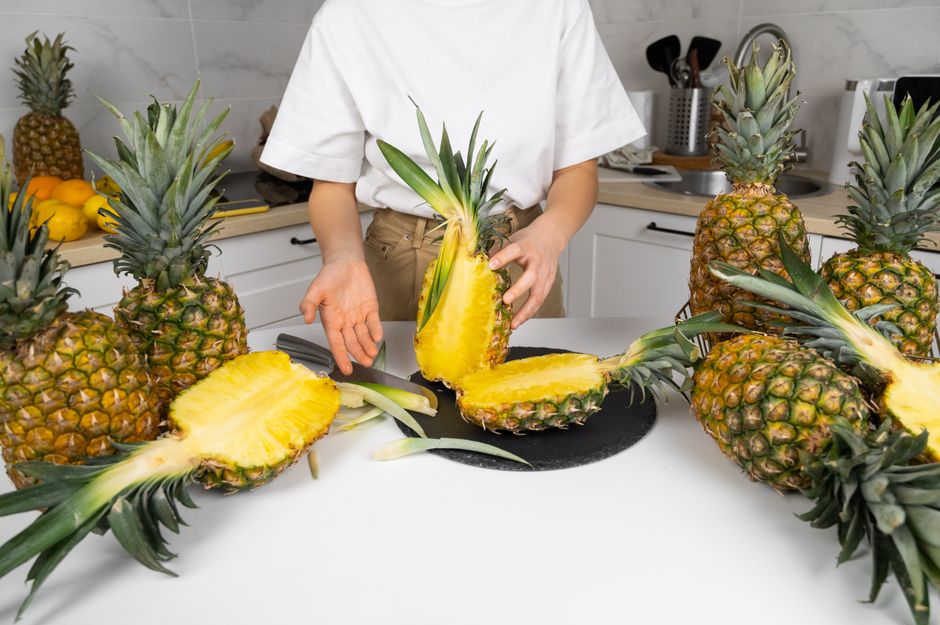
Lay the pineapple horizontally on the board. Hold the leafy crown with your non-dominant hand, keeping your fingers well away from the cut line, and slice straight through about ½ inch below the leaves. Flip the fruit and make a parallel cut across the base, removing only enough so that the pineapple stands upright without wobbling. The base edge often has ripe, sweet flesh close to the skin; do not slice off a thick pale slab.
Place the pineapple on its freshly cut base. Using an 8- to 10-inch chef’s knife, start at the top where the flesh meets the rind and slice downward, following the natural curve of the fruit and cutting just deep enough to remove the yellow-brown shell. Work around the pineapple in 6 to 8 wide panels rather than trying to peel the whole fruit in one spiral. Go shallow around the “belly” of the fruit and slightly deeper near the top and bottom, where the skin tucks inward. This preserves the rounded shape and avoids channeling the fruit with deep waste.
Most pineapples will still have shallow brown flecks or grooves after peeling. Do not scoop each one out with the tip of a paring knife. Look closely and you will see the eyes are arranged in a diagonal spiral around the fruit. Starting at one end of a spiral row, make two shallow cuts angling toward each other to form a V, then lift out the full strip of eyes. Repeat along each diagonal row. If a few shallow eyes remain after that, spot-clean only them; small remnants are harmless to eat but visually distracting in a fruit platter.
Set the peeled pineapple on its side and slice lengthwise from top to bottom into four equal wedges. Lay each wedge flat on the board with the narrow core strip facing up. Run the knife at a slight angle along the length of the core to remove it in one triangular piece; the core is edible but too fibrous for most fresh preparations. Now cut the wedges into cubes, or leave them whole to slice into rings and spears.
Three Finishes After the Core Is Gone
A medium pineapple that weighs about 2 kg (4½ lb) yields 4 to 5 cups of fresh cubes once the rind, crown, base, and core are removed. If your fruit gives you less than 3 cups, you were likely cutting the panels too deep or trimming off too much base flesh.
How to Pick a Pineapple Worth Cutting
A pineapple will not get noticeably sweeter after it is picked. The tug-a-leaf test mostly tells you how fresh or dehydrated a fruit is, not how ripe and sugary it is. A pineapple can soften and develop more aroma on the counter, but its sugar content is largely fixed at harvest [2]. For a reliably sweet result, smell before you buy: a ripe fruit smells fragrant and slightly musky at the base. It should feel heavy for its size and have a shell that yields just a little when pressed. A sour, fermented smell, weeping base, or soft spots means it is already past its prime.
Color is a partial clue but not a guarantee. Many pineapples are ripe while still mostly green, especially certain varieties from Hawaii and Costa Rica. Golden color tends to indicate more mature fruit, but the aroma at the stem end and firmness are better daily indicators. Since cutting cannot fix a bland pineapple, choose the best fruit at the market and cut it within a day or two.
Storage, Safety & Make-Ahead Tips
Fresh-cut pineapple is highly perishable because it is acidic, moist, and full of natural sugars. Refrigerate the pieces in an airtight glass or plastic container and use them within 3 to 4 days. Cut fruit should never linger at room temperature for more than 2 hours, including while on a picnic or brunch board. To freeze, arrange cubes in a single layer on a parchment-lined tray, freeze until solid, then transfer to a freezer bag for up to 3 months; frozen pineapple is best used in smoothies or cooked dishes rather than eaten raw as a crisp snack.
If the pineapple is firm and aromatic but tastes only mildly sweet, cut it into chunks and toss with a squeeze of lime and a pinch of flaky salt. The salt suppresses bitterness, and the lime accent makes the fruit taste brighter. Browning the fruit on a hot grill or in a cast-iron pan also caramelizes the cut surface and compensates for lower natural sugar.
The Right Tools & Knife Safety
You do not need a fancy pineapple corer, and many spiral slicers actually waste the outer flesh while struggling with uneven fruit. The five-move method above only needs three things:
A serrated knife is optional. It can grip the slick rind more easily, but it tends to tear the flesh if you are not precise. A sharp straight-edged chef’s knife is faster once the technique clicks.
Pineapple cutting injuries usually happen during the peeling step, not the chopping step. Curl the fingers of your guiding hand under like a claw, keep the knife edge pointed away from your body, and never try to catch a falling fruit or blade. If you are cutting rings, cut the pineapple in half crosswise first if it rolls and feels unstable. Slow, stable cuts are faster than a trip to urgent care.
Pineapple Cutting FAQ
Does pineapple get sweeter after you bring it home?
No. Pineapple does not continue accumulating sugar after harvest. It may soften, become juicier, and develop a stronger fragrance on the counter, but the sweetness you taste at purchase is essentially the sweetness you will get [2]. Smell and weight are better ripeness cues than leaf color or leaf-pull resistance.
Can you eat the pineapple core?
Technically yes. The core is edible and contains the same nutrients as the flesh, but it is woody and much less pleasant to chew raw. Rather than forcing yourself through it, save the cores after cutting. They are excellent for juicing, blending into smoothies, or simmering in water with cinnamon for a fragrant pineapple tea.
Why does fresh pineapple make my mouth tingle or burn?
Fresh pineapple contains bromelain, a group of enzymes that can break down proteins. Because the inside of your mouth is coated in protein, a slice of very fresh pineapple can create a tingling or mild burning sensation [3]. Refrigerating the fruit or cooking it deactivates much of the enzyme activity, which is why canned and grilled pineapple rarely cause the feeling.
What is the fastest way to peel a pineapple for a large batch?
For volume, skip the curved contour peeling. Slice off both ends, then stand the fruit upright and cut off the four sides straight down to make a square block. You sacrifice a little flesh along the curved edges, but you gain speed and the remaining fruit is perfectly flat for uniform cubes. This is the method most restaurant prep cooks use when turning out fruit salad for a crowd.
Should I soak cut pineapple in salted water?
It is a popular street-food technique in parts of Southeast Asia and Latin America. A very brief soak in lightly salted water can reduce the sharp tingle of bromelain and make the fruit taste rounder and sweeter. If you try it, use about 1 teaspoon of salt per 4 cups of water, soak for a minute or two, then drain thoroughly. Sugar or lime juice can play a similar balancing role without changing the texture.
How do I know if a cut pineapple has spoiled?
First signs are a sour, vinegary smell, slimy texture on the cut surfaces, or browning that goes beyond normal oxidation. Whole pineapple shells can sometimes show a little gray mold near the base or crown, but cut pineapple should look bright and smell clean. When in doubt, throw it out—cut fruit is inexpensive to replace and not worth a foodborne illness.
- Rinse and dry the whole pineapple before cutting so the knife does not drag shell bacteria or grit into the flesh.
- Cut only a minimal slice from the crown and base; the bottom-most flesh is often the sweetest and most wasted part.
- Peel in 6 to 8 vertical panels that follow the fruit’s natural curve, not in one aggressive sweep.
- Remove eyes by following the diagonal spiral rows with two shallow angled cuts rather than digging out each eye individually.
- Quarter the fruit before coring, then make cubes, rings, or spears from the clean wedges.
- Store cut pineapple in the refrigerator for up to 4 days, or freeze cubes for up to 3 months for smoothies and cooked dishes.