Pizza has become so familiar that its history is easy to take for granted. The bubbling, scorched flatbread we recognize today was not invented in ancient Rome or Greece — it was born in the crowded streets of 18th-century Naples, then carried across the world by immigrants, surviving queens, and the physics of a 430°C wood-fired oven.
The history of pizza begins in Naples, not ancient Rome. Before the 18th century, pizza was a plain, oven-baked flatbread; once the city’s poorer cooks laid tomato sauce and buffalo mozzarella onto that dough, modern pizza was born. Queen Margherita’s famous 1889 visit made a regional street food a national emblem.
- Ancient flatbreads and the word written in 997
- How Naples turned bread into pizza
- The Margherita legend: Fact, folklore, and the mother of all toppings
- Crossing the Atlantic with Italian immigrants
- Six regional expressions of the same idea
- The culinary science inside an 805°F oven
- Honoring pizza history in a home oven
- Pizza history FAQ
People often ask who “invented” pizza, but that framing misses the point. Flatbreads have fed Mediterranean cultures for many thousands of years. What made Naples exceptional was a convergence of poverty, urban density, and cheap, delicious ingredients that no earlier era possessed. A Neapolitan street baker had no interest in creating a culinary masterpiece — he was trying to feed a hungry customer for a few coins. That practical transaction placed a tomato-sauced, cheese-topped bread in front of the public, and it changed food history forever.
The rise of pizza also depended on an unusual set of regional conditions: the volcanic soil around Mount Vesuvius produces wheat and famously sweet San Marzano tomatoes; Campania’s water buffalo provided fresh mozzarella; and Naples’s street dwellers, called lazzaroni, ate standing up, often with no plates or cutlery. Pizza was literally built for their hands.
Ancient Flatbreads and the Word Written in 997
The deepest pizza ancestry lies in the ancient Mediterranean oven. Egyptians and Hebrews fermented wheat dough; Greeks baked a round, herbed flatbread called plakous; Romans stamped savory toppings onto focaccia-like bases and sometimes called them pinsa. None of those foods used tomato, none used fresh mozzarella, and none would look like a Margherita on a modern menu. They were, however, the dough-and-fire foundation on which Naples would later build.
The word itself has a murkier paper trail. Most etymologists trace pizza toward the Latin pinsere, meaning “to pound, stamp, or crush,” an appealing image of a baker pressing dough flat with open palms. Southern Italians also knew the Byzantines and Greeks as pitta, and medieval Latin documents from Italy contain similar terms. The first clearly recognized written use of “pizza” appears in an unlikely source: a 997 AD parchment from Gaeta, in the region south of Rome, in which a bishop leases land with a condition that one party pay “twelve pizzas” each year — likely flatbreads, not the tomato-topped version we know. The word existed centuries before the dish did as we now define it.[1]
| Stage | Place & approximate date | What changed |
|---|---|---|
| The word appears | Gaeta, Italy — 997 AD | “Pizza” is written in a Latin lease document; it still means a bread-like cake, not a sauced pie. |
| Tomatoes arrive | Europe — early 1500s | New World tomatoes reach Spain and Italy; Europeans first regard them as decorative or poisonous. |
| Neapolitan street stalls | Naples — 1700s | Poor urban bakers sell quick flatbreads topped with oil, lard, cheese, or eventually tomato. |
| First true pizzerias | Naples — 1738–1830 | Antica Pizzeria Port’Alba grows from a street stall into a sit-down pizzeria with wood-fired ovens. |
| Margherita moment | Naples — 1889 | The famous Brandi story links pizza to Queen Margherita and the Italian flag colors. |
| American landing | New York City — 1905 | Gennaro Lombardi operates what is commonly called the first licensed U.S. pizzeria. |
| Heritage status | UNESCO — 2017 | UNESCO inscribes the art of the Neapolitan pizzaiuolo on its Intangible Cultural Heritage list. |
This timeline matters because it upends the common mental image of pizza as an unchanged, centuries-old recipe. The dough is ancient; the tomato topping is comparatively modern; the mozzarella-and-basil arrangement is a sophisticated cultural composite.
How Naples Turned Bread Into Pizza
In the early 18th century, Naples offered exactly what a new street food needed: a vast urban population, abundant wheat from the surrounding countryside, and a class of laborers who ate standing up in public. Cooks prepared simple flatbreads in masonry ovens on every corner, then dressed them with pork fat, salt, affordable cheese, olive oil, and herbs. These early pizzas were not the luxurious pies of modern pizzerias, but they solved a daily problem: feeding a hungry person quickly and without silverware.
The tomato was the missing ingredient that made pizza modern. After arriving from the Americas in the 16th century, tomatoes crept into southern Italian cooking slowly. Gardeners grew them for ornament; wealthier tables distrusted their acidity. It was in the poorer quarters of Naples that the tomato found its true audience. Home cooks and street bakers realized that a slow-reducing tomato sauce brought sweetness, body, and a welcome hit of moisture to bread. By the late 18th and early 19th centuries, the Neapolitan pizza with tomato had become a recognizable local genre.
The city also organized pizza into a craft. Specialist bakers, the pizzaiuoli, developed a fast, athletic work style: tossing high-hydration dough into thin disks, sliding it onto a hot stone, and working in total synchronization around the small oven mouth. A social division followed — the words pizzaiuolo and pizzaiola eventually referred not just to the baker but to a whole urban kitchen culture. Around 1830, the storied Antica Pizzeria Port’Alba — still operating today — moved from a street stand into a proper pizzeria in Naples, an early milestone in pizza’s shift from marginal food to commercial institution. By the mid-19th century, visiting celebrities and European aristocrats had begun to climb down into the alleys of Naples just to taste the strange, fiery flatbreads the common people adored.
The Margherita Legend: Fact, Folklore, and the Mother of All Toppings
The most famous scene in pizza history has become a kind of culinary fairy tale. According to the standard account, in June 1889 Queen Margherita of Savoy and King Umberto I visited Naples. The queen, tired of rich aristocratic French cuisine, asked to be served the working-class pizzas that the city had become famous for. Raffaele Esposito and his wife, Maria, at Pizzeria Brandi, baked a trio of pizzas. The queen reportedly ignored the more traditional versions in favor of one topped with tomato, mozzarella, basil, salt, and olive oil. In its honor, the pizzeria named the creation pizza Margherita. A marble plaque outside the restaurant still recounts the visit.
How much of that story is strictly documented remains a subject of food-historical debate. Tomato-and-cheese pizzas were almost certainly sold before 1889, and the queen’s exact words have not survived in any contemporaneous royal record. What matters more than the exact menu is the symbolism. Fresh mozzarella is white, tomato sauce is red, and basil is green — the three colors of the Italian flag. If the story is partly constructed, it was constructed beautifully, during a period when newly unified Italy was hunting for a shared national culture.
The Margherita story did something no earlier pizza anecdote had done: it gave a street food respectability. After 1889, pizza was no longer solely the food of the lazzaroni. It became an object of tourist curiosity and national pride, the first chapter in pizza’s slow journey from the edge of a Neapolitan alley to the center of the world’s plate.
Crossing the Atlantic With Italian Immigrants
Pizza moved overseas on the same steamships that carried millions of Italian immigrants to the United States in the late 19th and early 20th centuries. Neapolitan bakers reconstructed their coal-fired ovens in Italian-American neighborhoods of New York, Boston, Philadelphia, and San Francisco. By 1905, Gennaro Lombardi had established a small grocery and pizzeria in Manhattan’s Little Italy. Lombardi’s grew into what popular food history recognizes as the first licensed pizzeria in the United States.
The Italian-American pizza that developed there was not content to stay a faithful Neapolitan copy. New York’s bread flour — richer in gluten than southern Italian 00 flour — made the dough stronger and more elastic. Cooks stretched large pies, often finished with a dusting of oregano and a layer of relatively low-moisture mozzarella, then served them by the slice. The foldable point of a New York slice became a city-wide breakfast, lunch, and dinner ritual.
Pizza continued to evolve through American regional ingenuity. New Haven’s Frank Pepe opened his famous coal-fired shop in 1925 and built a cult around the white clam pie. Chicago developed its towering, cheese-layered deep-dish pizza at Pizzeria Uno in 1943, although the exact paternity of that invention is still debated.
World War II amplified the trend: countless American soldiers stationed in southern Italy tasted wood-fired Neapolitan pizza for the first time and returned home asking for it. The postwar pizza boom inspired the national chains that made pizza ubiquitous by the 1960s and 1970s. Pizza had crossed the ocean as a minority heritage food; within a generation it was almost as American as an apple pie.
Six Regional Expressions of the Same Idea
Pizza’s global spread did not dilute its identity; it multiplied it. Each new town recorded local geography, local ovens, local flour, and local dairy culture in the shape of the pie. These six regional voices tell the wider history in miniature.
High-hydration dough, hand-stretched to a thin center with a puffy edge, and fired for 60–90 seconds in a wood-fired dome oven. The finished crust carries blistered leopardatura spots — the visual stamp of intense heat.
A large, hand-tossed crust with moderate chew, crisp enough at the tip to hold its shape when folded. Tomatoes and mozzarella remain restrained, making every element identifiable.
Frank Pepe’s coal-oven pizza has a thin, dramatically charred crust and often skips mozzarella entirely. Its signature white clam pie is a seafood-inflected reinvention of Neapolitan simplicity.
Deep-dish layers cheese directly over raw dough, then adds chunky tomatoes and chunky toppings on top. The butter-rich crust of the pan-edged pie approaches a savory pastry more than a flatbread.
Rome’s long, rectangular, focaccia-like sheet pizza is sold by weight and reheated as a snack. Its crisp, bubbly base is a direct descendant of the ancient Mediterranean bakery.
Baked in square automotive drip pans, Detroit pizza builds a thick, airy crust with a brick-cheese crown around the edges; the caramelized cheese rim is as essential as the tomato.
| Style | Birthplace | Defining character |
|---|---|---|
| Pizza Napoletana | Naples, Italy | Wood-fired, soft-edged, quickly blistered under extreme heat |
| New York slice | New York City, USA | Large, thin, foldable, sold by the single wedge |
| New Haven-style | New Haven, Connecticut | Coal-fired char, minimal cheese, unusual seafood toppings |
| Chicago deep dish | Chicago, Illinois | Upside-down cheese-and-tomato layering in a deep pan |
| Pizza al taglio | Rome, Italy | Rectangular sheet, crisp base, sold by weight |
| Detroit-style | Detroit, Michigan | Square pan pizza with crunchy cheese-fried edges |
Why a 430°C Oven Rewrote a Nation’s Food Culture
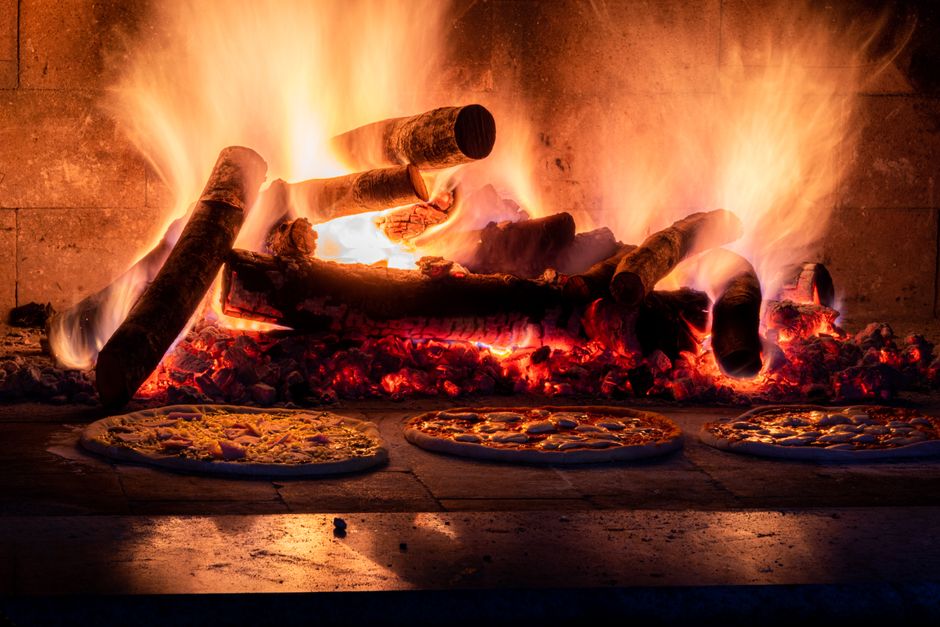
A traditional Neapolitan wood-fired oven operates at roughly 430°C (805°F), pushing pizza to finish in under 90 seconds. That extreme heat is not a theatrical flourish; it is a chemical instrument. During the brief bake, the dough’s exterior intensifies through Maillard browning, producing the hundreds of small toasted flavor compounds that make crust taste more complex than bread. Sugars at the surface caramelize, while water in the dough’s center remains trapped, leaving the thin base just moist enough to be pliable.
Professional Neapolitan pizza was formally disciplined by the Associazione Verace Pizza Napoletana, founded in 1984, which adopted a public standard for the preparation, dough composition, and firing conditions of what it calls “Verace Pizza Napoletana.”[3] European and transnational recognition later followed. In 2010, the European Commission entered “Neapolitan pizza” on its register of Traditional Specialities Guaranteed, a status that protects a traditional production method without claiming that only one town may use the name.[2] And in 2017, the United Nations Educational, Scientific and Cultural Organization inscribed “the art of the Neapolitan pizzaiuolo” on its celebrated Intangible Cultural Heritage list.[4]
The science also explains why most home ovens cannot replicate pizza history exactly. A conventional kitchen oven at 260°C (500°F) transfers far less thermal energy to the dough in the same two or three minutes. The crust bakes more slowly, the center may overcook before the rim bubbles, and the char of a coal-fired pie remains elusive. Understanding this gap between tradition and home equipment is the key to cooking a historically honest approximation.
How to Bake With Pizza’s History in a Home Oven
You can respect the tradition without building a brick dome. Change your tools, not your ambitions. Preheat a heavy pizza steel or thick cast iron pan on the highest rack at 260°C (500°F) for at least 45 minutes, then switch your oven to the broiler just before launching the pizza. The steel stores and radiates heat from below; the broiler mimics the fierce upper heat of a dome oven. A 250–280g dough ball, stretched to roughly 30cm, will usually bake in 4–6 minutes with a blistered rim and a crisp heel.
Dough deserves the same historical attention as the oven. Use 60–70% water by baker’s percentage and allow the dough a cold, slow fermentation of 24 to 72 hours. That long rest develops flavorful organic acids and gives the dough a more extensible gluten network, which can produce a puffy cornicione even in a domestic oven. Buy Italian-style 00 flour or a high-protein bread flour, keep the dough well-floured during stretching, and resist the urge to roll it with a pin.
Top the pizza as a Neapolitan baker would — simply. Crush whole, peeled San Marzano tomatoes by hand; season with fine sea salt and perhaps a few leaves of fresh basil. Add mozzarella in small, torn laced pieces, not a dense blanket; when cheese sits too thickly, it shields the crust from heat and steams the center. Bake, then finish with excellent olive oil and fresh basil after the pizza leaves the oven, so the herbs keep their aromatic lift.
Do not skip the preheat. A cold steel or pan acts like a heat sink, leaving the underside pale and soggy. Steel needs a long, full-oven preheat before it becomes a genuine substitute for a Neapolitan stone floor. The broiler should be used only after the steel is already saturated with heat; otherwise you will burn the top before the base sets.
Pizza History FAQ
Where was pizza actually invented?
Modern pizza was invented in Naples, Italy, during the 18th century, when the city’s street bakers began topping flatbreads with tomato sauce and cheese. Flatbread traditions existed earlier in Greece, Rome, and the Middle East, but the tomato-sauced, mozzarella-topped pizza is a Neapolitan creation.
Did Marco Polo bring pizza to Italy from China?
No. There is no credible contemporary evidence that Marco Polo introduced pizza from China. Italian bakers had been making herbed and topped flatbreads for centuries before Polo’s travels. The tomato, without which pizza would not exist, did not reach Italy from the Americas until generations after his death.
Is the Margherita story historically true?
It is true enough to be a cornerstone of the legend, but it has been softened by retelling. Most food historians accept that a pizzaiolo from Pizzeria Brandi prepared patriotic pizzas for Queen Margherita in 1889; whether the queen “invented” the specific Margherita composition is more doubtful. Cheese-and-tomato pizzas almost certainly existed before the royal visit.
Why is Neapolitan pizza different from New York pizza?
Flour and heat are the main differences. Neapolitan pizza uses finely milled 00 flour, a highly hydrated dough, and a blisteringly hot wood-fired oven. New York pizza evolved with stronger American bread flour, slightly higher gluten content, and a lower-temperature gas oven, which yields a sturdier, more foldable slice.
What does “Traditional Speciality Guaranteed” mean for Neapolitan pizza?
A Traditional Speciality Guaranteed is a European Union protection scheme that certifies a traditional production method and recipe. In 2010, the EU registered Neapolitan pizza on that list, meaning pizza sold under the registered designation must follow prescribed traditional practices. It is a method-based label, not a geographic origin label.
What belongs on a historically authentic Margherita?
Tomato sauce, fresh mozzarella made from Italian milk or water buffalo milk, fresh basil, extra-virgin olive oil, and fine sea salt over a wood-fired Neapolitan base. The crust should have a tender blistered rim, thin center, and a finish that does not need cured meat or a dozen additional toppings.
- Pizza was not created by a single chef in a single ceremonial moment; it was the long, practical invention of ordinary bakers in Naples, southern Italy.
- The first documented word “pizza” appears in a 997 AD Latin parchment from Gaeta, centuries before tomato arrived in Europe.
- Tomatoes transformed pizza only after they moved from botanical curiosity to everyday ingredient in Naples’s poorer kitchens.
- The Margherita legend of 1889, whether wholly accurate or partly myth, shifted pizza from a poor street food to a national Italian symbol.
- American pizza is not a corrupted copy; it is a regional evolution driven by different flour, bigger ovens, and immigrant confidence.
- A true Neapolitan pie lives and dies by high heat: roughly 430°C (805°F) in a wood-fired oven producing a 60–90 second bake with a blistered rim.
- Davidson, A., & Jaine, T. (eds.), The Oxford Companion to Food, 3rd ed. — entries on “pizza,” “focaccia,” and “tomato” (Oxford University Press, 2014).
- European Commission, Regulation (EU) No 97/2010 — registration of “Neapolitan pizza” as a Traditional Speciality Guaranteed, Official Journal of the European Union, 2010.
- Associazione Verace Pizza Napoletana (AVPN), Regulations for the International Verace Pizza Napoletana Mark, public standard for dough, ingredients, and wood-fired baking.
- UNESCO, The Art of Neapolitan “Pizzaiuolo”, inscribed on the Representative List of the Intangible Cultural Heritage of Humanity, 2017.