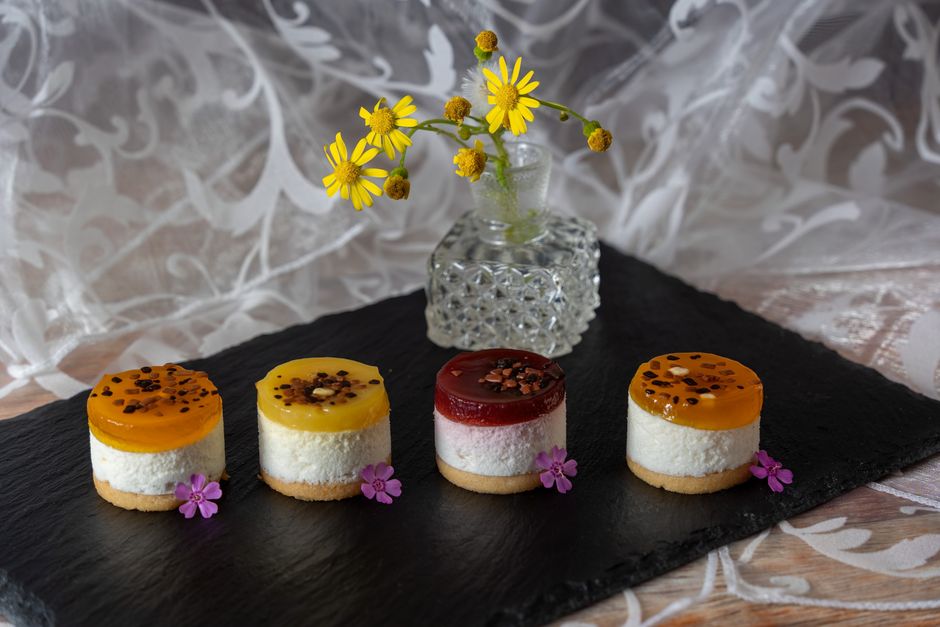
A 9-inch New York–style cheesecake with a buttery graham crust, a dense-but-silky custard center, and a surface that never cracks — built on exact temperatures, one critical mixing rule, and a water bath that does the hard work for you.
Beat 32 oz (907 g) of room-temperature full-fat cream cheese alone until perfectly smooth, then add 1 cup (200 g) sugar, ¾ cup (180 g) sour cream, 4 large eggs (one at a time, on low speed), vanilla and lemon. Pour over a par-baked graham crust in a 9-inch springform, bake in a water bath at 325°F (163°C) for 60–75 minutes to an internal center temperature of 150°F (65°C), then rest 1 hour in the switched-off oven, cool to room temperature, and refrigerate 8–12 hours before slicing.
Flavor Profile and the Real History of Cheesecake
A properly made cheesecake is not sweet-heavy. The dominant note is lactic tang — the cultured, slightly sour edge of cream cheese — followed by egg custard richness, then vanilla and a whisper of lemon that keeps the whole slice from turning cloying. The crust contributes salt and toasted-butter bitterness, which is why a graham base works better than a plain cookie one. Texturally, the goal is a crumb that holds its shape when sliced but dissolves on the tongue without any graininess.
The dessert is far older than the New York deli version most people picture. The earliest documented cheesecakes appear on Samos and other Greek islands as early as the 8th century BC, and by roughly 160 BC the Roman statesman Cato the Elder recorded a formula for libum — a sacrificial cake of flour, cheese, and eggs baked on bay leaves — in De Agri Cultura.[5] What changed in the modern era was the cheese itself.
An American dairyman, William Lawrence, was attempting to reproduce French Neufchâtel when he landed instead on a richer, creamier, higher-fat fresh cheese. That accident became mass-produced cream cheese, and by the 1920s it had displaced the cottage cheese and quark used in earlier American recipes.
The version we now call “New York style” crystallized in the 1920s–30s in Manhattan restaurant kitchens and Jewish-American dairy delis, where bakers pushed the cream cheese ratio higher, added heavy cream or sour cream, and served tall, dense slices. Meanwhile, Germany kept its Käsekuchen with quark, Italy leaned on ricotta, Japan developed a featherlight soufflé style, and the Basque Country produced the aggressively burnt, custardy tarta de queso. Same idea, five different custards.
One structural fact drives every technique in this recipe: cheesecake is a custard, not a cake. There is no gluten network holding it up and no chemical leavener. It sets because egg proteins unwind, bond, and trap water and fat as they coagulate, and because cream cheese is a dense emulsion of fat, protein, and water that firms up as it chills.[3] Push that coagulation too far and proteins squeeze out water — that’s the graininess and weeping you see in overbaked slices.
“A cheesecake that cracks is not a cheesecake that failed to rise. It’s a custard that was cooked past the point where it could still relax.”
— WorldDishly test kitchen notes
Ingredient Selection: What Actually Changes the Texture
Five ingredients carry this entire recipe. Get the fat level and the temperature right and most of the technique takes care of itself.
Cream cheese: use blocks, never spread
Full-fat block cream cheese contains roughly 33–34 g of fat and about 6 g of protein per 100 g, and it is formulated to hold a firm slice.[1] The whipped or “spreadable” tub versions contain added air and stabilizing gums and produce a mousse-like filling that slumps. Buy brick-style, full fat, and check the label: carob bean gum is fine, but you want cream cheese first on the ingredient list.
Eggs: the setting agent with a narrow window
Egg whites begin to coagulate near 144–149°F (62–65°C) and yolks around 158–165°F (70–74°C).[3] That narrow band between “liquid” and “rubbery” is why the internal temperature target of 150°F matters more than the timer. For food-safety reasons, USDA guidance for egg dishes calls for 160°F (71°C); a cheesecake pulled at 150°F in the center will carry over to roughly 155°F and is made with sugar, acid, and a high-fat dairy matrix. If you prefer to bake to the full official number, pull it at 158–160°F — you’ll lose a little silkiness but gain margin.[2]
Sugar: structure, not just sweetness
Sugar raises the coagulation temperature of egg proteins and holds moisture, which is why a cheesecake with a well-balanced sugar load stays creamy instead of turning to scrambled custard. Do not cut it below about ¾ cup (150 g) for this volume, and prefer fine or superfine granulated so it dissolves during a short mix.
The dairy liquid: sour cream vs. heavy cream
Sour cream adds tang and body; heavy cream adds pure richness and a looser, fluffier set. Using ¾ cup of sour cream is the classic New York balance. If you want Cheesecake Factory–style density, use half sour cream, half heavy cream and bake 5 minutes longer.
Crust: graham, digestive, or speculoos
Graham crackers give the lightest, most neutral base. Digestives are denser and slightly sweeter. Speculoos (Biscoff) adds caramel spice and pairs well with a burnt-Basque-style bake. Whatever you choose, the ratio is by weight: 3 parts crumbs to 2 parts sugar to 6 parts butter — for a 9-inch pan that’s 150 g crumbs, 25 g sugar, and 70 g melted butter.
| Component | Amount | Notes |
|---|---|---|
| Graham cracker crumbs | 1½ cups (150 g) | About 11 full sheets, finely crushed |
| Granulated sugar (crust) | 2 tbsp (25 g) | Optional if using speculoos |
| Unsalted butter, melted | 5 tbsp (70 g) | Cooled 5 min before mixing |
| Fine salt | ⅛ tsp (crust) + ¼ tsp (filling) | Do not skip — sharpens the tang |
| Full-fat cream cheese | 32 oz (907 g), 4 blocks | 68–70°F / 20–21°C |
| Granulated sugar (filling) | 1 cup (200 g) | Superfine if available |
| Cornstarch | 1 tbsp (8 g) | Optional insurance against cracking |
| Full-fat sour cream | ¾ cup (180 g) | Or ½ cup cream + ¼ cup sour cream |
| Large eggs | 4 (200 g), room temp | Beat in one at a time, low speed |
| Vanilla extract | 2 tsp | Pure, not imitation |
| Fresh lemon juice | 1 tbsp (15 ml) | Cuts the fat; do not exceed 2 tbsp |
Prep, Pans, and Equipment Setup
Ninety percent of cheesecake failures are decided before the batter hits the oven. Work through this checklist before you unwrap a single block of cream cheese.
If you bake on convection, drop the temperature to 300°F (149°C) and start checking at 50 minutes. Moving air sets the outer custard faster and exaggerates the temperature differential between rim and center — the exact condition that produces cracking.
One more prep note: have your cooling plan ready before baking. A cheesecake that goes from a 325°F oven to a 70°F kitchen counter in one move will contract fast and split across the top. The rest in this recipe is staged — oven off, then counter, then fridge — and each stage has a job.
The Step-by-Step Master Method
Total time: about 30 minutes active, 65 minutes baking, 8–12 hours chilling. Yield: one 9-inch cheesecake, 12 slices. The steps below are ordered so that nothing sits waiting — the crust par-bakes while you beat the filling.
Water at 212°F (100°C) can never exceed 212°F, so the sides of the pan never get hotter than a gentle simmer even while the air in the oven sits at 325°F. That flattens the temperature gradient across the cheesecake, so the rim sets at roughly the same rate as the center. It also humidifies the oven air, which keeps the surface from drying into a leathery skin that splits as the custard contracts.
USDA FSIS guidance for dishes containing egg calls for cooking to 160°F (71°C).[2] Cheesecake baked to 150°F in the center reaches about 155°F after carryover and is further protected by its sugar, acid, and high-fat content. If you are baking for anyone immunocompromised, pregnant, or elderly, either bake to 158–160°F internal or use pasteurized in-shell eggs, which are widely available in US supermarkets.
Key Ratios and Temperature Targets
Once you internalize these two tables, you can scale the recipe up or down, swap the crust, or invent a flavor variant without losing the texture.
| Component | Weight for a 9-inch cake | Baker’s % (cream cheese = 100%) |
|---|---|---|
| Full-fat cream cheese | 907 g (32 oz) | 100% |
| Granulated sugar | 200 g | 22% |
| Whole eggs | 200 g (4 large) | 22% |
| Sour cream or heavy cream | 180 g | 20% |
| Butter (crust) | 70 g | — |
| Graham crumbs (crust) | 150 g | — |
Increase the egg percentage past about 28% and the cheesecake turns distinctly soufflé-like — taller, airier, and prone to falling. Drop below 18% and it won’t set firmly enough to slice cleanly even after a long chill.
| Stage | Target | Why It Matters |
|---|---|---|
| Room-temperature ingredients | 68–70°F (20–21°C) | Cold cream cheese won’t blend smooth; it forces overmixing |
| Crust par-bake | 325°F (163°C), 10 min | Sets the butter and blocks a soggy base |
| Oven (conventional) | 325°F (163°C) | Low and slow keeps the custard in its coagulation window |
| Oven (convection) | 300°F (149°C) | Moving air sets edges faster; compensate with less heat |
| Water bath | 200–212°F (93–100°C) | Caps pan-side temperature at 212°F regardless of oven air |
| Internal doneness, creamy | 150°F (65°C) | Silkiest slice; carries over to ~155°F |
| Internal doneness, firm | 158–160°F (70–71°C) | Full FSIS egg-dish margin; slightly less silky |
| Oven-off rest | 1 hour, door ajar | Gradual cooling prevents surface cracks |
| Refrigerator chill | 38–40°F (3–4°C), 8–12 h | Firms the fat matrix for clean slicing |
A 9-inch round pan holds this batter at a depth of about 2¼ inches. For a 10-inch pan, multiply everything by 1.23 and check at 55 minutes. For three 4-inch mini springforms, use one-third of the batter and bake 30–35 minutes to the same 150°F internal. For a 9×13-inch rectangular pan, multiply by 1.4 and bake 40–45 minutes.
Common Mistakes and Troubleshooting
Every classic cheesecake defect traces back to one of five root causes: batter temperature, aeration, oven heat, cooling speed, or moisture loss. Diagnose your bake against the list below.
Cracks are cosmetic. Two legitimate fixes: serve the cake with a poured topping (salted caramel, sour cherry compote, or a thin layer of ganache) that fills and hides the split, or run a hot offset spatula across the surface while the cake is still barely warm to smooth the crack closed. Do not try to patch it cold — you’ll tear the surface.
Flavor Variations That Keep the Structure
- Vanilla bean: swap the extract for the seeds of one vanilla bean plus 1 tsp extract.
- Lemon: increase juice to 2 tbsp and add 1 tbsp finely grated zest. Do not exceed 2 tbsp juice or the acid will tighten the custard.
- Chocolate: melt 170 g bittersweet chocolate, cool to lukewarm, and fold into the finished batter in three additions. Reduce sour cream to ½ cup.
- Pumpkin: replace the sour cream with 180 g pumpkin purée and add 1½ tsp cinnamon, ½ tsp ginger, ¼ tsp cloves. Bake 5–8 minutes longer.
- Basque burnt style: skip the water bath, increase the oven to 450°F (232°C), bake 30–35 minutes until deeply browned and still liquid in the center, then cool and chill 6 hours.
Pairing, Slicing, and Storage
Cheesecake’s acidity and fat make it unusually friendly to sharp, fruity, and bitter accompaniments. What it does not need is more sugar.
What to serve with it
- Fresh fruit: macerated raspberries, sour cherries, or sliced strawberries with a squeeze of lemon.
- Sauces: salted caramel, dark chocolate ganache, or a thin lemon curd.
- Beverages: espresso or cold brew (the bitterness mirrors the tang), an off-dry Riesling, a tawny port, or a small pour of bourbon.
- Contrast: a pinch of flaky salt on the slice, or toasted nuts for crunch.
Storage rules that actually matter
Because this is a dairy-and-egg custard, the cold chain is non-negotiable. Per USDA FSIS guidance, perishable foods should be refrigerated at 40°F (4°C) or below and never left at room temperature longer than 2 hours.[4] Cheesecake is at its best within the first 3 days and remains safe and good for 4 days; beyond that the crust softens and the custard starts to weep.
| Method | Time & Temperature | How To |
|---|---|---|
| Refrigerator | 38–40°F (3–4°C), up to 4 days | Cover with a domed lid or inverted bowl, not cling film pressed to the surface |
| Freezer, whole | 0°F (−18°C), up to 2 months | Chill fully, then wrap in plastic, then foil, then a freezer bag |
| Freezer, individual slices | 0°F (−18°C), up to 2 months | Freeze on a sheet pan 2 hours, then wrap each slice; thaw 8 hours in the fridge |
| Room temperature | Maximum 2 hours | FSIS limit for perishable dairy-egg desserts[4] |
Cheesecake is the ideal make-ahead dessert. Bake it 1 day before serving and chill overnight. For a 2-day lead time, bake, chill 12 hours, then wrap the top tightly and refrigerate. Add fruit toppings within 2 hours of serving so they don’t bleed into the surface.
Cheesecake FAQ
Why does my cheesecake always crack?
Cracking is caused by the surface setting before the interior, then the interior contracting faster than the set surface as it cools. Three fixes, in order of impact: bake in a water bath, bake to 150°F internal rather than a fixed time, and rest the cake in the switched-off oven with the door ajar for a full hour.
Do I really need a water bath?
You don’t need it, but you’ll get a visibly better result with it. The bath limits the pan-wall temperature to 212°F and humidifies the oven, which produces an even set and a glossy top. If you skip it, drop the oven to 300°F (149°C), bake 75–90 minutes, and accept that small cracks are likely.
How do I know when a cheesecake is done?
The center should jiggle like firm gelatin when you nudge the pan — a gentle whole-surface wobble, not a liquid ripple. The definitive test is an instant-read thermometer in the center: 150°F (65°C) for maximum creaminess, 158–160°F for the full USDA egg-safety margin.[2]
Can I make this cheesecake without a stand mixer?
Yes. A hand mixer on low speed works, though it takes about 5 minutes to get the cream cheese truly smooth. You can also do it by hand with a sturdy spatula and 10 minutes of determined work — just make sure the cream cheese is fully at 68–70°F first.
Why does the recipe use both sour cream and lemon juice?
Sour cream provides tang and body at a rate of about 20% of the cream cheese weight. Lemon juice adds brightness and acidity, which sharpens the cultured flavor and lightens the perceived richness on the palate. Both are balance tools, not just flavor additions.
Can I use low-fat or dairy-free cream cheese?
Low-fat (neufchâtel-style) cream cheese has more water and less fat, producing a softer, wetter set — reduce the sour cream to ½ cup and bake 5 minutes longer. Most dairy-free cream cheese alternatives rely on coconut oil or cashew base and set very differently; expect a looser custard and a shorter safe storage window.
How long can cheesecake sit out at room temperature?
Two hours maximum, per USDA FSIS guidance for perishable desserts containing dairy and eggs.[4] When serving buffet-style, set the cake on a tray over an ice bath or slice to order and keep the remainder in the refrigerator.
Can I bake cheesecake in a regular round cake pan?
You can, but lining it with a parchment sling is essential because the custard has no structural gluten and will tear if you invert the pan. A springform is far easier. If you use a solid pan, freeze the chilled cheesecake for 30 minutes before lifting it out with a wide spatula.
- Temper cream cheese, eggs, and sour cream to 68–70°F (20–21°C) — cold ingredients are the root cause of lumpy batter and overmixing.
- Beat the cream cheese alone first, add eggs last, and keep the mixer on low speed the entire time to avoid whipping in air.
- Bake at 325°F (163°C) in a water bath and pull the cake at 150°F (65°C) internal for the silkiest custard.
- Rest 1 hour in the switched-off, propped-open oven, then chill 8–12 hours — this staging, not luck, is what prevents cracks.
- Refrigerate at 40°F (4°C) or below within 2 hours and eat within 4 days; freeze slices up to 2 months at 0°F (−18°C).
- Scale confidently with baker’s percentages: cream cheese 100%, sugar 22%, eggs 22%, dairy liquid 20%.
- USDA FoodData Central. “Cheese, cream.” Nutrient profile: ~33–34 g fat, ~6 g protein per 100 g. fdc.nal.usda.gov
- USDA Food Safety and Inspection Service. “Eggs and Egg Products: Safe Handling, Storage, and Cooking.” Safe minimum internal temperature 160°F (71°C) for egg dishes. fsis.usda.gov
- McGee, Harold. On Food and Cooking: The Science and Lore of the Kitchen. Revised ed., Scribner, 2004. Egg protein coagulation temperatures; custard set and syneresis.
- USDA Food Safety and Inspection Service. “Refrigeration and Food Safety.” 40°F (4°C) or below; 2-hour limit for perishable foods at room temperature. fsis.usda.gov
- Cato, Marcus Porcius. De Agri Cultura (c. 160 BC). Recipes for libum and placenta, the earliest recorded cheese-and-egg cakes in the Roman tradition.
- FDA. Food Code (current edition). Two-stage cooling parameters: 135°F to 70°F within 2 hours, then 70°F to 41°F within an additional 4 hours. fda.gov