Egg bites that hold up in a lunchbox, chaffles with a real crust, and a six-minute steak-and-eggs plate — every recipe built on tested ratios, honest net-carb math, and techniques that survive a weekday alarm clock.
The three keto breakfast templates that cover 90% of mornings are: custard-set egg bites (1 egg : 1 tbsp cream : 10 g grated cheese, baked at 325°F/163°C in a water bath), the chaffle (1 egg + 56 g low-moisture mozzarella + 1 tbsp almond flour, 3–4 minutes in a hot waffle iron), and fat-forward skillet plates (steak, chorizo, or salmon plus eggs cooked in the rendered fat). Each lands between 0.5 g and 4 g net carbs per serving, where net carbs = total carbohydrate − dietary fiber − erythritol/allulose.[1]
- Why Keto Breakfast Looks Nothing Like Standard Breakfast
- Ingredient Selection: Fat, Protein, and the Sweetener Trap
- Prep and Equipment: The Short List That Actually Matters
- The Master Method: Six Core Keto Breakfast Recipes
- Ratio, Temperature, and Timing Table
- Common Mistakes and Troubleshooting
- Pairing, Storage, and Make-Ahead Notes
- Keto Breakfast FAQ
Why Keto Breakfast Looks Nothing Like Standard Breakfast
Breakfast is the most carbohydrate-dense meal in the Western canon. A bowl of oat flakes with a banana and honey runs roughly 60–75 g of carbohydrate; two slices of whole-grain toast with jam adds another 60 g or so. On a ketogenic protocol that targets 20–50 g of total carbohydrate per day, the entire morning budget is spent before the coffee cools.
So the keto breakfast isn’t a swap of one ingredient for another — it’s a structural rebuild. You remove the grain or fruit starch base and replace it with three things: a fat that carries flavor, a protein that carries structure, and a small amount of fibrous vegetable or nut flour to give the plate texture. That is the whole architecture. Every recipe below is a variation on it.
Before the 20th century, the English and American farm breakfast was already ketogenic by accident — eggs, cured pork, cream, butter, and occasionally leftover roast. The grain-and-juice breakfast that most people picture today was a marketing construction of the late 1800s and early 1900s, built by cereal manufacturers and the citrus industry.
What we call “keto breakfast recipes” in 2026 is largely a return to that pre-industrial plate, with modern precision: sous-vide egg bites, nut-flour batters, and sugar alcohols standing in for the jam and toast. The culinary traditions being revived — huevos rancheros without the tortilla, shakshuka without the bread, the Turkish menemen — were never carbohydrate-first to begin with.
That history matters practically. It means you are not inventing food from nothing. You are cooking dishes that already existed and simply not serving the starch component — which is a far easier brief than “make a low-carb version of a croissant.”
“The best keto breakfast is a breakfast that was never designed around bread in the first place. Shakshuka, chaffles, egg bites, steak and eggs — all of them work because nothing was removed.”
WorldDishly test kitchen note, October 2026
Ingredient Selection: Fat, Protein, and the Sweetener Trap
Fat: choose by function, not by trend
Fat in a keto breakfast does two jobs — it carries fat-soluble flavor compounds, and it slows gastric emptying so the plate holds you until lunch. Different fats do those jobs at different temperatures.
- Clarified butter or ghee (smoke point ~250°C/482°F) — the default for searing eggs and meat. Milk solids removed, so it won’t scorch at skillet temperatures.
- Bacon fat, rendered and strained — the best medium for frying eggs, because it already carries cured-pork flavor and has a smoke point around 190°C/375°F.
- Extra-virgin olive oil — reserve for finishing and for the chimichurri in Recipe 5. Its polyphenols degrade above roughly 200°C/392°F, so it is a finishing fat, not a searing fat.
- Coconut cream (the thick top layer of an unshaken can, ~20–22% fat) — the base for chia jars and for dairy-free custards.
Protein: cook to temperature, not to time
Egg dishes are the most commonly overcooked item in low-carb cooking, because the cues most people rely on — bubbling, browning, a dry-looking surface — all indicate past-doneness. Coagulation of egg proteins begins around 63°C/145°F for the yolk and 71°C/160°F for the white, and the window between “silky custard” and “rubber” is roughly 8°C/15°F wide.
For egg-based dishes served to anyone in a high-risk group (pregnant, elderly, immunocompromised, children), cook until the white and yolk are firm — USDA FSIS gives 160°F/71°C as the safe minimum for egg dishes.[2]
Not all “zero-carb” sweeteners behave the same way. Maltitol is a sugar alcohol with roughly half the glycemic impact of sucrose and a glycemic index around 35 — it will move blood glucose and cause digestive distress at doses above about 15 g. Erythritol is absorbed almost entirely before reaching the colon and carries an official acceptable daily intake of 0.5 g per kg of body weight per day under the EFSA 2023 re-evaluation.[3] Allulose is a rare sugar that is metabolized but not counted in net carbs on most labels.
For keto breakfast batters, use erythritol-allulose blends. They brown and caramelize, which pure erythritol does poorly, and they leave no cooling aftertaste in a savory-adjacent recipe.
Nut flours: blanched, superfine, and weighed
Almond flour varies enormously by brand. Almond meal — ground with skins on — is coarser, darker, and about 25% higher in fibre, and it will make a chaffle gritty. Look for “blanched almond flour, superfine” and weigh it rather than scooping: one cup of superfine almond flour weighs 96 g, and a scoop-and-level cup can easily hit 120 g, which throws off an entire batter. Coconut flour absorbs roughly four times its weight in liquid, so substitute it at one-quarter the volume of almond flour, never one-to-one.
Prep and Equipment: The Short List That Actually Matters
Keto breakfast fails most often for equipment reasons, not recipe reasons. Four pieces of gear carry nearly all the value:
- A 10-inch (25 cm) carbon-steel or cast-iron skillet — for skillet plates. Carbon steel is lighter and reaches searing temperature in about 90 seconds.
- A 7-inch (18 cm) nonstick skillet with a lid — for menemen, shakshuka, and covered egg cooking. A lid traps steam and sets the top of the egg without flipping.
- A standard 4-inch round waffle iron — for chaffles. Older, lower-wattage irons underperform: you want one that reaches and holds 375°F/190°C.
- A 12-cup silicone or nonstick muffin tin, plus a roasting pan deep enough for a water bath — for egg bites.
- Optional but transformative: an instant-read thermometer. A $20 probe converts egg cookery from guesswork into repeatable craft.
Render 500 g of diced bacon or pancetta in one batch, strain the fat into a jar, and refrigerate both separately. Cook and crumble 500 g of chorizo. Grate 300 g of a hard cheese — Gruyère, Manchego, or extra-sharp cheddar — and keep it in a sealed container with a paper towel. With those three components in the fridge, every recipe below becomes a five-minute assembly job on a weekday morning.
The Master Method: Six Core Keto Breakfast Recipes
These six recipes cover the full range of keto breakfast technique: custard, batter, bake, no-cook, skillet, and griddle. Learn the first two and the rest follow.
Recipe 1 — Brown Butter & Gruyère Egg Bites (Custard Method)
Yield: 12 bites · Net carbs: ~1.5 g per 2 bites · Active time: 10 min · Total: 40 min
This is a coffee-chain copycat that improves on the original because you control the cheese quality and the water bath keeps the custard at a safe, gentle temperature.
Recipe 2 — Smoked Salmon & Dill Chaffle (Batter Method)
Yield: 2 chaffles · Net carbs: ~2.5 g each · Total time: 8 min
Recipe 3 — Chorizo & Manchego Baked Eggs
Yield: 4 ramekins · Net carbs: ~3 g per ramekin · Total time: 22 min
Brown 150 g cured Spanish chorizo, diced, in a dry pan until the paprika-stained fat renders out; drain and reserve the fat. Divide the chorizo among 4 buttered 8-ounce ramekins along with 60 g sautéed spinach (squeezed dry) and 40 g grated Manchego. Crack 2 eggs into each ramekin, spoon 1 tbsp of the reserved chorizo fat over the tops, and bake at 400°F/205°C for 12–14 minutes, until the whites are just set and the yolks still wobble. Rest 3 minutes before serving — the residual heat finishes the set.
Recipe 4 — Coconut & Chia Overnight Jars (No-Cook Method)
Yield: 4 jars · Net carbs: ~4 g per jar · Chill: 4 hours minimum, 12 ideal
Whisk 400 ml full-fat coconut milk (or 240 ml coconut cream plus 160 ml water) with 60 g chia seeds, 2 tbsp erythritol-allulose blend, 1 tsp vanilla extract, and a pinch of salt. Chia absorbs roughly nine times its weight in liquid, so the mixture will look far too thin at first — that is expected. Refrigerate at least 4 hours, stirring once after 30 minutes to prevent clumping. Top with toasted unsweetened coconut flakes and 15 g crushed macadamia nuts. Chia brings 10 g of fibre per 28 g serving, which is why the net-carb count stays low.[1]
Recipe 5 — Steak & Eggs with Chimichurri
Yield: 2 servings · Net carbs: ~1 g per serving · Total time: 6 min with prepped steak
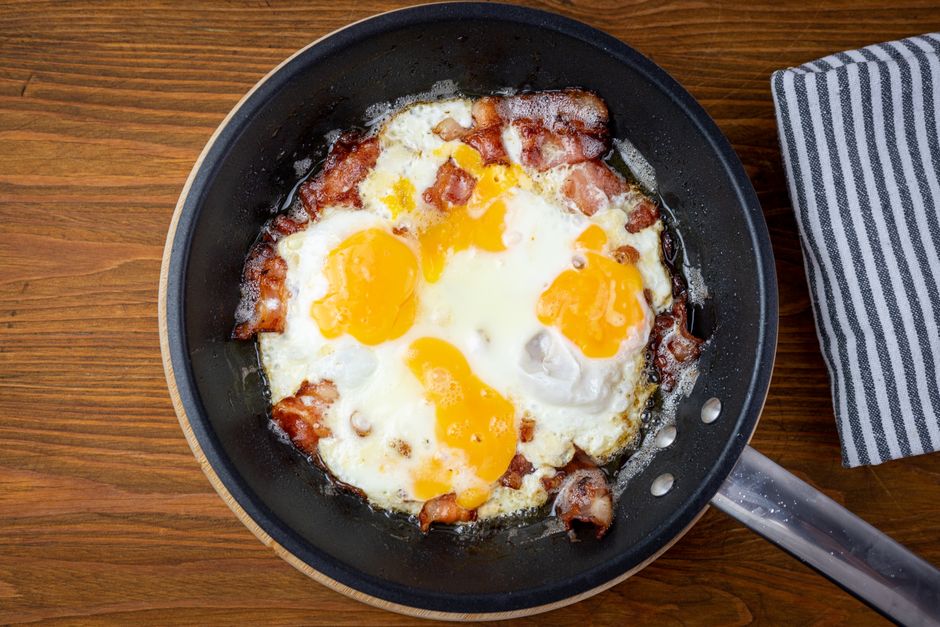
Season two 170 g sirloin or flat-iron steaks generously with salt at least 40 minutes ahead — or the night before — and let them sit uncovered in the fridge. Pat bone dry, then sear in a ripping-hot carbon-steel pan with 15 g ghee for 2–3 minutes per side for medium-rare (internal 130°F/54°C). Rest 5 minutes. Meanwhile, fry 4 eggs in the rendered pan fat, spooning hot fat over the whites until they set but the yolks stay liquid. Chimichurri: chop 30 g parsley, 2 garlic cloves, and 1 small shallot; combine with 4 tbsp olive oil, 1 tbsp red wine vinegar, ½ tsp dried oregano, and ¼ tsp red pepper flakes. Note that the shallot and garlic carry most of this dish’s carbohydrate — about 0.5 g per serving, which is why the herb sauce is modestly portioned.
Recipe 6 — Almond Flour Griddle Cakes
Yield: 8 small cakes · Net carbs: ~2 g each · Total time: 15 min
Whisk 120 g superfine almond flour, 1 tsp baking powder, 1 tbsp erythritol-allulose, and ¼ tsp salt. In a second bowl, whisk 3 eggs, 60 ml unsweetened almond milk, 30 g melted butter, and 1 tsp vanilla. Fold wet into dry and rest the batter 5 minutes — almond flour needs time to hydrate or the cakes stay gritty in the centre. Cook 2 tbsp of batter per cake on a buttered griddle at 325°F/163°C for 2 minutes per side. They brown faster than wheat pancakes, so pull them at deep golden, not dark brown. Serve with 1 tbsp salted butter and 2 tbsp whipped cream instead of syrup.
Across all six recipes, the ingredient that most often blows the carb budget is not the batter — it is the condiment. Two tablespoons of maple syrup is 26 g of carbohydrate. Two tablespoons of ketchup is roughly 8 g. Two tablespoons of most barbecue sauces run 14–18 g. Swap them deliberately: whipped cream and salted butter for pancakes, chimichurri or aioli for eggs, and full-fat Greek yogurt with lemon for anything that wants tang.
Ratio, Temperature, and Timing Table
Every number below was verified in the WorldDishly test kitchen at sea level. Above 3,000 feet, increase oven temperatures by 15°F/8°C and expect custards to set 3–5 minutes faster.
| Recipe | Core Ratio | Temperature | Time | Net Carbs / Serving |
|---|---|---|---|---|
| Brown Butter Gruyère Egg Bites | 1 egg : 15 g cottage cheese : 15 g cheese : 7 ml cream | 325°F / 163°C (water bath) | 22–26 min | ~1.5 g per 2 bites |
| Smoked Salmon Chaffle | 1 egg : 56 g mozzarella : 7 g almond flour | 375°F / 190°C iron | 3–4 min | ~2.5 g each |
| Chorizo & Manchego Baked Eggs | 2 eggs : 37 g chorizo : 10 g cheese per ramekin | 400°F / 205°C | 12–14 min | ~3 g per ramekin |
| Coconut & Chia Jars | 1 part chia : 6.5 parts liquid by volume | Refrigerated (≤40°F / 4°C) | 4 h minimum | ~4 g per jar |
| Steak & Eggs with Chimichurri | 170 g steak : 2 eggs per person | Steak 130°F / 54°C internal | 6–8 min | ~1 g per serving |
| Almond Flour Griddle Cakes | 40 g almond flour : 1 egg : 20 ml liquid | 325°F / 163°C griddle | 2 min per side | ~2 g per cake |
Common Mistakes and Troubleshooting
- Cook egg dishes to a minimum internal temperature of 160°F/71°C if serving anyone in a high-risk group.[2]
- Refrigerate egg bites, baked eggs, and chia jars within 2 hours of cooking — 1 hour if the room is above 90°F/32°C.
- Cooked egg dishes keep 3–4 days refrigerated at 40°F/4°C or below.[4]
- Reheat egg bites covered at 300°F/150°C for 8–10 minutes. A microwave works but tightens the texture noticeably.
- Never reheat a dish containing previously reheated eggs a second time.
Pairing, Storage, and Make-Ahead Notes
A keto breakfast plate benefits from the same pairing logic as any other: something fatty, something acidic, something with bite. Coffee with heavy cream is the default, but a dry café americano with a strip of lemon peel, or cold brew with unsweetened almond milk and cinnamon, cuts fat better and keeps the meal from feeling heavy at 7 a.m.
For weekend cooking, the skillet recipes are the ones worth doing properly. Steak rests 5 minutes minimum. The chimichurri is better made 30 minutes ahead so the garlic and oregano hydrate into the oil, and it keeps 5 days refrigerated in a sealed jar — but it loses its green within about 48 hours as the acid oxidizes the parsley.
“Portion the fat, not the flavour. Two tablespoons of chimichurri costs you half a gram of carbohydrate and makes a plain steak plate into a restaurant dish.”
WorldDishly test kitchen, October 2026
Keto Breakfast FAQ
How do I calculate net carbs for a keto breakfast recipe?
Net carbs = total carbohydrate − dietary fiber − sugar alcohols (erythritol and allulose are typically subtracted in full; maltitol is usually counted at about half). Start from verified database values per 100 g of each ingredient, then divide by your actual number of servings.[1] Weighing ingredients rather than measuring by volume is the single biggest accuracy improvement you can make — a “cup” of almond flour can vary by 25% between brands and scooping styles.
Can I eat bacon and eggs every day on keto?
Nutritionally, yes — the combination is close to ideal for the macro split, and eggs supply choline, B12, and complete protein. Practically, variety matters more than most keto guides admit: rotating in smoked salmon, chia, cheese, and vegetables gives you a broader micronutrient spread and far less palate fatigue. Most people who quit keto cite boredom, not difficulty.
What can I use instead of almond flour in these recipes?
Coconut flour works but at one-quarter the volume, with eggs increased by roughly one per 20 g of coconut flour to compensate for its absorbency. Sunflower seed flour is a nut-free option that measures closer to one-to-one, though it turns green in batters containing baking powder over time — harmless, but visually odd. For chaffles specifically, you can omit the flour entirely; you get a thinner, more cheese-forward result that is still excellent as a base.
Why do my keto pancakes taste eggy?
Because almond flour batters use more eggs per unit of flour than wheat batters do. Three fixes: use superfine blanched almond flour (it has less fibre to mask flavour), add 1 tsp of vanilla and a pinch of salt, and rest the batter 5 minutes so the flour fully hydrates. A tablespoon of full-fat sour cream in the batter also buffers the egg note.
Is erythritol safe, and how much is too much?
EFSA’s 2023 re-evaluation set an acceptable daily intake of 0.5 g per kg of body weight per day — about 35 g daily for a 70 kg adult.[3] Erythritol is absorbed in the small intestine, so unlike maltitol or sorbitol it rarely causes gas or laxation at normal culinary doses. For reference, a typical keto pancake recipe uses 8–12 g across eight servings.
How many net carbs should a keto breakfast have?
If you are targeting 20 g of total carbohydrate per day, keep breakfast at 3–5 g net. If your target is 50 g, a 6–10 g breakfast leaves comfortable room for lunch and dinner. The recipes here sit between 1 g and 4 g net per serving precisely so they work at the strict end of the range.
Do I need to eat breakfast at all on keto?
No. Many people on ketogenic protocols find appetite suppressed in the morning and naturally drift toward two meals a day. Skipping breakfast is not a failure state. The recipes here are built to be portable and make-ahead precisely so they fit whichever pattern you are in — eat at 7 a.m., or pack an egg bite for 11 a.m. and skip lunch instead.
Can I prepare egg bites ahead and freeze them?
Yes, and they reheat better than most egg dishes. Cool completely, then freeze on a sheet pan until solid before transferring to a bag — this keeps them from fusing into a block. Reheat from frozen, covered, at 300°F/150°C for 15–18 minutes, or thaw overnight in the refrigerator and reheat for 8–10 minutes. Discard anything left at room temperature longer than 2 hours.[4]
- Keto breakfast works by removing the starch base and rebuilding around fat, protein, and fibre — not by substituting one ingredient for another.
- Three templates cover most mornings: custard egg bites (1 egg : 15 g cottage cheese : 15 g cheese, 325°F water bath), chaffles (1 egg : 56 g mozzarella : 7 g almond flour), and fat-forward skillet plates.
- Cook egg custards to 175°F/79°C internal; go to 160°F/71°C minimum for anyone in a high-risk group.[2]
- Use erythritol or allulose, not maltitol, in batters — maltitol has a glycemic index around 35 and causes digestive distress above roughly 15 g.
- Weigh almond flour instead of scooping: 1 cup superfine = 96 g, and inaccurate measuring is the most common cause of failed keto batters.
- The condiment, not the recipe, is usually what breaks the carb budget — 2 tbsp of maple syrup is 26 g of carbohydrate.
- U.S. Department of Agriculture, Agricultural Research Service. FoodData Central — nutrient profiles for chia seeds, almonds, eggs, and cheese. fdc.nal.usda.gov
- USDA Food Safety and Inspection Service. Egg Products and Food Safety — safe minimum internal cooking temperatures for egg dishes. fsis.usda.gov
- EFSA Panel on Food Additives and Flavourings. Re-evaluation of erythritol (E 968) as a food additive. EFSA Journal, 2023 — acceptable daily intake of 0.5 g/kg body weight per day. efsa.europa.eu
- U.S. Food and Drug Administration. Refrigerator & Freezer Storage Chart — cold storage limits for cooked egg dishes and prepared foods. fda.gov
This article is for general culinary information only and is not medical or dietary advice. Ketogenic diets are not appropriate for everyone — people who are pregnant or breastfeeding, managing diabetes, taking insulin or other glucose-lowering medication, or living with kidney, liver, or pancreatic conditions should speak with a qualified clinician before making major dietary changes. Nutritional values are estimates calculated from database values for the ingredient weights listed and will vary with brand, exact portion, and preparation method. Always follow safe food-handling and cooking-temperature guidance.