A pound of unsoaked pinto or black beans goes from pantry to a thick, smoky bowl of chili in about 90 minutes — no overnight soak, no cans, and no lectin risk if you follow the pressure and release times below.
Use 1 lb (454 g) dried pinto or black beans + 7 cups (1.65 L) liquid in a 6-quart Instant Pot. Sauté the aromatics and bloom the spices first, then pressure cook on HIGH for 35 minutes with a 20-minute natural release. Add the canned tomatoes, masa slurry, and vinegar after the beans are tender — acid added earlier keeps the skins tough. Never fill the pot past the halfway mark with dry beans; they roughly triple in volume.
Why Dry Beans Beat Canned in Pressure-Cooker Chili
Chili con carne as most of the world knows it is a twentieth-century American construction — the San Antonio chili queens of the 1880s sold a beanless, beef-and-chile stew from open-air stalls, and the beans-versus-no-beans argument has been running ever since. What dry beans bring to the Instant Pot version is not romance but measurable texture: a freshly cooked pinto has a creamy, self-thickening interior that releases starch into the cooking liquid. That starch is what makes a pot of chili taste like it simmered all afternoon instead of pressurizing for 35 minutes.
The trade-off has always been time. On a stovetop, unsoaked pinto beans take 2 to 2.5 hours of gentle simmering. A 6-quart electric pressure cooker running at roughly 15 psi holds the contents near 116–118 °C (240–245 °F), which is 16–18 °C hotter than a rolling boil. Cellulose pectin in the bean’s middle lamella hydrolyzes far faster at that temperature, cutting unsoaked cooking time by 65–75 percent.[1]
Beans cooked from dry in the same pot as the chili base do something canned beans can’t: they starch-thicken the sauce from the inside out.
— WorldDishly Test Kitchen
Choosing Beans & The Science of Softening
Which bean belongs in the pot
Pinto is the default for a Texas-style bowl: it breaks down slightly, giving the chili body. Black beans hold their shape better and taste earthier — good with chipotle and lime. Dark red kidney beans are the largest and firmest-skinned, which means they need the longest pressure time, and they also carry the one genuine safety consideration in this recipe.
Pinto & Black
Best all-purpose chili beans. Pintos thicken the sauce; blacks stay intact. Interchangeable at the same timing.
Dark Red Kidney
Firmest skin, longest cook. Must reach full pressure for the full time — no shortcuts — to neutralize lectins.
The kidney bean lectin question, answered
Raw and undercooked red kidney beans contain phytohaemagglutinin (PHA), a lectin that causes violent nausea and vomiting within 1–3 hours of eating as few as four or five raw beans. The FDA’s Bad Bug Book is explicit about the fix: PHA is destroyed by boiling at 100 °C for at least 10 minutes. The danger zone is the opposite of intuition — a slow cooker held at 75–80 °C can actually increase PHA activity up to fivefold, because that temperature range is warm enough to activate the toxin but not hot enough to destroy it.[1]
A 6-quart Instant Pot at HIGH pressure reaches roughly 116–118 °C — well above the 100 °C / 10-minute threshold the FDA requires. Never cook dry kidney beans in a slow cooker on LOW, and never pressure cook them for less than the full time listed here. If the pot loses pressure early or you cancel the cycle, restart it for the full duration.
Salt, acid, and hard water
Three variables decide whether your beans turn creamy or stay chalky, and only one of them is the bean itself.
- Salt does not toughen beans. The old “no salt until the end” rule has been debunked repeatedly. Salt ions displace calcium and magnesium from the pectin network, which weakens cell walls and actually speeds softening while seasoning the interior. Salt at the start.[5]
- Acid does toughen beans. Tomatoes, vinegar, citrus, and even large amounts of acidic chili powder blends firm up the pectin and can add 30–60 minutes of required cooking. This is why the diced tomatoes go in after the pressure cycle.
- Hard water stalls softening. Calcium and magnesium ions in hard tap water cross-link pectin and hold the cell walls rigid. If your tap water leaves scale in the kettle, use filtered or bottled water, or add 1/8 teaspoon of baking soda per pound of beans. More than 1/4 teaspoon makes the beans taste soapy and turn to mush.[6]
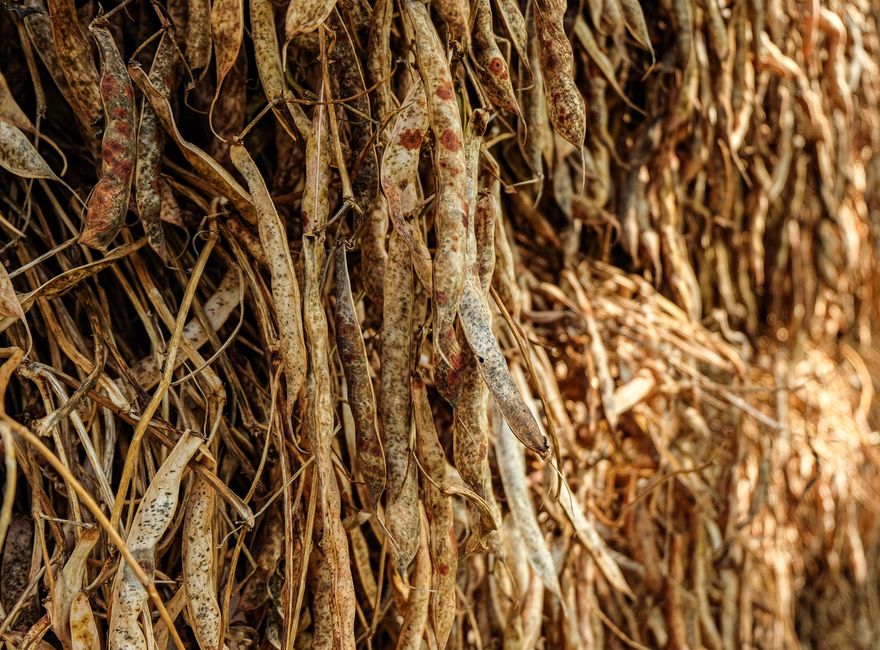
- Bean age is the silent saboteur. Beans harvested more than two years ago develop a hardened seed coat that may never soften, no matter the pressure time. Buy from a store with fast turnover, and use the oldest bag in your pantry first.
The Full Ingredient List
Makes about 10 cups; serves 8 generously or 10 as a side. Prep 20 minutes, active cook 22 minutes, pressure 35 minutes, natural release 20 minutes.
For the pot
- 1 lb (454 g / about 2 cups) dried pinto beans or dried black beans, picked over and rinsed
- 1 tbsp (14 g) neutral oil, bacon drippings, or beef tallow
- 1 lb (454 g) ground beef chuck, 80/20 — omit for vegetarian
- 1 large yellow onion (about 300 g), diced 1/4 inch
- 1 red bell pepper, stemmed, seeded, diced 1/4 inch
- 4 garlic cloves, minced (about 4 tsp)
- 3 tbsp (24 g) mild chili powder blend — check the label for added salt
- 1 tbsp (6 g) ground cumin
- 2 tsp dried Mexican oregano, crumbled
- 1 tsp smoked paprika
- 1/2 tsp ground coriander
- 1/4 to 1/2 tsp cayenne, to taste
- 1 tbsp (16 g) tomato paste
- 1 tbsp (9 g) Diamond Crystal kosher salt — use 1 1/2 tsp if using Morton’s
- 1 dried bay leaf
- 7 cups (1.65 L) low-sodium chicken or vegetable broth, or 4 cups broth plus 3 cups water
Added after the pressure cycle
- 1 can (14.5 oz / 411 g) fire-roasted diced tomatoes, with their juice
- 1 tbsp masa harina whisked into 3 tbsp cold water (or 2 tbsp fine cornmeal)
- 1 tbsp (15 mL) apple cider vinegar or fresh lime juice
For the table
- Sharp cheddar, sour cream or crema, chopped cilantro, diced white onion, pickled jalapeños, saltine crackers or cornbread
Diamond Crystal kosher salt is roughly half the density of Morton’s kosher salt, which is itself lighter than table salt. If you measure by volume across brands you’ll swing the sodium by 40 percent. Weigh it: 9 g of any kosher salt is the target for 1 lb of beans.
Step-by-Step Master Method
To guarantee no burn warning, place the rinsed dry beans in a stainless steel bowl with 4 cups of the broth and set it on the trivet above the chili base. Pressure cook HIGH for the same 35 minutes. The beans cook in clean liquid and you stir them into the spiced base afterward — slightly less integrated flavor, but completely foolproof in a pot that runs hot.
Bean-to-Liquid Ratios & Pressure Timings
There is almost no evaporation in a sealed pressure cooker, so the liquid you add is the liquid you finish with — minus what the beans absorb. That’s why the ratio here (7 cups liquid to 1 lb beans) is leaner than a stovetop recipe calling for 10 or 12 cups.
| Bean (1 lb dry) | Pressure time, HIGH | Natural release | Finished texture |
|---|---|---|---|
| Black beans | 25–28 min | 15 min | Holds shape, earthy, good with lime |
| Navy / Great Northern | 25–30 min | 15 min | Small, creamy, thickens quickly |
| Pinto | 30–35 min | 20 min | Slightly broken down, classic chili body |
| Cannellini | 30–35 min | 15 min | Firm, meaty, mild |
| Dark red kidney | 35–40 min | 20 min | Firm skin, dense interior |
| Pre-soaked (any variety) | Subtract 8–10 min | 15 min | Same as above, faster |
Volume and yield conversions
| Dry measure | Dry weight | Cooked yield | Canned equivalent |
|---|---|---|---|
| 1 cup | ~6.5 oz / 185 g | ~3 cups | 1 1/2 cans (15 oz) |
| 2 cups | 1 lb / 454 g | ~6 cups | 3 cans (15 oz), drained |
| 2 1/2 cups | 1 1/4 lb | ~7 1/2 cups | — (exceeds 6-qt capacity) |
Electric pressure cooker manuals specify that the inner pot should never be filled beyond two-thirds capacity, and for foods that expand during cooking — dried beans, rice, dried vegetables — never beyond one-half. Dry beans absorb liquid and swell to roughly 2.5–3 times their dry volume. In a 6-quart pot, that makes 1 lb of dry beans the hard ceiling, with total contents staying at or below the 3-quart line.[4]
To make a larger batch, don’t double in one pot — cook two consecutive batches, or use an 8-quart cooker with 1 1/2 lb beans and 9 cups liquid at the same pressure time. Pressure time is determined by bean size and texture, not by batch volume, so a larger load does not need more minutes; it only needs more time to come up to pressure.
Common Mistakes & Troubleshooting
Pairing, Storage & Reheating
What to serve alongside
Skillet cornbread is the canonical pairing — the sweetness and crumb cut the fat and capsaicin. For something lighter, a shredded cabbage slaw dressed with lime and cumin does the same job. If you’re building a larger Tex-Mex table, this chili sits well next to cilantro-lime rice, charro beans (ironic but welcome), or a simple chile relleno. To drink, a dry lager, an amber ale, or an un-oaked Tempranillo all work; avoid heavily oaked reds, which fight the cumin.
Storage
Cool the chili within two hours of cooking and refrigerate in shallow containers (no more than 2 inches deep) so it passes through the 4–60 °C danger zone quickly. USDA guidance puts refrigerated leftovers at 3 to 4 days. Beyond that, freeze it: chili freezes exceptionally well because the bean starch protects the texture. Portion into 2-cup containers, press out air, and freeze up to 3 months. Reheat to 74 °C (165 °F) throughout — a rolling simmer for 3 minutes in a saucepan, or 3–4 minutes on the stovetop after thawing overnight in the fridge.[2]
Add 1/4 cup water per 4 cups chili, set to Sauté on Low, and stir every 2 minutes. Or pressure cook on LOW for 5 minutes with a 5-minute natural release. Never reheat on Sauté More — thick chili scorches on the base in under two minutes at that setting.
Frequently Asked Questions
Do I really not need to soak the beans?
Correct — no soak is required, which is the entire advantage of the pressure cooker here. Unsoaked pinto and black beans reach a creamy texture in 35 minutes at HIGH pressure. Soaking overnight does cut the pressure time by 8–10 minutes, softens the finished bean slightly more evenly, and reduces the oligosaccharides that cause gas. If convenience matters more than any of that, skip it.
Can I use canned beans instead?
Yes, and the timing changes completely. Use three 15-oz cans, drained and rinsed, and skip the pressure cook. Sauté the aromatics and spices as written, add the tomatoes and 3 cups of broth, then pressure cook HIGH for 8 minutes with a 10-minute natural release, or simmer on Sauté for 20 minutes. Add the canned beans after pressure cooking so they don’t disintegrate.
Is it safe to pressure cook kidney beans from dry?
Yes — provided you cook them at HIGH pressure for the full 40 minutes and allow a 20-minute natural release. At ~15 psi, the pot reaches 116–118 °C, well above the 100 °C / 10-minute boil that the FDA identifies as sufficient to destroy phytohaemagglutinin. The danger is undercooking, not pressure cooking.[1]
Why did my beans never soften, even after two rounds?
Bean age is the most common cause. Beans stored more than two years develop an insoluble seed coat that resists hydration no matter how long you cook them. Secondary causes: very hard water (use filtered water plus 1/8 tsp baking soda per pound), or acid from tomatoes, molasses, or vinegar added before the beans were tender.
Can I double this recipe in a 6-quart Instant Pot?
No. One pound of dry beans is the maximum for a 6-quart cooker because the manufacturer caps foods that expand at half the pot’s capacity. For a bigger batch, use an 8-quart pot with 1 1/2 lb beans and 9 cups liquid at the same pressure time, or cook two batches back to back.
How do I make this vegetarian or vegan?
Omit the ground beef and add 1 tbsp of soy sauce or tamari plus 1 tsp of smoked paprika for the savory depth the beef would have contributed. Sauté the aromatics in olive oil instead of rendered fat. Use vegetable broth. A handful of finely chopped mushrooms added with the onions, cooked until dry, adds a comparable umami backbone. Everything else — including the salt and pressure time — stays exactly the same.
Can I use a chili powder blend with added salt?
Yes, but adjust. Many commercial blends contain salt, sugar, and anti-caking agents. If yours lists salt in the first three ingredients, start with 1 1/2 tsp of added kosher salt instead of 1 tbsp, then taste after the pressure cycle and correct. Read the label before you salt the pot, not after.
Is there a way to make this faster?
Three lever points. First, pre-soak the beans overnight — saves 8–10 minutes of pressure time. Second, use black beans rather than pinto or kidney; they’re the fastest at 25–28 minutes. Third, cut the natural release from 20 minutes to 15 for black beans only, and never below that for kidney beans or with a full pound of beans in the pot.
- One pound of unsoaked dry beans + 7 cups of liquid + 35 minutes at HIGH pressure (40 for kidney) + 20 minutes natural release is the core formula for a 6-quart Instant Pot.
- Add tomatoes, vinegar, and citrus only after the beans are tender — acid firms the pectin and can add an hour of cooking time.
- Salt early. The “salt toughens beans” rule is outdated; salt actually accelerates softening while seasoning the interior.
- Pressure cooking at 15 psi exceeds the 100 °C / 10-minute boil the FDA requires to destroy kidney bean lectins. Never shortcut the pressure time or quick-release kidney beans.
- Fill the pot no more than halfway with dry beans — they swell to roughly triple their dry volume.
- Refrigerate up to 4 days, freeze up to 3 months, and reheat to 74 °C (165 °F).
- U.S. Food and Drug Administration, Bad Bug Book: Foodborne Pathogenic Microorganisms and Natural Toxins Handbook, 2nd ed. — Phytohaemagglutinin (kidney bean lectin). fda.gov
- FoodSafety.gov (USDA/FDA), “Cold Food Storage Chart” — refrigerated leftovers, 3–4 days. foodsafety.gov
- USDA FoodData Central, “Beans, pinto, mature seeds, cooked, boiled, without salt.” fdc.nal.usda.gov
- Instant Pot, Duo Series User Manual — filling limits for foods that expand during cooking. instantpot.com
- The Bean Institute (Northarvest Bean Growers Association), “Soaking and Cooking Dry Beans” — salt and bean softening. beaninstitute.com
- Colorado State University Extension, “Dry Bean Food Safety and Preparation” — hard water, calcium, and legume softening. extension.colostate.edu