Twelve tested morning builds — four no-cook, four stovetop, four batch-prepped — each engineered to hit 20–30 g protein and 8 g+ fiber before 9 a.m. Every one takes 15 minutes or less of active work.
A breakfast that actually holds you until lunch hits three numbers: 20–30 g protein, 8–12 g fiber, and under 400 calories — with added sugar kept under 6 g. Build from one protein anchor (Greek yogurt, cottage cheese, eggs, or tofu), one fiber anchor (oats, chia, legumes, or whole-grain bread), and one produce item. Rotate three tiers so you never cook from scratch on a weekday: no-cook (5 min), stovetop (10 min), and batch-prepped (weekend, 45 min total for four days of food).
- The Macro Blueprint: What “Healthy” Actually Means at 7 a.m.
- Ingredient Selection: Reading the Labels That Matter
- Tier 1 — Four No-Cook Recipes (5 Minutes)
- Tier 2 — Four Stovetop Recipes (10 Minutes)
- Tier 3 — Four Batch-Prep Recipes (Weekend Prep)
- Key Ratios, Temperatures & Timings
- Common Mistakes & Troubleshooting
- Storage, Food Safety & Pairing Notes
- FAQ
The Macro Blueprint: What “Healthy” Actually Means at 7 a.m.
Morning is the one meal where the body’s hormonal context works in your favor. After an overnight fast, hepatic glycogen is partly depleted and insulin sensitivity tends to run higher in the first half of the day, meaning carbohydrate eaten at breakfast is handled more efficiently than the same carbohydrate eaten at 10 p.m. That is why breakfast recipes get more forgiveness on starch than dinner does — but almost none on sugar.
The regulatory floor is not the goal. The USDA Dietary Guidelines for Americans recommend keeping added sugars below 10% of total daily calories[1] — roughly 50 g on a 2,000-calorie plan. If you spend half of that at breakfast on a flavored yogurt cup and a granola cluster, the rest of your day is a negotiation. Aim for under 6 g added sugar in the morning and the whole day gets easier.
Protein is the lever with the strongest evidence behind it. In controlled feeding trials, a higher-protein breakfast (roughly 30–39 g) reduced post-meal hunger and blunted the evening snacking drive compared with a protein-matched but lower-protein morning meal, largely through slower gastric emptying and steadier glucose response[2]. Practically: two eggs alone get you to about 12 g. You need a second anchor — yogurt, cottage cheese, or tofu — to cross 25 g without doubling the calorie load.
Two eggs and a slice of toast is a snack. Two eggs, half a cup of cottage cheese, and a slice of rye is breakfast.
— WorldDishly test kitchen principle
Fiber is the second lever and the one most breakfasts fail on. Soluble fiber from oats and barley — specifically beta-glucan — forms a viscous gel in the gut that slows glucose absorption and binds bile acids, which is why 3 g of oat beta-glucan per day is the threshold associated with measurable LDL cholesterol reduction in meta-analyses[3]. Chia, ground flax, and legumes (black beans, chickpeas) do similar work. The trick is that fiber needs water — a dry chia pudding will stop you up rather than help you. Soak it properly or don’t bother.
Every recipe in this guide contains exactly three anchors: protein (yogurt, cottage cheese, eggs, tofu, beans, smoked fish), fiber (oats, chia, flax, legumes, whole grain, berries), and produce (fresh or frozen fruit, vegetables, herbs). If a recipe you invent has all three, it will almost always land in range on calories, protein, and fiber without counting anything.
Ingredient Selection: Reading the Labels That Matter
Most breakfast failures happen in the grocery aisle, not the kitchen. Four buying decisions separate a genuinely healthy breakfast from a marketed one.
Dairy: the fat percentage is a tool, not a moral test
Nonfat Greek yogurt runs roughly 10 g protein per 100 g, and the 2% version runs about 9 g with more satiety per calorie spent. For most people, 2% is the better buy — the small fat load improves mouthfeel and slows emptying. Skip “vanilla” and “fruit on the bottom” cups; the flavored versions routinely carry 10–14 g of added sugar per cup. Buy plain and sweeten with ½ tsp honey or a mashed date. Cottage cheese is the underrated pick: 4% milkfat cottage cheese delivers about 11 g protein per 100 g, and a ½-cup scoop is 12–14 g protein for roughly 110 calories[4].
Oats: rolled, not instant, and never “flavored”
Instant oats are steamed and rolled thinner, so they cook faster but digest faster too. Rolled (old-fashioned) oats hold their shape in overnight preparations and give a visibly lower glycemic response. The flavored packets are the trap — a single apple-cinnamon packet can carry 11 g of added sugar before you add anything. Buy plain rolled oats and flavor with cinnamon, salt, and fruit.
Eggs: size, freshness, and the 160°F line
Large eggs are 50 g each and reliably give 6 g protein and 5 g fat. Freshness matters for frying and poaching (older whites thin out and spread); it barely matters for scrambles and bakes. Food safety is non-negotiable: cook eggs until both white and yolk are firm, which corresponds to 160°F, and refrigerate at 40°F or below[5].
Plant protein: tofu, hemp, and the legume option
Firm tofu scrambled with nutritional yeast and turmeric is the closest 1:1 swap for eggs at roughly 8 g protein per 100 g. Hemp hearts add 10 g protein per 3 tbsp and need zero cooking. Black beans, at 7–8 g protein and 6 g fiber per ½ cup, turn a plain egg into a complete plate.
| Anchor | Best pick | Protein per serving | Avoid |
|---|---|---|---|
| Yogurt | Plain Greek, 2% | 17 g / 170 g cup | Vanilla & fruit-on-bottom cups |
| Cheese | Cottage, 4% milkfat | 12–14 g / ½ cup | “Whipped” spreads with added sugar |
| Eggs | Large, refrigerated | 6 g / egg | Pre-cooked egg patties with additives |
| Oats | Rolled, plain | 5 g / ½ cup dry | Instant flavored packets |
| Seeds | Chia, ground flax, hemp | 4–10 g / 2–3 tbsp | Sugared “trail mix” clusters |
| Legumes | Black beans, chickpeas | 7–8 g / ½ cup | Refried beans with lard + salt load |
Tier 1 — Four No-Cook Recipes (5 Minutes)
These are the recipes that survive a bad morning. Nothing touches a heat source; everything is assembly. Keep the components in one shelf of the fridge so the whole tier takes a single reach.
1. Greek Yogurt Power Bowl with Chia & Frozen Berries
- 170 g plain 2% Greek yogurt
- 1 tbsp chia seeds
- ¾ cup frozen wild blueberries (they thaw in 3 minutes and release juice that sweetens the bowl)
- 1 tbsp hemp hearts
- Pinch of flaky salt, ¼ tsp cinnamon
Stir the chia into the yogurt first and let it sit 3 minutes while you get everything else out — it hydrates and thickens the base. Add berries on top, then hemp and cinnamon. Per serving: ~345 kcal · 28 g protein · 11 g fiber · 2 g added sugar.
2. Overnight Oats, Base Ratio 1:1:1
- ½ cup rolled oats
- ½ cup milk of choice
- ½ cup plain Greek yogurt
- 1 tbsp chia, ½ tsp vanilla, pinch salt
- Topping at serving: ½ cup raspberries + 1 tsp maple syrup
The 1:1:1 oat-to-liquid-to-yogurt ratio gives a thick, spoonable texture rather than soup; using all milk and no yogurt produces a watery jar by morning. Shake in a lidded jar and refrigerate at least 6 hours, up to 4 days. Per serving: ~390 kcal · 22 g protein · 12 g fiber · 4 g added sugar.
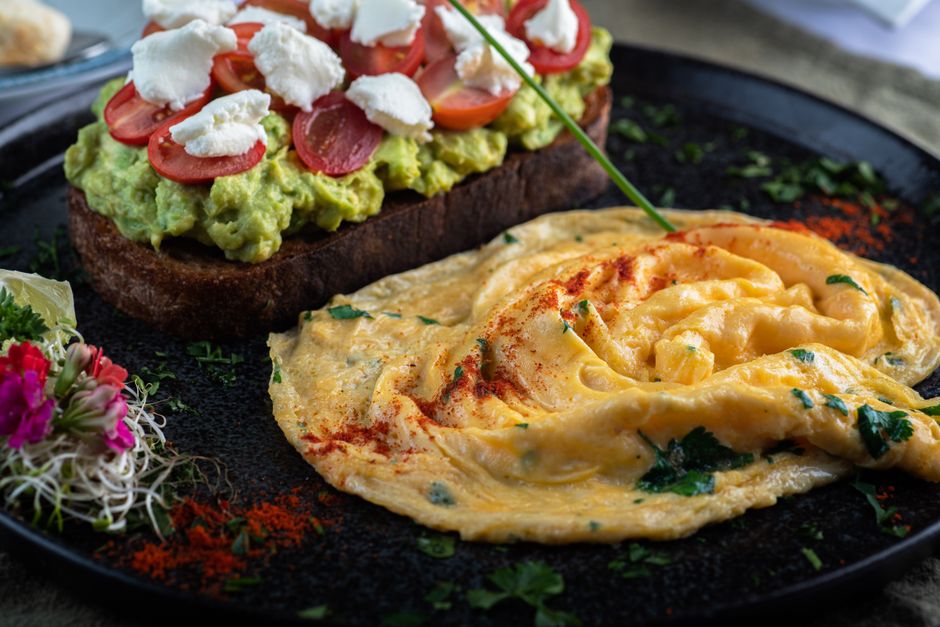
3. Cottage Cheese & Tomato Toast on Rye
- 1 slice dense rye or seeded whole-grain bread (look for ≥3 g fiber per slice)
- ½ cup 4% cottage cheese
- 4 cherry tomatoes, halved
- 1 tsp olive oil, cracked black pepper, torn basil
Toast the bread dark — the Maillard crust is what keeps the cottage cheese from reading as wet. Spread cheese while warm, then tomatoes, oil, and pepper. Per serving: ~320 kcal · 24 g protein · 8 g fiber · 1 g added sugar.
4. Green Protein Smoothie (No Banana)
- 1 cup unsweetened soy milk (7 g protein per cup — the highest of the plant milks)
- 1 scoop unflavored or vanilla whey/pea protein
- 2 cups baby spinach
- ½ cup frozen mango, 1 tbsp ground flax
- ¼ tsp cinnamon, pinch salt, 3 ice cubes
Blend the spinach with the liquid first, alone, for 20 seconds — this breaks down the cellulose and prevents the fibrous flecks that make people hate green smoothies. Then add everything else and blend 45 seconds. Per serving: ~355 kcal · 30 g protein · 9 g fiber · 0 g added sugar.
Tier 2 — Four Stovetop Recipes (10 Minutes)
Ten minutes, one pan wherever possible. These are the recipes for mornings when you want something hot and savory and have exactly one cup of coffee’s worth of patience.
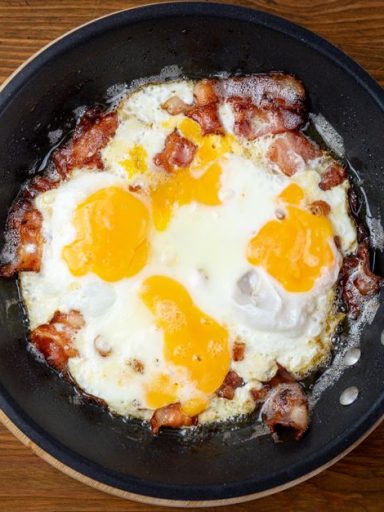
5. Two-Egg Vegetable Scramble with Feta
- 2 large eggs + 2 egg whites (or 3 whole eggs)
- 1 cup frozen spinach, squeezed dry, or 2 cups fresh
- 2 tbsp crumbled feta
- 1 tsp olive oil, 2 tbsp diced onion
Sweat the onion in oil over medium for 2 minutes, add spinach and cook until any water has evaporated — wet vegetables are the number one cause of gray, weeping scrambles. Lower heat to medium-low, add beaten eggs, and stir slowly with a silicone spatula in long strokes, pulling from the edges. Pull off heat at 155°F; carryover takes it to 160°F[5]. Per serving: ~310 kcal · 24 g protein · 4 g fiber · 0 g added sugar.
6. Savory Oats with a Jammy Egg
- ½ cup rolled oats, 1 cup low-sodium broth
- 1 egg, soft-boiled 6½ minutes
- 1 tsp miso, 1 tsp olive oil, scallion, chili crisp
Simmer oats in broth for 5 minutes instead of water — the savory base is what makes this read as a meal rather than a dessert. Whisk in miso off the heat (boiling destroys the enzymes and flattens the flavor). Top with the halved egg and scallion. Per serving: ~365 kcal · 20 g protein · 9 g fiber · 0 g added sugar.
7. Single-Skillet Chickpea Shakshuka
- ¾ cup crushed tomatoes, ½ cup chickpeas, rinsed
- 2 eggs
- 1 tsp olive oil, cumin, smoked paprika, garlic
- 2 tbsp crumbled feta, cilantro
Bloom the spices in oil for 30 seconds before the tomatoes go in — ground spices are fat-soluble, and this single step is the difference between a flat sauce and a fragrant one. Simmer 4 minutes, make two wells, crack in eggs, cover, and cook 4–5 minutes until whites set. Per serving: ~390 kcal · 22 g protein · 10 g fiber · 0 g added sugar.
8. Black Bean Breakfast Tacos
- 2 corn tortillas, charred directly over the flame
- ½ cup black beans, 1 egg, ¼ avocado
- Lime, hot sauce, cilantro, 1 tbsp cotija
Warm the tortillas over an open burner for 15 seconds a side until they puff and speckle — a dry skillet steams them instead and you lose the char. Mash half the beans into the egg for binding. Per serving: ~380 kcal · 21 g protein · 13 g fiber · 0 g added sugar.
For eggs, medium-low (about 250–275°F on an infrared thermometer) beats high heat every time. Above 300°F, egg proteins coagulate fast and squeeze out water, producing rubbery curds and a weeping pan. The single most common home-kitchen egg failure is a pan that was too hot to begin with.
Tier 3 — Four Batch-Prep Recipes (Weekend Prep)
Ninety minutes on Sunday covers four weekday mornings with zero cooking. Two of these freeze; two hold in the fridge for four days.
9. Egg & Veggie Muffins (Freezer-Friendly)
- 8 eggs + ½ cup cottage cheese, blended smooth
- 1 cup sautéed and cooled vegetables (peppers, spinach, onion)
- ½ cup shredded sharp cheddar
- Salt, pepper, ¼ tsp nutmeg
Blending cottage cheese into the egg base is the technique that keeps these custardy instead of spongy — the extra dairy fat and moisture buffer the protein coagulation. Fill a greased 12-cup tin two-thirds full and bake at 350°F for 20–22 minutes until just set with no jiggle. Cool completely, then refrigerate up to 4 days or freeze up to 2 months[6]. Reheat two muffins for 60 seconds. Per 2 muffins: ~230 kcal · 19 g protein · 2 g fiber.
10. Chia Pudding, Soaked Correctly
- ¼ cup chia seeds
- 1 cup unsweetened almond or soy milk
- 1 tsp maple syrup, ½ tsp vanilla, pinch salt
Whisk, wait 10 minutes, then whisk again — this second stir is what prevents the dense clump at the bottom of the jar that no amount of overnight soaking fixes. Refrigerate 4 hours or overnight. Top at serving with berries and 2 tbsp chopped pistachios. Per serving: ~280 kcal · 11 g protein · 15 g fiber · 4 g added sugar.
11. Baked Oatmeal Squares with Apple
- 2 cups rolled oats, 1 tsp baking powder, 1 tsp cinnamon, ½ tsp salt
- 2 cups milk, 2 eggs, ¼ cup maple syrup, 1 tsp vanilla
- 1 diced apple, ½ cup walnuts
The maple syrup is doing structural work here — ¼ cup across 9 squares means about 4 g added sugar per serving, which stays under the ceiling while keeping the bake moist. Bake at 350°F for 40 minutes in an 8×8 pan. Cut into 9 squares; refrigerate 4 days. Per square: ~215 kcal · 8 g protein · 4 g fiber.
12. Freezer Smoothie Packs
- Per bag: ½ cup frozen mango, ½ cup frozen spinach, 1 tbsp ground flax, 1 tbsp hemp hearts
- At blending: add 1 cup soy milk + 1 scoop protein powder
Portion eight bags at once. The frozen spinach keeps for months without the slime that fresh spinach develops by day five. Per smoothie: ~350 kcal · 29 g protein · 9 g fiber.
Oven on first (350°F): mix the baked oatmeal, get it in. While it bakes, whisk the chia pudding and portion the smoothie bags. When the oatmeal comes out, drop the oven to 350°F again for the egg muffins — the residual heat means they bake in 18 minutes instead of 22. Total active time: about 35 minutes.
Key Ratios, Temperatures & Timings
Print this table. Almost every variation in this guide is a rearrangement of these numbers.
| Element | Ratio / Target | Why it matters |
|---|---|---|
| Overnight oats | 1 : 1 : 1 oat : liquid : yogurt | All-liquid versions turn soupy by day 2 |
| Chia pudding | 1 : 4 chia : liquid by volume | Below 1:3 the seeds never fully hydrate |
| Smoothie liquid | 1 cup liquid per 1 cup frozen fruit | Prevents the blender from stalling |
| Egg doneness | 160°F / 71°C | Food-safe coagulation point[5] |
| Soft-boiled egg | 6 min 30 sec, then ice bath | Liquid yolk, fully set white |
| Egg muffin bake | 350°F for 20–22 min | Higher heat = rubbery, weeping custard |
| Baked oatmeal | 350°F for 40 min, 8×8 pan | Deeper pan needs +10 min |
| Fridge life, cooked | 3–4 days at 40°F or below | Standard leftovers window[6] |
| Freezer life, egg muffins | Up to 2 months | Wrap individually to prevent ice burn |
| Refrigerator setting | 40°F / 4°C or lower | Slows bacterial growth[5] |
Common Mistakes & Troubleshooting
These are the failures that show up most often when readers write in with “my healthy breakfast didn’t work.” Each has a specific fix.
Cook eggs until white and yolk are firm (160°F / 71°C). Keep the refrigerator at 40°F or below and never leave egg or dairy-based breakfasts at room temperature for more than 2 hours. Discard refrigerated cooked egg dishes after 4 days[5][6]. If you are pregnant, immunocompromised, or cooking for young children, use pasteurized eggs for any preparation that isn’t fully cooked through.
Storage, Food Safety & Pairing Notes
Batch cooking only works if the food survives to Thursday. These are the windows that hold up in testing.
Pairing logic
Pair a high-fiber recipe with a high-protein one when you want maximum staying power — a baked oatmeal square alongside two egg muffins lands near 27 g protein and 6 g fiber for about 445 calories. Pair a fat-forward recipe (avocado, nuts, full-fat dairy) with something acidic — lime, hot sauce, vinegar, or pickled onion — to keep it from reading heavy. And pair a sweet-leaning base (yogurt, oats, chia) with a savory accent (salt, miso, smoked paprika) to prevent palate fatigue across a week of repeats.
FAQ
How much protein should a healthy breakfast actually have?
Target 25–30 g for a breakfast that has to hold you until lunch. Research on higher-protein morning meals shows reduced hunger and lower evening snacking compared with lower-protein breakfasts of equal calories[2]. Below 15 g, most people report an energy dip within three hours. You can hit 25 g with 170 g of Greek yogurt plus a tablespoon of hemp hearts, or two eggs plus ½ cup of cottage cheese.
Can I prep these healthy breakfast recipes on Sunday for the whole week?
Five days is too long for egg dishes. Cooked egg muffins and scrambles are safe for 4 days refrigerated[6]. Overnight oats and chia pudding are fine on a 4-day rotation. The practical solution is to prep two batches on Sunday and one midweek on Wednesday — roughly 25 minutes of work each time.
Are these recipes good for weight loss?
All twelve land under 400 calories with 20 g+ protein and 8 g+ fiber, which is the profile most associated with spontaneous calorie reduction — protein and fiber are the two nutrients that reliably increase satiety per calorie. That said, no breakfast in isolation causes weight loss. What these recipes do is remove the 10 a.m. pastry decision, which is where most morning plans fall apart.
What are the best healthy breakfast recipes for people who hate eggs?
Recipes 1, 2, 3, 4, 10, 11, and 12 in this guide are egg-free. The strongest substitutes are Greek yogurt (17 g protein per 170 g), cottage cheese (12–14 g per ½ cup), firm tofu scrambled with nutritional yeast, and unsweetened soy milk, which carries 7–8 g protein per cup versus 1 g for almond milk.
Is it bad to skip breakfast entirely?
Not inherently. Whether breakfast helps depends on total daily intake and how you feel without it. If skipping leads to a 700-calorie lunch and afternoon grazing, a 350-calorie protein-forward breakfast is a net win. If you genuinely aren’t hungry until noon and eat normally afterward, there is no strong evidence you must force it. The one group where breakfast reliably matters is people managing blood glucose, for whom a protein-and-fiber morning meal blunts the rest of the day’s response.
How do I make overnight oats thicker?
Three fixes, in order of effectiveness: add 1 tbsp chia or ground flax, increase the yogurt proportion of the 1:1:1 ratio, or reduce liquid by 2 tbsp. Do not simply use more oats — the ratio goes starchy and chalky. If they’ve already been made and are too loose, stir in 1 tbsp of chia and give it 20 minutes.
Are frozen fruits and vegetables as nutritious as fresh?
Generally yes, and sometimes better. Produce destined for freezing is typically picked at peak ripeness and blanched within hours, which locks in vitamin content; fresh produce shipped long distances can lose comparable amounts during transit and storage. Frozen wild blueberries in particular have thinner skins and higher anthocyanin content than the cultivated fresh alternative. The one caveat is added sugar in frozen fruit blends — read the panel.
Can I make these recipes dairy-free?
Yes. Swap Greek yogurt for a thick coconut or soy-based unsweetened alternative with at least 8 g protein per serving (check the panel — many plant yogurts sit at 1–2 g). Replace cottage cheese with mashed white beans or crumbled tofu. Use unsweetened soy milk rather than almond or oat milk if protein is your anchor, since the gap is roughly 7 g versus 1–3 g per cup.
- Build every breakfast from three anchors: protein, fiber, and produce. Hit 20–30 g protein, 8–12 g fiber, under 400 calories, and under 6 g added sugar.
- Rotate three tiers — no-cook (5 min), stovetop (10 min), and batch-prepped (Sunday) — so a bad morning never defaults to a drive-through.
- Use the ratios: overnight oats at 1:1:1 oat-to-liquid-to-yogurt, chia at 1:4 seed-to-liquid, and eggs always cooked to 160°F.
- Blend cottage cheese into egg bases and keep pan heat at medium-low for custardy, not rubbery, results.
- Refrigerate cooked egg dishes no longer than 4 days at 40°F or below; freeze egg muffins up to 2 months.
- The grocery aisle is where most “healthy” breakfasts fail — buy plain dairy, plain rolled oats, and unsweetened plant milk.
- U.S. Department of Agriculture and U.S. Department of Health and Human Services. Dietary Guidelines for Americans, 2020–2025. 9th Edition. Chapter 1: Added sugars and daily intake recommendations. dietaryguidelines.gov
- Leidy HJ, Ortinau LC, Douglas SM, Hoertel HA. “Beneficial effects of a higher-protein breakfast on the appetitive, hormonal, and neural signals controlling energy intake regulation in overweight/obese ‘breakfast-skipping’ late-adolescent girls.” American Journal of Clinical Nutrition. PubMed
- Whitehead A, Beck EJ, Tosh S, Wolever TMS. “Cholesterol-lowering effects of oat β-glucan: a meta-analysis of randomized controlled trials.” American Journal of Clinical Nutrition. PubMed
- U.S. Department of Agriculture, Agricultural Research Service. FoodData Central: nutrient profiles for plain Greek yogurt, cottage cheese, and tofu. fdc.nal.usda.gov
- U.S. Food and Drug Administration. “Egg Safety: What You Need to Know” and “Refrigerator & Freezer Storage Chart.” fda.gov/food
- USDA FoodSafety.gov. “Refrigeration and Food Safety: Leftovers and Storage Times.” foodsafety.gov