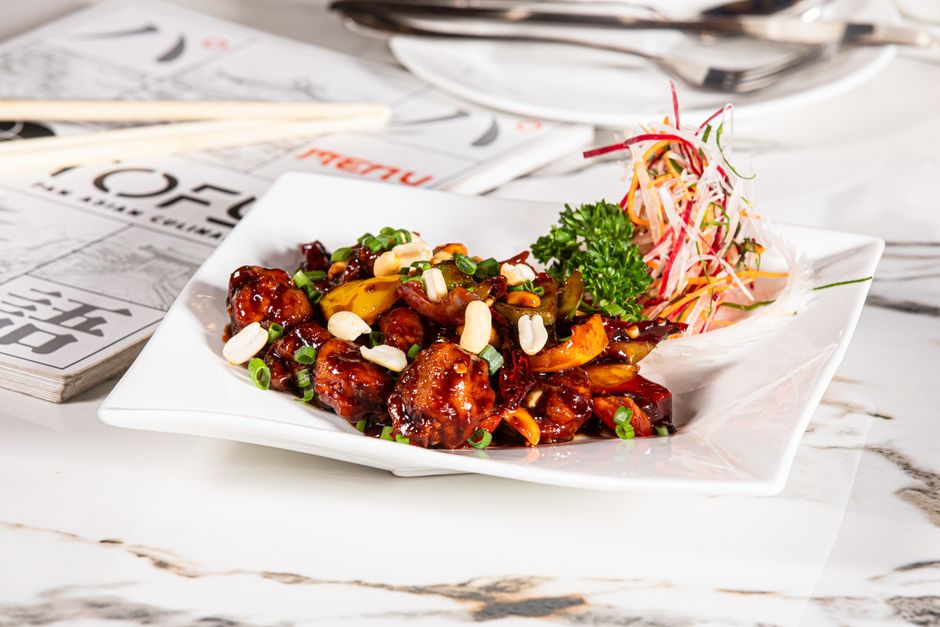
Gong bao ji ding done properly: dried chilies bloomed in hot oil, whole Sichuan peppercorns, and a lychee-flavored sauce that clings to the chicken instead of pooling at the bottom of the plate.
Cube 675 g (1½ lb) of boneless chicken thigh, velvet it in Shaoxing wine, water, and cornstarch for 25 minutes, then stir-fry over a wok heated to 400–450°F (204–232°C). Bloom 12–16 dried red chilies and 1 tsp Sichuan peppercorns for 20–30 seconds, add the chicken back with a pre-mixed sauce of Chinkiang vinegar, sugar, light and dark soy, and cornstarch, and finish with roasted peanuts off the heat. Total wok time: 4–5 minutes. The signature flavor is lychee-flavored (荔枝味) — sweet, sour, and savory in balance, not sticky-sweet.
Flavor Profile and Culinary Origin
Kung Pao chicken — gong bao ji ding (宫保鸡丁) — is named for Ding Baozhen, a Qing-dynasty official who governed Sichuan in the 1870s and held the honorary title gong bao, roughly “palace guardian.” The dish is usually traced to his household kitchen: a quick chicken stir-fry with dried chilies that traveled from Shandong and Guizhou cooking traditions into the Sichuan repertoire, where it picked up whole Sichuan peppercorns and an unmistakably Sichuanese sweet-sour-savory architecture.[4]
That architecture is what separates the real thing from the takeout version. Sichuan cooks describe the sauce as lychee-flavored — sugar and vinegar balanced so precisely that neither reads as dominant, backed by salt, wine, and the slow burn of toasted chilies. There is no thick, glossy cornstarch blanket and no pineapple, bell pepper, or zucchini. Those additions belong to the Chinese-American adaptation that spread through US restaurants in the 1970s, a sweeter, heavier dish that is genuinely good on its own terms but is a different recipe.
“Gong bao ji ding is a study in restraint: a handful of chilies, a scatter of peppercorns, peanuts, scallion — and a sauce that tastes of nothing but balance.”
Adapted from Fuchsia Dunlop’s writing on the Sichuan kitchen[4]
What you’re building in the wok is a three-layer sensation:
- Heat from dried chilies, which release capsaicin into the oil during a short bloom.
- Numbing buzz from Sichuan peppercorns — a tingling, citrus-adjacent vibration, not a burn.
- Savory-sour-sweet depth from aged black vinegar, sugar, and two grades of soy working with the roasted peanut’s fat.
Ingredient Selection and the Science Behind Each
Kung Pao chicken has nine or ten components and no hiding places. Each one is doing measurable work, so substitutions change the dish rather than merely shading it.
Chicken thigh over breast
Boneless skinless thigh carries roughly 19 g of protein and a meaningful amount of intramuscular fat per 100 g raw[6] — enough to stay juicy through two passes in a screaming-hot wok. Breast works, but it dries out in seconds past 165°F and needs a shorter sear. If you use breast, cut it slightly larger (2 cm) and pull it from the wok 15 seconds earlier than you think you should.
Velveting: why the marinade matters more than the sauce
Velveting is the step home cooks skip and then blame on the wok. A slurry of cornstarch, Shaoxing wine, water, and a pinch of salt coats each cube, and the starch gelatinizes on contact with hot oil into a thin, slippery jacket that traps moisture. A quarter-teaspoon of baking soda raises the surface pH, which slows the muscle proteins from contracting and squeezing out water — but it is a timed tool, not a permanent upgrade. Past 30 minutes, the surface turns spongy and tastes faintly soapy. Fifteen to twenty-five minutes is the window.
Dried chilies: aroma first, heat second
Sichuan kitchens typically reach for er jing tiao — long, slender, deep red, moderately hot, and intensely fragrant — or the shorter, brighter facing heaven chili for more punch. Snip them into 2 cm segments and shake out most of the seeds; the seeds brown faster than the pods and turn bitter. They are not meant to be eaten in quantity. They perfume the oil, and diners push them to the side.
Sichuan peppercorns and the tingle
The numbing sensation comes from hydroxy-alpha-sanshool, a compound that inhibits two-pore potassium channels in sensory neurons, causing them to fire spontaneously. That’s the literal mechanism behind the buzzing, vibrating feeling on your lips.[3] Buy whole, red-brown peppercorns with visible open husks and a strong citrus aroma. Toast them in a dry wok for 30–45 seconds until they smell like orange peel, then grind or leave whole. Pre-ground “Sichuan pepper powder” loses its punch within a few months.
Blooming dried chilies in oil at 350°F or above for longer than 30 seconds produces acrid, throat-scraping fumes and a bitter, ash-like flavor that no amount of sugar will fix. If the chilies darken from brick red to near-black, dump the oil, wipe the wok, and start the aromatics again. Also work with the exhaust fan on and a lid within reach.
Vinegar, sugar, and soy: the balance engine
Chinkiang vinegar (aged Chinese black rice vinegar) is malty, slightly sweet, and rounded rather than sharp — it is the backbone of the sauce. Rice vinegar is a workable stand-in; balsamic is not, despite the similar color. Use both light soy (for salt and base savoriness) and a small amount of dark soy (for color and a molasses-like depth).
| Ingredient | Function | Best Substitute | Do Not Use |
|---|---|---|---|
| Chinkiang vinegar | Sour backbone, malty depth | Unseasoned rice vinegar + ¼ tsp molasses | Balsamic, white distilled |
| Shaoxing wine | Aroma, marinade acidity | Dry sherry | Rice cooking wine with added salt |
| Dried er jing tiao chilies | Fragrant heat in the oil | Chile de árbol (use half the count) | Fresh jalapeño |
| Sichuan peppercorns | Numbing tingle | None — omit rather than fake it | Black pepper |
| Raw peanuts | Crunch, fat, sweetness | Roasted cashews or toasted walnuts | Peanut butter |
| Cornstarch | Velvet coating + sauce body | Potato starch | Flour |
Prep, Mise en Place, and Equipment
The wok phase of this recipe is under five minutes. That means the entire dish must be fully prepped and arranged before you turn on the burner — there is no moment mid-cook to mince garlic.
What you need
- A carbon steel wok, 12–14 inches. Thin walls and a wide flare give you the hot floor and cool upper slopes that let ingredients move. On an electric coil or induction hob, a flat-bottomed wok is non-negotiable.
- A fallback: 12-inch cast iron or heavy stainless skillet. Work in two batches. Crowding is what steams chicken instead of searing it.
- A metal wok spatula (chuan). A wooden spoon cannot scrape the hot zone fast enough.
- A spider or slotted spoon for lifting the chicken out of the oil.
- Four small bowls for aromatics, chilies, sauce, and peanuts.
A new carbon steel wok needs a 10-minute seasoning before its first stir-fry: scrub off the factory coating, heat until it turns blue-grey, then wipe with a teaspoon of high-smoke-point oil over high heat, repeating three times. After that, never scour it with soap. A dark, glassy patina is what gives you wok hei — the seared, faintly smoky aroma that comes from food hitting metal above 400°F.
Step-by-Step Master Method
This is a restaurant-style two-pass stir-fry: the chicken sears first, comes out, the aromatics bloom in the same oil, and everything reunites for the final 45 seconds. Serves 4 with rice.
The marinade (for 675 g / 1½ lb chicken thigh, cut into 1.5 cm dice)
- 1 tbsp Shaoxing wine
- 1 tbsp cold water
- 2 tsp cornstarch
- 1 tsp light soy sauce
- ¼ tsp baking soda (optional, for tenderness)
- Pinch of white pepper
The sauce (whisk together in a bowl)
- 2 tbsp Chinkiang vinegar
- 1½ tbsp granulated sugar
- 1 tbsp light soy sauce
- 2 tsp dark soy sauce
- 1 tbsp Shaoxing wine
- 2 tsp cornstarch
- 3 tbsp water or unsalted chicken stock
- 1 tsp toasted sesame oil
The finished dish should look barely sauced. The coating is a thin, glossy film — if you can see liquid sliding around the bottom of the wok or plate, the sauce has not reduced enough. Return it to high heat for 15 seconds before serving.
Key Ratios and Temperature Table
Once you internalize the ratios, you can cook this without the recipe card. Scale everything proportionally for larger batches, but never crowd the wok — cook in two rounds instead.
| Element | Ratio / Target | Why It Matters |
|---|---|---|
| Sauce master ratio | 3 vinegar : 2 sugar : 2 light soy : 1 wine | Produces the balanced lychee profile; deviating pushes it sweet or harsh |
| Cornstarch in sauce | 1 tsp per 3 tbsp liquid | Below this, sauce pools; above, it turns gluey |
| Velvet marinade | 2 tsp cornstarch per 675 g chicken | Thin jacket that seals moisture without sliminess |
| Baking soda (optional) | ¼ tsp per 675 g, max 30 min | Tenderizes; beyond 30 min texture degrades |
| Wok surface | 400–450°F (204–232°C) | Required for Maillard browning and wok hei |
| Chili bloom | 20–30 seconds at ~350°F oil | Extracts aroma; longer turns acrid and bitter |
| Total wok time | 4–5 minutes | Longer cooking toughens thigh meat |
| Chicken finish temp | 165°F (74°C)[1] | USDA FSIS safe minimum for poultry |
| Oil for stir-frying | 3 tbsp total, peanut or avocado | High smoke point; peanut adds complementary flavor |
Doubling the recipe does not mean doubling the wok load. Cook the chicken in two batches of 340 g each in a 14-inch wok, or three batches in a 12-inch skillet. Bloom the chilies once, in the oil left after the second batch, and increase the chili count by 50% rather than 100% — the aroma compounds saturate the oil quickly.
Common Mistakes and Troubleshooting
Nearly every disappointing home version of this dish fails at one of six predictable points. Here’s what goes wrong and how to correct it on the next attempt.
Peanuts are one of the major food allergens requiring disclosure under US labeling law, and this dish traditionally contains them.[5] For a peanut-free version, substitute roasted cashews or toasted sunflower seeds and use a neutral oil instead of peanut oil. Cross-contamination in shared woks is a real risk in restaurants — if the allergy is severe, cook at home.
Pairing and Storage Notes
What to serve alongside
Kung Pao chicken is rich and assertive, so the supporting cast should be plain and cooling. Steamed jasmine or short-grain rice is the default for good reason. A smashed cucumber salad with black vinegar and garlic cuts the oil. Blistered green beans with garlic, or a plain stir-fried leafy green like gai lan, round out the table without competing. Skip anything sweet — the sauce is already doing that work.
Storage and reheating
- Refrigerate leftovers within 2 hours of cooking in a shallow, covered container at 40°F (4°C) or below.[2]
- Keep for 3–4 days. Peanuts soften after about 24 hours; if that bothers you, pick them out before storing and add fresh ones when reheating.
- Reheat in a skillet over medium-high heat with a splash of water, or in the microwave to 165°F (74°C).[2]
- Cooked rice is the higher-risk item: cool it within 1 hour, refrigerate immediately, and use within 24 hours.
- Do not freeze the finished stir-fry. The cornstarch coating breaks down and the vegetables go limp. The raw velveted chicken can be frozen in its marinade for up to 1 month, though the baking soda should be omitted if you plan to freeze it.
Prep everything up to 4 hours in advance — cube and velvet the chicken, mix the sauce (whisk again before use), snip the chilies, mince the aromatics — then refrigerate each component separately in small bowls. The actual cooking is 5 minutes from a cold start.
Frequently Asked Questions
Can I use chicken breast instead of thigh?
Yes. Cut it into 2 cm cubes rather than 1.5 cm, keep the velveting time to 15–20 minutes, and pull it from the wok about 15 seconds earlier in step 4. Breast has far less intramuscular fat, so the margin between juicy and chalky is thin. Check for 165°F (74°C) and no higher.[1]
What’s the best substitute for Chinkiang vinegar?
Unseasoned rice vinegar mixed with a quarter-teaspoon of molasses or dark brown sugar per tablespoon gets you close — malty, mildly sweet, and not as sharp as distilled vinegar. Cider vinegar works in a pinch. Balsamic is too sweet and too grapey; it will make the sauce read as Italian rather than Sichuan.
Are Sichuan peppercorns essential?
They are the defining sensory signature of the dish, but if you cannot source fresh ones, omit them rather than substituting black pepper, which tastes entirely different. A half-teaspoon of ground toasted peppercorn from a reputable spice shop is a reasonable fallback. Buy whole berries and grind them yourself — the aromatic oils fade within months of grinding.[3]
How do I make it less spicy?
Reduce the chili count rather than removing them entirely — four to six pods still perfumes the oil. Choose er jing tiao over facing heaven chilies, and shake out all the seeds, since much of the capsaicin sits in the pith and seeds. Never compensate by adding more sugar; that tips the sauce out of balance.
Can I make Kung Pao chicken ahead of time?
You can prep every component up to 4 hours ahead, but the stir-fry itself should be cooked to order. Reheated Kung Pao loses its crust, the peanuts go soft, and the sauce tightens. Cooked leftovers are still good for 3–4 days refrigerated and reheated to 165°F.[2]
Is Kung Pao chicken gluten-free?
Not as written — both light and dark soy sauce contain wheat, and Shaoxing wine may as well. Use tamari or a certified gluten-free soy sauce, swap the Shaoxing for dry sherry or a gluten-free rice wine, and verify your chili paste and stock. The rest of the ingredient list is naturally gluten-free.
What’s the difference between Kung Pao chicken and General Tso’s chicken?
They are cousins from different kitchens. General Tso’s is a Hunan-influenced, deep-fried, heavily sweetened dish with a thick, sticky glaze and often broccoli. Kung Pao is a Sichuan stir-fry — not battered, not deep-fried, seasoned with whole dried chilies, Sichuan peppercorns, and roasted peanuts, and finished with a thin, balanced lychee-flavored sauce. General Tso’s is sweeter; Kung Pao is numbing and sour-edged.
Can I cook this in a regular skillet?
Yes, with adjustments. Use a 12-inch cast iron or heavy stainless skillet, heat it until it just begins to smoke, and sear the chicken in two batches of 340 g so the pan temperature doesn’t collapse. You’ll get less wok hei but a perfectly good dish. Nonstick pans cannot handle the required heat and won’t brown the meat properly.
- Velvet the chicken for 20–25 minutes in cornstarch, Shaoxing wine, and water — this step, not the sauce, is what keeps the meat juicy.
- Bloom dried chilies and Sichuan peppercorns for only 20–30 seconds; past that they turn bitter and acrid.
- The sauce follows a 3:2:2:1 ratio of vinegar, sugar, light soy, and wine, thickened with 1 tsp cornstarch per 3 tbsp liquid.
- Two-pass stir-frying at 400–450°F is what creates browning and wok hei; cook in batches rather than crowding the pan.
- Add peanuts off the heat and verify the chicken reaches 165°F (74°C) before serving.[1]
- Leftovers keep 3–4 days refrigerated at 40°F or below and must be reheated to 165°F.[2]
- USDA Food Safety and Inspection Service. “Safe Minimum Internal Temperature Chart.” fsis.usda.gov
- USDA Food Safety and Inspection Service. “Leftovers and Food Safety.” fsis.usda.gov
- Bautista DM, Sigal YM, Milstein AD, et al. “Pungent agents from Szechuan peppers excite sensory neurons by inhibiting two-pore potassium channels.” Nature Neuroscience, 2008;11(7):772–779.
- Dunlop, Fuchsia. The Food of Sichuan. Bloomsbury Publishing, 2019 — on the origins of gong bao ji ding and the lychee-flavor profile in Sichuan cooking.
- U.S. Food and Drug Administration. “Food Allergies: What You Need to Know.” fda.gov
- USDA FoodData Central. “Chicken, broiler or fryers, thigh, meat only, raw.” fdc.nal.usda.gov