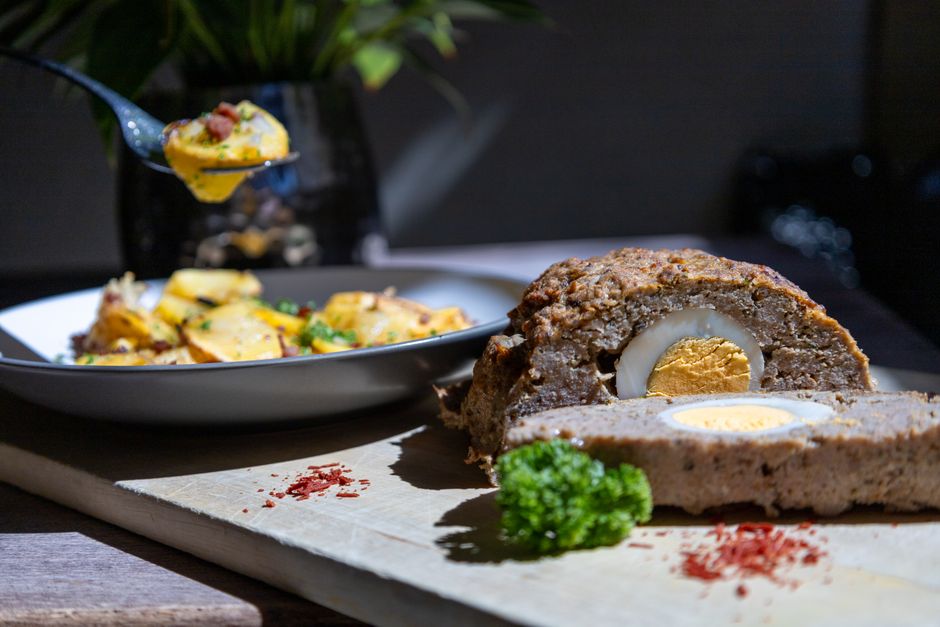
A really good meatloaf does more than feed a hungry table — it delivers a lacquered, sweet-tangy crust, a sliceable yet supple interior, and the kind of nostalgic depth that turns Tuesday supper into a ritual worth repeating.
Build a tender, crusty meatloaf with 80/20 ground chuck, a bread-and-milk panade (1 slice soft bread plus ¼ cup whole milk per pound of meat), and a ketchup–brown sugar glaze. Shape it free-form on a rimmed baking sheet, bake at 350°F (177°C) until the center registers 155°F (68°C), then rest 10–15 minutes so carryover heat lands at the USDA-recommended 160°F (71°C)[1] for ground meat.
Good Meatloaf Is an Exercise in Moisture Management
A great meatloaf asks you to hold two contradictions at once: it should slice as cleanly as a terrine, yet break apart with the tender give of a great meatball. The deciding factor is almost never the ratio of ketchup to brown sugar. It is moisture — how much you build into the raw mix and how carefully you avoid squeezing it out before the loaf reaches the table.
Flavor-wise, the ideal meatloaf hinges on a double layer of savoriness. Outside, the glaze reduces into a sticky, bittersweet lacquer of tomato, vinegar, molasses, and Worcestershire. Inside, the seasoned ground meat stays rosy-brown, juicy, and suffused with onion, Dijon, and a whisper of smoked paprika. No single ingredient shouts; the pleasure arrives as a rich, layered hum of umami and gentle sweetness, anchored by that distinctive browned-beef crust.
Culinary history explains why meatloaf became so beloved: the dish rose to prominence in American home kitchens during the late 19th century alongside the growing availability of mechanically ground meat, then found its enduring status during the Depression and wartime years, when thrifty cooks stretched modest portions of chopped beef with bread, oats, and pantry aromatics. Those same economical binders are precisely the ingredients that make a properly made loaf so luxurious — a lesson in turning humble staples into quiet elegance.
Meat, Panade, and the Science of a Tender Slice
Start with the same rule you would follow for a great burger: buy 80/20 ground chuck rather than lean ground sirloin or round. The fat percentage is not about indulgence alone — it is the primary liquid insurance for a loaf that spends close to an hour in the oven. A 93/7 lean grind may look virtuous in the butcher case, but it renders almost no internal fat, resulting in a dry, crumbly loaf that tastes more like a hockey puck than a comfort-food centerpiece.
For even better texture, replace up to 25% of the beef with ground pork. Pork contributes a softer, sweeter fat that keeps the formula juicy without making the loaf taste sausage-like. If you prefer an all-beef version, staying loyal to 80/20 chuck gives you nearly the same result; just be careful not to overwork the mixture.
The panade is not filler — it is insurance. A loaf without it is just a very large, very dry burger.
The most important technical component is the panade: soft bread soaked in milk, then mashed into a paste. The starch from the bread gelatinizes as it absorbs liquid, and those swollen starch granules physically block the meat proteins from fusing into overly tight, rubbery clumps. As the proteins in the meat try to contract and expel moisture during cooking, the panade traps that liquid and holds it inside the loaf. One slice of good sandwich bread and ¼ cup whole milk per pound of meat produces the proper ratio — enough to keep the loaf tender without making it taste bready.
A single large egg per 2 pounds of meat acts as a secondary binder, helping the loaf hold together when you slice it. Anything more turns the texture custardy and heavy. The aromatics merit equal attention: finely chopped onion sautéed in butter until translucent adds sweetness and moisture, while raw onion would leave a harsh crunch and force the loaf to bake longer before it fully softens.
For seasoning, aim for about 1 teaspoon kosher salt per pound of meat plus a generous crack of black pepper. Worcestershire sauce supplies glutamates that deepen the beefiness; Dijon mustard adds acid and a faint pungent heat; and smoked paprika rounds out the glaze with a subtle campfire note. None should dominate. The glaze — usually ketchup, brown sugar, apple cider vinegar, and a splash of Worcestershire — provides the final sweet-sour counterpoint that cuts through all that richness.
What You Need Before You Mix
Great meatloaf does not demand any esoteric equipment, but the correct pan makes an outsized difference. For the deepest, most caramelized crust, shape the loaf free-form on a rimmed baking sheet lined with parchment or foil. A classic 9×5-inch loaf pan works and yields those tidy diner-style slabs, but it traps moisture around the sides and leaves the loaf pale and steamed instead of deeply browned.
The tools list is short: a rimmed sheet pan, parchment or heavy foil, a large mixing bowl, a chef’s knife, a cutting board, and a flexible spatula. You also need a reliable digital instant-read thermometer — not a nice-to-have, but an actual requirement, since visual cues are notoriously unreliable in a thick loaf of ground meat. Finally, set a wire cooling rack nearby so the finished loaf can rest off the hot pan and let its juices redistribute rather than run out onto a cutting board.
The three most important prep rules should be decided before the meat ever enters the bowl. First, sauté the onions in advance and cool them completely; warm aromatics will start to melt the meat fat and can cause the loaf to smear. Second, soak the bread in cold milk and let the panade sit for at least five minutes before mashing it — patience here translates into even moisture distribution. Third, measure everything before you begin mixing so you are never scrambling to find the Worcestershire while your hands are covered in raw meat.
The Master Method
This master recipe yields one 2-pound loaf that serves six generously.
The Mixture
- 2 lb (907 g) ground meat — 1½ lb (680 g) ground chuck 80/20 plus ½ lb (225 g) ground pork
- 2 slices soft white sandwich bread, torn into small pieces (~3 oz / 85 g total)
- ½ cup (120 ml) whole milk
- 2 tbsp (28 g) unsalted butter
- 1 cup finely chopped yellow onion, about 1 medium
- 1 large egg, lightly beaten
- 2 tbsp Worcestershire sauce, divided
- 2 tsp Dijon mustard, divided
- ½ tsp smoked paprika
- 1 tsp kosher salt plus more for the onions
- ½ tsp freshly ground black pepper
The Glaze
- ⅓ cup ketchup
- 2 tbsp brown sugar, packed
- 1 tbsp apple cider vinegar
- 1 tsp Worcestershire sauce
- ½ tsp Dijon mustard
When the loaf is done, the glaze should look sticky and lacquered rather than glossy and wet, and the edges of the loaf should have developed deep browning. If juices bubbling out of the loaf look completely clear, you have almost certainly exceeded the target temperature. A few runnels of amber juice around the pan edges are fine; a gray dry moat means it baked too long.
Every Meatloaf Ratio, Batch Size, and Temperature Guide
Memorize the 1:1:¼ skeleton and meatloaf becomes infinitely scalable: for every pound of ground meat, use 1 slice of soft bread, ¼ cup of milk, and roughly ¼ cup of aromatic mix. The egg scale runs at one large egg per pound up to two eggs at the 3-pound mark. These are flexible guardrails, not dogma — a slightly smaller egg or a heavy slice of brioche will not wreck the formula.
| Total Meat Batch | Panade & Egg | Free-Form Loaf Time at 350°F (177°C) | 9×5-Inch Loaf Pan Time |
|---|---|---|---|
| 1 lb (454 g) | 1 slice bread + ¼ cup milk + 1 large egg | 45–55 minutes | 55–65 minutes |
| 2 lb (907 g) | 2 slices bread + ½ cup milk + 1 large egg | 55–65 minutes | 70–80 minutes |
| 3 lb (1.36 kg) | 3 slices bread + ¾ cup milk + 2 large eggs | 75–85 minutes | 85–95 minutes |
Temperatures matter more than minutes. Because ground meat is comminuted, bacterial pathogens can be distributed throughout the loaf rather than remaining only on the surface, which is why the USDA Food Safety and Inspection Service recommends cooking ground meat to 160°F (71°C) before serving[1]. Many recipes suggest pulling the loaf at 155°F because resting produces a 5–8°F carryover rise, letting the final resting temperature cross that safe threshold while keeping the interior visibly juicier. If you choose to keep the loaf in the oven until the thermometer reads 160°F directly, the result is still safe — just slightly more well done, with a touch less pink in the center.
A cold loaf from the refrigerator can add 15–20 minutes of bake time. If you assemble the meatloaf ahead, remove it from the fridge, cover it, and let it sit at room temperature for 20–30 minutes before baking — or simply rely on the thermometer rather than the clock. Never leave raw ground meat at room temperature for more than two hours total.
The Five Most Common Ways Meatloaf Goes Wrong
Failed meatloaf almost always fails for the same five reasons, and none of them are fixed by adding more ketchup. Below are the pitfalls the test kitchen sees most often, along with the mechanics behind each one.
Use the lean-to-fat rule as your non-negotiable: never bake a meatloaf with a grind leaner than 85/15, always include a starchy panade, and test the center with a digital thermometer at the 50-minute mark. Those three choices will solve 90% of rubbery, dry, underdone meatloaf problems before they start.
Pairings and Storage
Meatloaf asks for simple, bold sides that soak up its sweet-savory glaze. Buttery mashed potatoes are the canonical companion, and the loaf’s pan juices do double duty as a quick sauce spooned over both. Roasted carrots or green beans with a drizzle of olive oil and flaky salt add enough acidity and color to balance the deep brown richness. A crisp wedge salad or quick cabbage slaw with a bright vinaigrette works even better on warmer evenings, cutting through the meat with crunch.
Leftover meatloaf deserves the same respect as the first dinner. Allow the loaf to cool completely, then wrap it tightly in plastic or foil, or stash individual slices in an airtight container. Cooked meatloaf will keep in the refrigerator for 3–4 days, and it should be placed in the fridge within two hours after cooking to keep it out of the USDA-defined danger zone between 40°F and 140°F (4°C and 60°C)[1]. For longer storage, freeze whole or sliced portions for up to 3 months; thaw in the refrigerator overnight before reheating.
Day-two meatloaf arguably shines brighter than the original when slid into a toasted bun or good white bread with a smear of mayonnaise, crisp lettuce, and a spoonful of the leftover glaze. If you prefer a hot second act, reheat slices gently in a skillet over medium-low heat with a splash of beef broth, or in a 325°F (163°C) oven covered with foil so the meat stays moist until warmed through.
Meatloaf Recipe FAQ
Why is my meatloaf dry and tough?
Two causes dominate: too-lean meat and overmixing. Ground round or sirloin at 90/10 lacks the intramuscular fat needed to keep the loaf moist through a long bake. Overmixing, meanwhile, tightens the proteins into a dense network that pushes water out as it coagulates. Switch to 80/20 ground chuck, use the full bread-and-milk panade, and fold just until no raw streaks remain.
Do I have to bake meatloaf in a loaf pan?
No. Baking in a loaf pan is a tradition rooted in diner presentation, not flavor. The pan traps steam and keeps the side walls pale and soft. Shaping the loaf free-form on a rimmed baking sheet exposes more surface area to the oven’s dry heat, which produces a deeply caramelized crust and lets excess fat render away. The only advantage of a loaf pan is that neat, square slice — and you can still approximate that by making a taller, rectangular free-form shape.
Why did my meatloaf fall apart when I sliced it?
A meatloaf that crumbles usually contains too little binder or was sliced too early. Make sure each pound of meat has both a full panade portion and one large egg per 1–2 pounds. An even more common culprit is slicing while the loaf is still hot, before the gelatinized starches and cooled fats have set. Give the loaf a full 10–15 minute rest, then slice with a sharp knife rather than sawing with a serrated blade.
Can I make gluten-free or dairy-free meatloaf?
Yes. Swap the wheat sandwich bread for a slightly stale gluten-free bread or certified gluten-free old-fashioned oats. For a dairy-free version, replace whole milk with unsweetened oat milk or chicken stock, which still hydrates the starches. Avoid very watery substitutions like plain almond milk, which can weaken the binder. Gluten-free bread is often drier, so you may need an extra tablespoon of liquid to achieve the same paste consistency.
What is the safest finished temperature for ground beef meatloaf?
The USDA Food Safety and Inspection Service recommends cooking all ground meat to an internal temperature of 160°F (71°C)[1]. Because grinding spreads any surface pathogens throughout the meat, color is not a reliable test. Always insert an instant-read thermometer into the thickest part of the loaf and verify the reading before serving.
- Use 80/20 ground chuck or swap up to 25% of the beef for ground pork to protect moisture and richness.
- Always add a panade — 1 slice soft bread soaked in ¼ cup milk per pound of meat — to keep the proteins tender and juicy.
- Mix gently and briefly; overmixing produces a dense, dry loaf by over-contracting the meat proteins.
- Shape free-form on a rimmed baking sheet for maximum caramelized crust and even browning.
- Bake at 350°F (177°C) and pull the loaf at 155°F (68°C); resting brings it safely to 160°F (71°C)[1].
- Let the cooked loaf rest 10–15 minutes before slicing so the juices redistribute and slices hold together.
- USDA Food Safety and Inspection Service — Safe Minimum Internal Temperature Chart; ground meats recommended at 160°F (71°C), www.usda.gov
- Harold McGee — On Food and Cooking: The Science and Lore of the Kitchen, rev. ed. 2004; Maillard browning and flavor development in roasted meats.